Pinterest for Business: The Complete 2026 Playbook
Pinterest is worth it for a business when customers plan, compare, or look for ideas before they buy, because Pinterest is a visual search engine where a pin keeps earning discovery for months rather than hours.
JN
Joe Nyambura
Founder & operator, Pinners Haven · August 14, 2026
You've been told Pinterest is "huge for business" by roughly the same people who said that about Clubhouse. Meanwhile your Instagram reach is shrinking, your ad costs aren't, and you're trying to work out whether Pinterest is a real channel or another place to post things nobody sees. Fair question, and most guides skip straight past it to the part where you make a board.
Pinterest is worth it for a business when customers plan, compare, or look for ideas before they buy, because Pinterest is a visual search engine where a pin keeps earning discovery for months rather than hours. It reported 640 million monthly active users in Q2 2026, 106 million of them in the US and Canada, and Pinterest says the number-one reason people use it is to find new products and brands. It is a poor fit for businesses whose customers don't plan ahead, or that have no page worth sending a click to. Everything below is how to tell which one you are, what it actually costs to run, and which playbook to follow.
Let me be honest about what this page is. It's the strategy layer: the decisions that make or break a Pinterest account before anyone designs a pin. If you already know Pinterest fits and want the account steps, go to how to set up a Pinterest business account. If you want the day-to-day operating manual, that's how to use Pinterest for business. This is the page you read first.
Is Pinterest worth it for business in 2026?
Here's the thing nobody tells you: the platform is bigger and healthier than its reputation. Pinterest's Q2 2026 results, published 4 August 2026, reported 640 million monthly active users, up 11% year on year and an all-time high, and $1.18 billion in quarterly revenue, up 18%. That's the eleventh straight quarter of double-digit user growth.
Two numbers in that release matter more than the headline:
Region
Monthly active users
Revenue per user (quarter)
US and Canada
106 million
$8.30
Europe
157 million
$1.35
Rest of world
377 million
$0.23
Global
640 million
$1.86
Source: Pinterest Q2 2026 press release. Revenue per user is an advertising metric, not shopper spend, but it tells you where the commercial activity is concentrated.
If your customers are in North America, you're fishing in the pond where advertisers pay the most, which is a fair proxy for where buyers are. If they're elsewhere, the reach is still there but the monetisation is younger.
Pinterest's own business site makes two claims about intent: that "the #1 reason people use Pinterest is to find new products and brands," and that weekly users are more likely to say ads feel relevant there than on other platforms. Both are Pinterest research about Pinterest, so treat them as the company's framing rather than independent fact. The claim that survives scrutiny is simpler and observable: people arrive with a plan and a search box, which is not how anyone opens TikTok.
To be clear: "worth it" has nothing to do with those totals. A 640-million-user platform is worthless to a late-night pizza delivery business and very valuable to a wedding photographer with 400 followers. Fit is about how your customer buys.
The six-question fit test
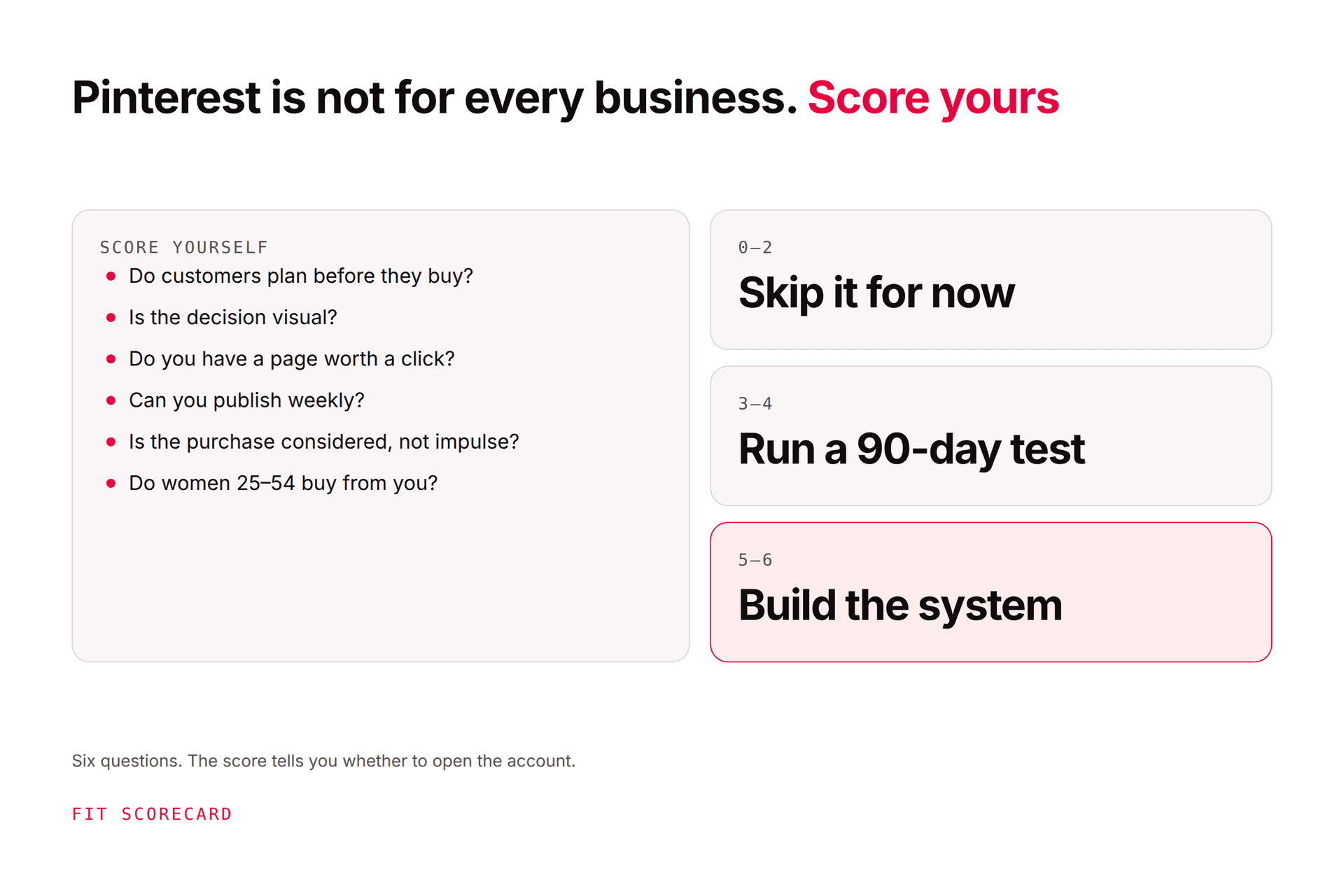
Answer honestly. One point each.
Do customers research, plan, or collect ideas before buying from you? Home, food, fashion, weddings, travel, parenting, personal finance, crafts, fitness, education, B2B templates: yes. Emergency plumbing: no.
Can you show the outcome visually without lying about it? A finished room, a plated recipe, a worksheet, a before-and-after, a chart. If your product is an abstraction you can't picture, Pinterest is harder.
Is there a page worth sending a click to? A product page, a blog post, a lead magnet, a booking page that loads fast on a phone and delivers what the pin promised. No page, no Pinterest.
Does your buying cycle last longer than a day? Pinterest is strongest when someone saves today and buys in three weeks. Pins keep surfacing; Pinterest's own guidance notes that pins can gain engagement months later.
Can you produce original visual content every week? Not daily. Weekly. Pinterest's only published cadence guidance is to create original content weekly, and there's more on what "original" means below.
Is at least part of your market in North America or Europe? See the table. It's not a requirement, but it's where the platform is most mature commercially.
0–2: skip Pinterest for now and put the hours elsewhere. 3–4: run a 90-day organic test before you commit a person or a budget. 5–6: build the system, because you're in the group Pinterest was designed for.
Why Pinterest behaves differently from the channels you already run
Most businesses fail on Pinterest because they run their Instagram playbook there. The platform punishes that, quietly.
Discovery is search-driven, not follower-driven. Pinterest distributes pins to people searching for or browsing the topic, whether or not they follow you. Followers matter far less than on any social network, and "post and hope our audience sees it" isn't the mechanic.
Content compounds. A post on a feed is dead in 48 hours. A pin that matches a real search can deliver clicks for a year. This is why the right team to own Pinterest is usually whoever owns SEO, not whoever owns social.
The user is planning, not scrolling. They're building a board for a kitchen, a wedding, a launch. That's commercial intent you rarely get on a feed, and it's why product-style content doesn't feel like an interruption there.
We wrote up the full argument in is Pinterest social media?, including a plot of where each platform sits. The short version: file Pinterest under search and your expectations, cadence, and measurement all fall into place.
The playbook: four decisions, then execution
Every successful business account we've seen made four decisions before it made a single pin. Skip them and you get the most common Pinterest outcome: a lot of impressions and nothing you can report to anyone.
Decision 1: What is Pinterest's one job for you?
Pick one. Qualified website traffic, product discovery, email signups, enquiries, or sales. Everything else becomes a supporting metric. "Brand awareness" is not a job; it's what you call it afterwards when you didn't pick one.
The job decides the destination. Traffic goes to content. Product discovery goes to product pages or a catalogue. Enquiries go to a page with one form. If you can't name the page a pin should send someone to, you've found the real problem, and it isn't Pinterest.
Decision 2: What's your content engine?
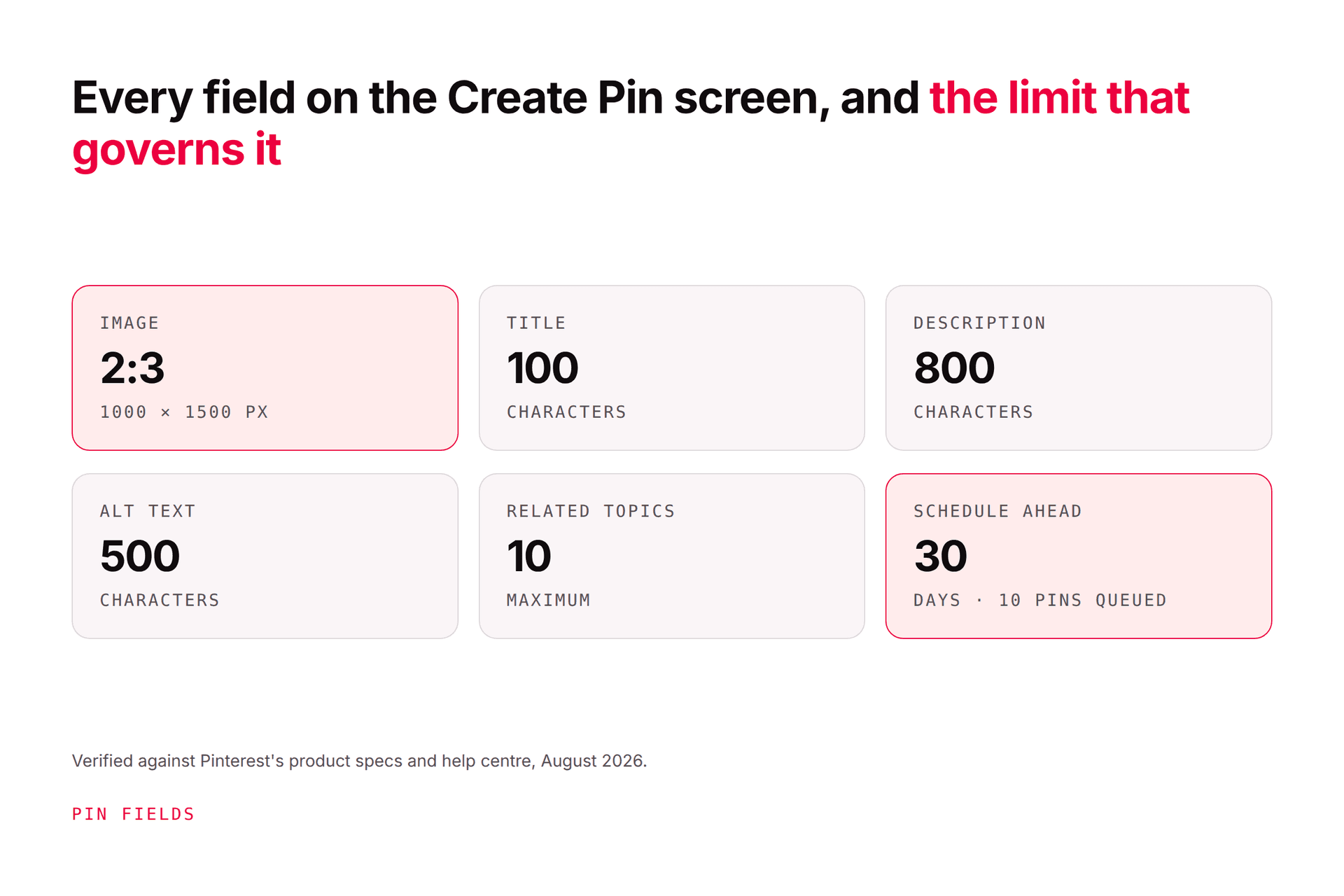
This is the decision that quietly kills most accounts. Pinterest rewards original pins: new images, new titles, new descriptions, not the same graphic reposted with a different background colour. Its distribution guidance asks for relevant keywords in titles, descriptions, and board names, original content saved to relevant boards, and a 2:3 image (commonly 1000 × 1500 pixels). Our fresh pins guide draws the line between "fresh" and "clone" in detail.
So the question is: where will your original pins come from every week, for a year?
You have a content library (blog, recipes, tutorials, product catalogue): your engine is turning each page into several genuinely different pin angles. One post can honestly carry five to twenty pins aimed at different searches.
You have products but no content: your engine is the catalogue plus idea-style pins that show products in use. See how to sell on Pinterest without ads.
You have neither yet: build the destination first. A Pinterest account pointing at a thin site is a traffic source for a page that can't convert it.
Keyword research sits inside this decision, because the angles come from what people search. Pinterest keywords and Pinterest Trends cover how to find them; Pinterest SEO covers how the whole chain, from board to landing page, gets ranked.
Decision 3: What cadence can you sustain, and who makes it?
You might be thinking, "I read you need 15 to 25 pins a day." That figure traces to a Pinterest webinar from February 2020 and hasn't been restated since; Pinterest's current written guidance says weekly originals. The honest number is the highest cadence at which every pin is still original and every link still works, which for a solo operator is usually three to ten a week and for a team can be far higher. How often to pin works through the arithmetic, and it's sobering: a 100-post blog holds maybe 300 honest pin concepts, and at 25 a day you burn through them in 12 days.
Resourcing follows. Someone has to research, design, write, and publish. That's you, a virtual assistant, an agency, or software, and the costs are very different (table below).
Decision 4: What will you measure, and when will you judge it?
Not monthly views. Pinterest's own metric definitions separate impressions (shown), saves (future interest), pin clicks (close-up), and outbound clicks (left for your site). Judge the account on outbound clicks and what happens after them, tied to the job from Decision 1, and give it a real window. Pins take weeks to index and months to mature. Judging at day 30 is judging a seed.
Local-only, same-day, or one-off-emergency businesses aren't in the table on purpose. They can exist on Pinterest; it just won't be their growth channel, and we'd rather say so than sell you a board.
What it actually costs to run
The business account is free. Running it isn't, and this is where "is Pinterest worth it" really gets answered. Checked August 2026; Pinners Haven pricing is ours, the rest are the ranges we see quoted for specialist help.
Approve, supply product/content; strategy is included
Full-service agency
$3,000+
Pay the invoice
Agency and VA ranges from our agency costs guide; our own pricing from pricing. The DIY hours are what it takes to publish a handful of original pins a week at a quality Pinterest will distribute.
The pattern in that table is the pattern in every Pinterest account we've looked at: the cost is in producing original pins, not in posting them. That's why we built Pinners Haven the way we did. It takes a topic or a URL, writes a keyword-led title and three to five distinct descriptions per pin, generates an original image on a human-designed template, and publishes on a paced, account-safe cadence, while you approve each pin and keep the four decisions above. It won't choose your customer or fix a slow product page. Nothing will.
Pinterest ads work, and for some product businesses they're the fastest path. But they amplify whatever you point them at. A business that hasn't found a pin-to-page match that converts organically is paying to learn that at $0.75 or more a click instead of for free. Run organic until a few topics reliably earn outbound clicks, then promote those. The full economics, including the crossover point where organic gets cheaper than paid, are in Pinterest ads vs organic.
Where businesses quit, and how not to
From what we've seen across thousands of scheduled pins, accounts don't fail dramatically. They fade, in one of three ways:
Week six: the content runs out. The founder pinned every product and every post, twice, and now it's reposts. Fix: Decision 2. Plan angles, not pins.
Month three: nobody can say if it's working. Monthly views went up, sales didn't, the meeting gets awkward. Fix: Decision 4. Outbound clicks and the job, judged at 90 days, not 30.
Month five: reach falls off a cliff and nobody notices for three weeks. A template got overused, or a spam filter tripped, and the slow bleed only shows when someone finally opens Analytics. Fix: look weekly, or let software watch for you. Pinners Haven's Freshness Meter retires a template after roughly 5–10 uses, before the sameness costs reach, and its cliff alert emails you when an account's week-over-week reach drops past a threshold you set. If it drops anyway, why your Pinterest impressions dropped is the triage.
None of these are Pinterest being fickle. They're the four decisions not being made.
Frequently asked questions
Is a Pinterest business account free?
Yes. Pinterest's business account is free and gives you Analytics, the Business Hub, ad tools, and merchant features where eligible. You pay only if you choose to run ads or buy outside help or software. You can create a new business account or convert an existing personal one without losing pins or followers, though a business profile is public.
What kind of business does best on Pinterest?
Businesses whose customers plan, compare, or gather ideas before buying: home, food, fashion, weddings, travel, parenting, crafts, fitness, education, digital products, and many B2B templates and tools. The industry matters less than the behaviour. If your customer saves ideas for later and you have a page worth sending them to, you fit.
How long does Pinterest take to work for a business?
Expect pins to start earning meaningful impressions within a few weeks and to mature over months, and judge the account at 90 days on outbound clicks rather than at 30 days on views. Pinterest says pins can gain engagement months after publishing. There's no reliable fixed timeline; new accounts, competitive topics, and seasonal niches all move at different speeds.
Do I need a website to use Pinterest for business?
You can open the account without one, but Pinterest only becomes a business channel when there's a destination to send clicks to: a product page, a post, a booking or lead page. Claiming an eligible website also unlocks analytics for pins linked to it. Marketplace shops such as Etsy can't be claimed as your website, which changes the playbook for those sellers.
Should Pinterest sit with my social media team or my SEO team?
SEO, or whoever thinks in keywords and long-lived content. Pinterest distributes by search intent rather than follower count, and pins keep earning for months, so the skills that win are topic research, matching a pin to a page, and patience. A social team managing Pinterest like a feed tends to post often and original rarely, which is the wrong way round.
Do I need Pinterest ads to get results?
No. Organic publishing is free and is the right starting point. Ads buy distribution for creative and pages that already convert, and they're worth testing once a few organic topics reliably earn outbound clicks. Starting with ads before that point is paying to find out what organic would have told you for free.
Decide first, then pin
Pinterest in 2026 is a 640-million-user search engine where a good pin works for a year. For the right business it's the cheapest compounding traffic available. For the wrong one it's a board nobody sees. Score the fit test, make the four decisions, pick your playbook from the table, and then, and only then, open the account.
You've got the map. If you'd like the part where someone else makes the pins, Pinners Haven produces original, keyword-led pins from your topics and publishes them at a safe pace, so the hours in the DIY row go back to running the business.