Pinterest Ads vs Organic: Which Works Better in 2026?
This gets argued as a philosophical question and it's an arithmetic one. Both channels buy you clicks. They just buy them on completely different terms, and the right answer depends on numbers specific to your business.
JN
Joe Nyambura
Founder & operator, Pinners Haven · August 18, 2026
This gets argued as a philosophical question and it's an arithmetic one. Both channels buy you clicks. They just buy them on completely different terms, and the right answer depends on numbers specific to your business.
Pinterest ads buy clicks at a roughly fixed price that never falls: third-party benchmarks put Pinterest CPC in the region of $0.30 to $1.50, commonly cited around $0.50 to $1.00, with CPMs frequently quoted at $2 to $5. That price is the price in month one and in month thirty. Organic works the other way round: you pay the production cost of a pin upfront and then it earns clicks indefinitely at no further cost, which means your effective cost per organic click falls over time and approaches zero. So organic wins on cost, eventually, but only if your pins actually earn enough clicks to amortise what they cost to make. That last clause is where most "organic is free" advice falls apart.
The useful question isn't which is better. It's where your crossover point is, and whether you can survive until it.
Ad cost figures throughout are third-party agency benchmarks with wide variance by category, region and objective. They are not Pinterest's published rates. Checked 7 August 2026.
The two cost structures, plainly
Pinterest Ads
Organic
Upfront cost
Near zero
Production time per pin
Marginal cost per click
Fixed, roughly $0.30–$1.50
Approaches zero
Time to first click
Hours
Weeks to months
Cost when you stop
Traffic stops immediately
Traffic continues
Predictability
High. Spend more, get more
Low, especially early
Scales by
Budget
Content library
Fails when
Margin can't absorb CPC
Pins don't earn clicks
Read that table and the strategic split becomes obvious. Paid is a tap. Organic is a well. One gives you water immediately for as long as you keep paying; the other costs effort to dig and then keeps producing.
The crossover maths
Here's the calculation almost nobody does, and it decides the question for your specific business.
Assume a pin costs you $10 to produce. That's roughly 20–30 minutes of concept, design and copy at a modest hourly rate. Adjust it to your own.
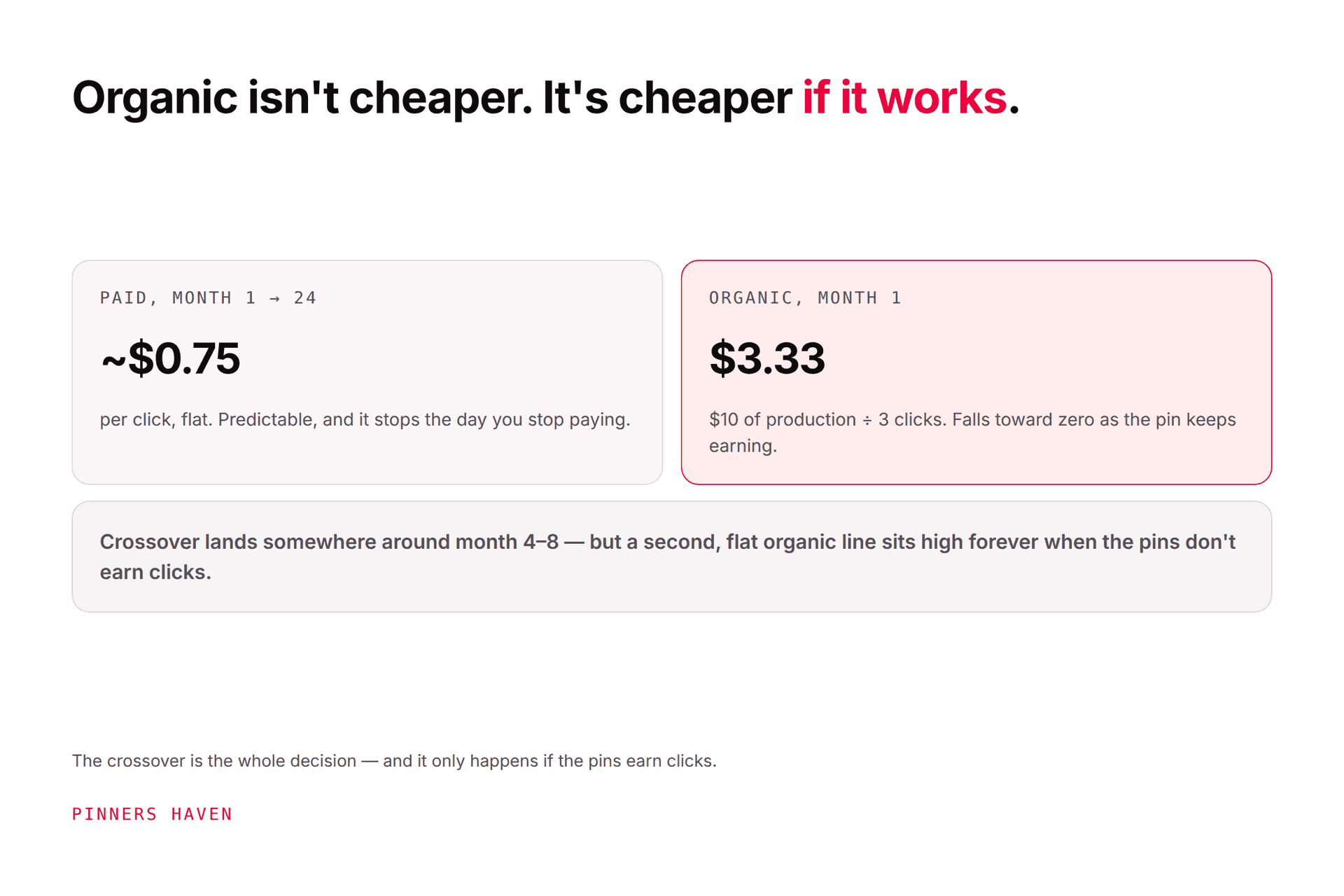
Your effective organic cost per click for that pin is simply $10 ÷ total clicks it ever earns.
Total clicks that pin earns
Effective cost per click
vs paid at $0.75
3
$3.33
Paid is 4x cheaper
10
$1.00
Paid still cheaper
15
$0.67
Roughly break-even
50
$0.20
Organic 3.7x cheaper
200
$0.05
Organic 15x cheaper
1,000
$0.01
Organic is effectively free
The break-even is about 15 clicks per pin, at these assumptions. Above that, organic wins and keeps winning because the denominator grows for years while the numerator is fixed. Below it, you were better off buying the traffic.
That single number reframes the whole debate. The question is not "is organic better than ads." It's "do my pins earn more than fifteen clicks each?"
And for a great many accounts, the honest answer is no. A pin that gets 400 impressions and 3 clicks cost you $3.33 a click, which is worse than Pinterest ads and worse than most other channels. Publishing more of them makes the problem bigger, not smaller.
What moves you above the line
The variables that decide whether your pins clear 15 clicks are the same ones this whole site is about:
Search demand for the topic. No demand, no clicks, regardless of quality.
Whether the creative earns the click at thumbnail size.
Whether the pin promises something specific. Vague pins get saves and not clicks.
Destination quality, which determines whether the click was worth having.
Longevity. Pinterest notes pins can gain engagement long after publication, and that tail is where the amortisation happens.
You have a time-bound offer. A seasonal launch, an event, a sale. Organic can't be summoned on a deadline.
You need data fast. Ads will tell you in a week which creative and which audience respond. That's a legitimate research purchase even if you never scale it, and it makes your organic better.
Your margin comfortably absorbs the CPC. High-ticket or high-margin products can pay $0.75 a click and still profit. Thin-margin products often can't, and this is the calculation that kills most small ecommerce ad accounts.
You already have proven organic winners. The best use of Pinterest ads is amplifying a pin that has already demonstrated it converts. You're not guessing.
You're testing a new market or product and need a signal before committing content effort.
The strongest structural argument for Pinterest paid specifically: benchmarks consistently place its CPC and CPM well below Meta's, often cited at around half. If those ranges hold for your category, the same budget buys substantially more reach here.
When organic is the right call
You're building an asset, not renting one. The pins you make this quarter can still be working in three years. Ad spend leaves nothing behind.
Your margin can't take a $0.75 click. Then organic isn't preferable, it's the only viable option, and the 15-click threshold becomes your operating target.
Your topic has genuine search demand and you can produce content that answers it.
You can wait a season. Pinterest is a planning platform where seasonality dominates, so a fair read takes months.
You want compounding. Every pin adds to a library that keeps working, which is a fundamentally different financial shape from a monthly ad bill.
The answer for most people: sequence, not choice
The framing that actually works:
Fix the destination first. Neither channel survives a page that doesn't convert. More traffic to a bad page just loses money faster, and ads lose it faster than organic.
Install measurement before either. The Pinterest tag with real values on purchase events. Without this your first months of data are unusable in both channels. See Pinterest for ecommerce.
Run organic and find your winners. Which topics, formats and promises actually earn clicks and conversions.
Use paid to amplify proven winners, not to discover them.
Keep publishing organic underneath, so the library keeps compounding while paid handles the peaks.
The mistake is treating them as alternatives. Ads spent on unproven creative is the most expensive way to learn what organic would have told you for free.
The thing both channels need
Notice what's identical in both columns of that first table: creative that earns the click, and a destination that keeps the promise.
A Pinterest ad is a pin with money behind it. If the pin is weak, paid distribution buys you more people declining to click it, at $2 to $5 per thousand impressions. Ads do not fix creative; they price it.
Which means the production question is upstream of the channel question entirely. Whether you go paid, organic, or both, you need a steady supply of distinct, well-targeted pins pointing at pages that deliver.
That's the layer Pinners Haven covers. It writes up to 20 angles per topic so one page produces real keyword surface, generates an SEO title with three to five unique description variations per pin, designs original images on human-designed templates, and publishes on a paced, account-safe cadence via official OAuth. Its performance learning loop measures saves and outbound clicks per pin, not impressions, and biases new generation toward what's proven, which is precisely the signal you need to decide what's worth putting ad budget behind. The Freshness Meter retires each design after roughly five to ten uses. Nothing publishes until you approve it.
Where that connects to the maths above: production cost per pin is the numerator in the crossover calculation. At Solo, $41/mo for 900 pins works out to under five cents per pin in tooling cost, which changes the arithmetic considerably against $10 of your own time.
The honest limit: it doesn't run your ads, manage your catalog, install your tag, or fix a landing page. And it can't make an undemanded topic earn clicks. If your pins are below the 15-click line because nobody is searching for the subject, cheaper production doesn't help.
Solo is $41/mo, Operator $124/mo for 25 sites and 11,250 pins, both billed annually. There's a 14-day trial; no card is needed, and when it ends publishing pauses until you pick a plan.
(Disclosure: we make Pinners Haven. We're not affiliated with Pinterest. Ad benchmark figures are third-party estimates, not Pinterest's published rates.)
Frequently asked questions
Are Pinterest ads worth it in 2026?
They can be, particularly where margins absorb the click cost and you're amplifying creative that has already proven it converts. Third-party benchmarks place Pinterest CPCs well below Meta's, which is the main structural argument in their favour.
How much do Pinterest ads cost?
Third-party benchmarks commonly cite $0.30 to $1.50 per click, often around $0.50 to $1.00, with CPMs frequently quoted at $2 to $5. Actual costs vary widely by category, region, objective and competition. Pinterest doesn't publish fixed rates.
Is Pinterest organic reach still good?
Organic still works because Pinterest is search-driven and content has an unusually long life. What's changed is that undifferentiated content doesn't surface, so the bar is whether individual pins earn meaningful clicks rather than whether organic "works" in general.
Should I run Pinterest ads or focus on organic?
For most businesses: prove organic first, then use ads to amplify what already converts. Run ads first only when you have a deadline, a research question, or margins that make paid clicks comfortably profitable.
How long until organic Pinterest traffic pays off?
On the assumptions in this article, a performing pin passes paid on cost per click somewhere around four to eight months. Pins that never clear roughly 15 lifetime clicks never pay off, which is the outcome most volume-first advice ignores.
Do Pinterest ads help organic reach?
There's no published mechanism by which paying promotes your organic distribution. What ads genuinely give you is fast data about which creative and audiences respond, and that intelligence makes your organic better.
Can I do both on a small budget?
Yes, and it's often the right shape: publish organic continuously, and hold a small ad budget for seasonal peaks and for amplifying pins that have already demonstrated they convert.
Work out your own crossover
Don't take a position on this debate. Do the division.
Take what a pin costs you to make, divide it by the clicks your pins actually earn, and compare that with what a Pinterest click costs to buy. If your number is comfortably under, organic is your channel and the only question is how fast you can produce. If it's over, you have a creative problem that ad spend will expose rather than solve.
Either way, the number tells you what to do next, which is more than the argument ever will.