Pinterest for Real Estate Agents: A Listing Promotion Playbook
Most agents use Pinterest exactly backwards. They pin listings, the listings sell, and they're left with an account full of beautiful pins pointing at properties that no longer exist.
JN
Joe Nyambura
Founder & operator, Pinners Haven · August 18, 2026
Most agents use Pinterest exactly backwards. They pin listings, the listings sell, and they're left with an account full of beautiful pins pointing at properties that no longer exist.
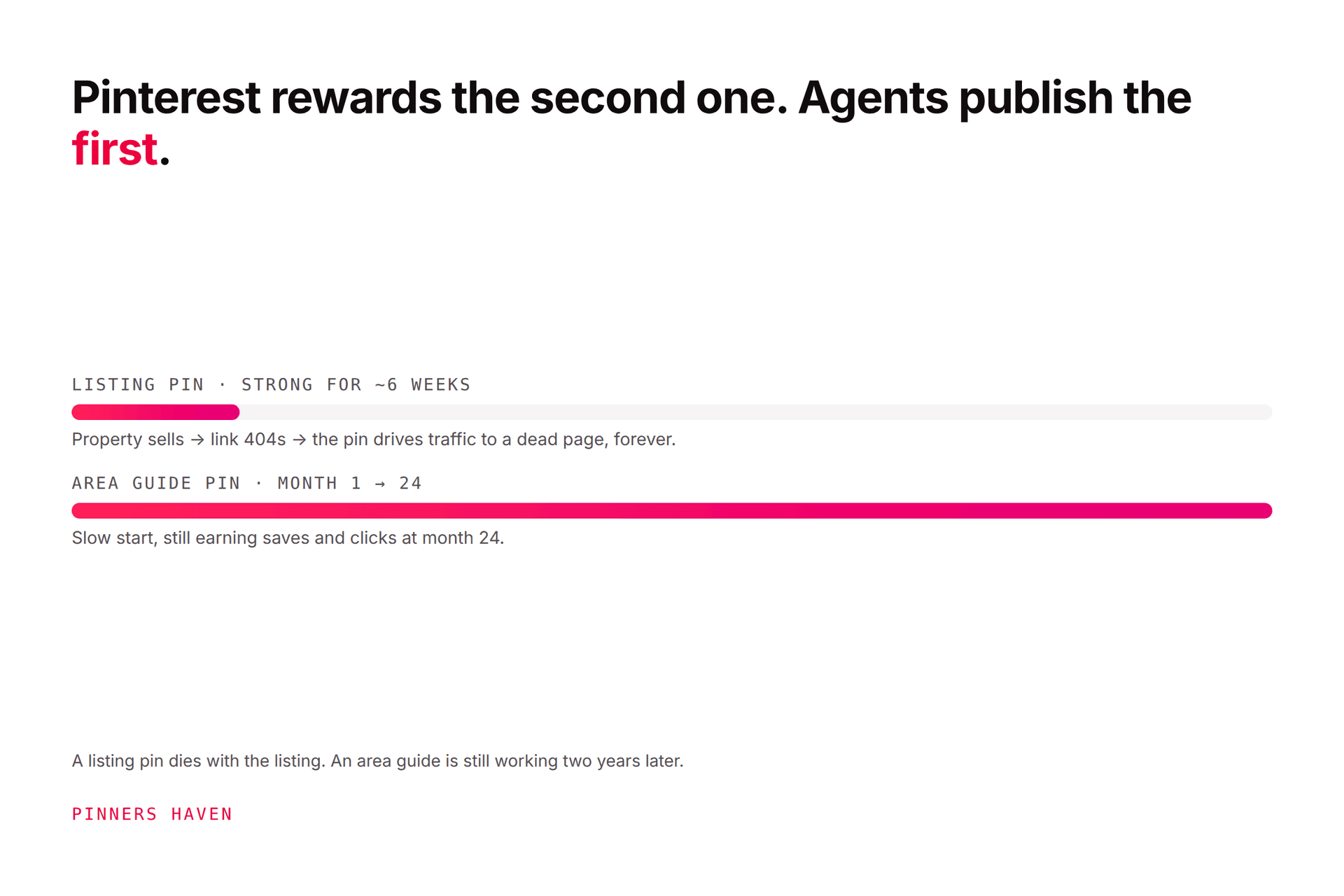
Pinterest is a long-lifespan platform and a listing is a short-lifespan asset, which makes listing pins a structurally poor fit. Pinterest notes pins can gain engagement months or years after publication, and a listing pin is dead the day the property goes under offer. The agents who get leads from Pinterest publish evergreen local content, area and neighbourhood guides, buying and selling process explainers, staging and moving advice, and let that content establish them as the person who knows the area. Listings can be pinned, but they should be a minority of the account and always point at a page that survives the sale.
Real estate also carries a hard legal constraint that a lot of Pinterest advice ignores: fair housing rules apply to your organic content, not just your ads.
Why listing pins waste the platform
Run the maths on a listing pin's life:
Week
Listing pin
Area guide pin
1–6
Working
Slow, indexing
7
Property sells
Building
8–104
Dead link
Still earning saves and clicks
Pinterest content compounds. Listings don't. Publishing primarily listings means most of your account is decaying by design, and worse, actively harming you: pins pointing at dead pages give visitors a broken experience, and a domain full of broken destinations is a genuine distribution problem. Our pins not showing up guide covers how destination problems affect every pin on a domain, not just one.
If you pin listings, point them at a page that survives. A neighbourhood page with current listings embedded, or a "recently sold in [area]" page, both outlive any individual property. Then redirect the specific listing URL when it sells rather than leaving a 404.
The content that actually works
1. Area and neighbourhood guides
Your strongest asset, by a distance. "What it's actually like to live in [neighbourhood]": commute times, schools, what the streets are like, where people shop, what you pay for what.
This is the content an agent two towns over cannot write, it stays relevant for years, and it attracts exactly the person who is considering moving there. Build one per area you serve.
Careful here: describe the area, not the people who live in it or who would suit it. More on this below, and it matters.
2. Process explainers
"What actually happens between offer accepted and completion." "The costs nobody mentions when buying." "How long does selling take, honestly."
Buyers and sellers search these constantly, they're evergreen, and answering them well is a strong competence signal.
3. Staging and preparation
Highly visual, highly saveable, and it demonstrates that you'll actually help sell the property. "What to do to a kitchen before photographs." "Rooms that put buyers off, and cheap fixes."
4. Moving and settling
Checklists, timelines, what to sort in which week. Saveable months ahead of the move, which is exactly Pinterest's planning behaviour.
5. Market explainers, dated
"What's happening in the [area] market, [month] [year]." Genuinely useful and inherently perishable, so date them visibly and accept a shorter life. Undated market commentary that's two years old damages your credibility.
6. Sold case studies
"How this [area] house sold in 11 days." Demonstrates results without promising them, and points at a page that stays live.
Fair housing: the part that isn't optional
This is where real estate differs from every other niche in this content plan, and where generic Pinterest advice will get you in trouble.
Fair housing law restricts how properties and areas may be described and to whom housing may be marketed, and those restrictions apply to your organic social content, not only to paid advertising. A pin description is marketing.
Practical implications:
Describe the property and the area, never the ideal occupant. "Three bedrooms, close to the park" is fine. "Perfect for a young Christian family" is not.
Avoid describing neighbourhoods by the characteristics of the people in them. Including phrasing that sounds positive.
Be careful with "safe," "good schools" and similar shorthand, which have been treated as proxies for protected characteristics.
Don't use audience targeting in a way that excludes protected classes, if you ever promote pins.
Check your brokerage's own policy, which is often stricter than the law.
Get compliance review before publishing at volume.
This section is orientation, not legal advice. Rules vary by jurisdiction and change. Have someone qualified review your templates once, and then reuse approved language.
Also standard: follow your licensing body's disclosure requirements, and put your brokerage identification wherever it's required.
Buyers and sellers are different audiences
A common structural mistake is one account mixing both. They're searching different things at different moments.
Buyer content
Seller content
Area guides
Staging and prep
"What can I afford in [area]"
"What's my home worth" explainers
Process for buying
Process for selling
Moving checklists
Timeline to sale
Schools and commutes
Recent sold results
Separate boards at minimum. Separate pages certainly. A seller looking for staging advice does not want your first-time-buyer guide, and merging them makes both harder to find.
A practical starting plan
Month 1. Write area guides for your top three neighbourhoods. These are the foundation and they take real work.
Month 2. Write six process explainers, three for buyers and three for sellers.
Month 3. Build three or four distinct pin concepts per page, and start publishing steadily. How often to pin covers setting a sustainable rate.
Ongoing. One dated market piece a month, listings pinned to durable pages, and a new area guide whenever you expand.
Judge over a year. Property decisions have long lead times and Pinterest content published now often reaches someone who moves next spring.
Where agents stall
Agents are busy in exactly the periods that matter, and Pinterest is a task that never becomes urgent. The pattern is a strong burst of content, then nothing for four months, then a rebuild.
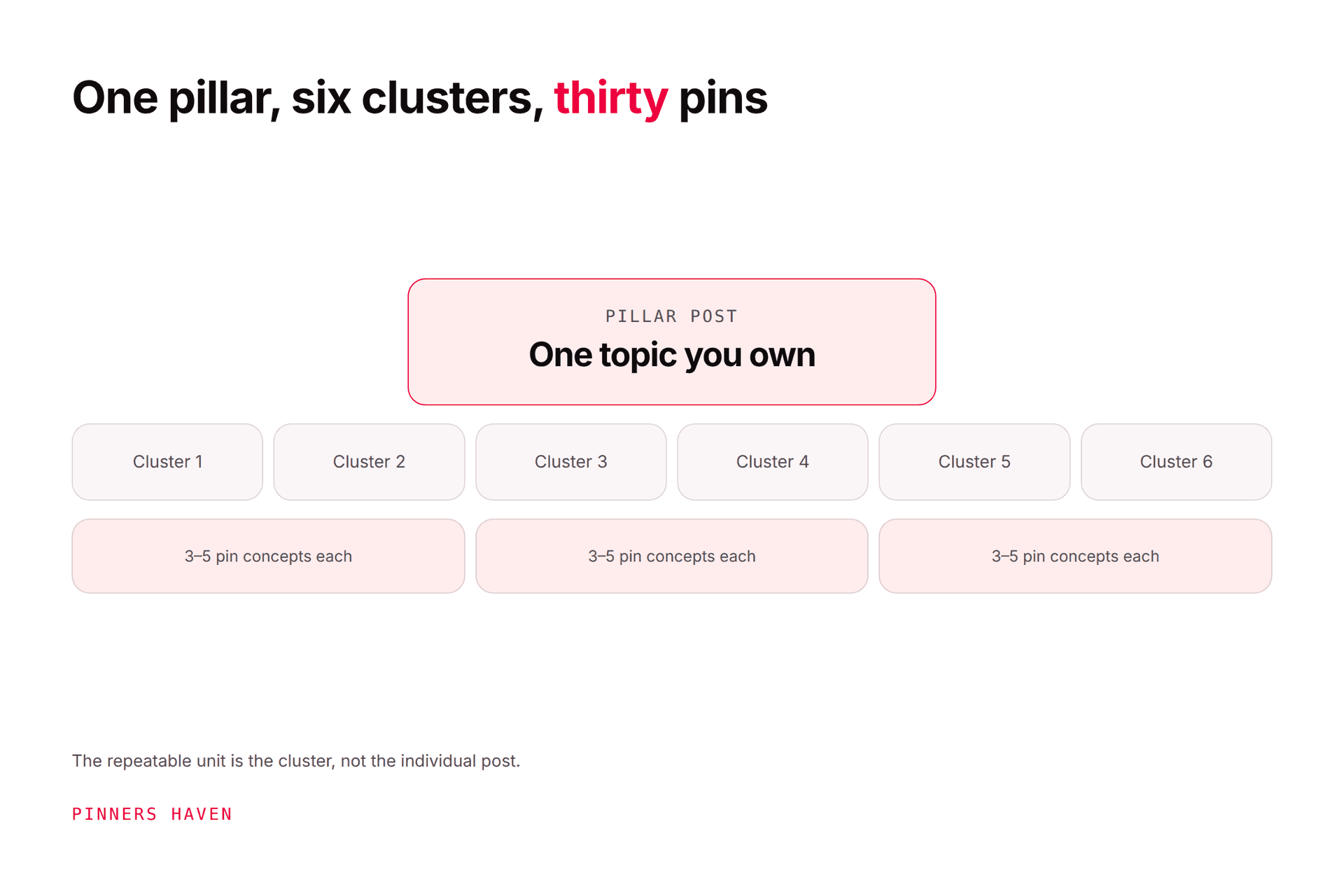
Nine pages at four concepts each is 36 pins, plus a monthly market piece, plus every new area you take on. It's not difficult work; it's work that competes with actually selling houses.
Pinners Haven produces that layer: up to 20 angles per topic, an SEO title with three to five unique descriptions per pin, original designs on human-designed templates, and paced publishing via official OAuth with nothing going live until you approve it. Solo is $41/mo billed annually for 3 sites and 900 pins a month; there's a 14-day trial, no card is needed, and when it ends publishing pauses until you pick a plan.
The approval gate matters more in this industry than any other on our site. Generated copy in a regulated field must be read by a person who knows the fair housing rules before it publishes, every time. Nothing goes out automatically, and for real estate you should treat that as a hard requirement rather than a convenience.
(Disclosure: we make Pinners Haven. We're not affiliated with Pinterest. Nothing here is legal advice.)
Frequently asked questions
Does Pinterest work for real estate agents?
It works for agents who publish evergreen local content rather than listings. Pinterest is a planning platform with a long content lifespan, which suits area guides and process explainers and suits individual listings poorly.
Should real estate agents pin their listings?
Sparingly, and always to a page that survives the sale. A listing pin becomes a dead link the moment the property goes under offer, and an account full of broken destinations creates problems beyond that one pin.
What's the best Pinterest content for real estate?
Neighbourhood and area guides, by a wide margin. They're impossible for an out-of-area competitor to replicate, they stay relevant for years, and they attract exactly the people considering a move to your patch.
Do fair housing rules apply to Pinterest posts?
Treat them as applying to all marketing, including organic social content. Describe properties and areas rather than the people who should live there, and have your brokerage or a qualified reviewer approve your standard language.
How do agents get leads from Pinterest?
By becoming the visible local expert through area and process content, then offering a next step on the destination page: a valuation request, an area report, a buyer's guide. The pin earns the visit; the page has to earn the enquiry.
Should I have separate boards for buyers and sellers?
Yes. They're different audiences searching different things at different stages, and mixing them makes both harder to find. Separate boards at minimum, ideally separate content clusters.
How long before Pinterest brings real estate leads?
Longer than most channels, because moving decisions take months and often years. Judge across a full year, and expect area guides to keep producing long after they're published.
Be the person who knows the area
Listings are what you sell. They are not what people search for months before they're ready to move.
What they search for is what it's like to live somewhere, what the process involves, and whether anyone will tell them the truth about the costs. Publish that, keep it accurate, get the wording reviewed once, and you'll still be getting enquiries from it long after this month's listings have sold.