Why Your Pinterest Impressions Dropped and How to Respond
You opened Analytics, saw the line fall off a shelf, and your stomach went with it. Breathe. A sudden impressions drop is almost never a permanent penalty, and in our experience most of them are diagnosed in about ten minutes, often before you've changed a single pin.
Joe Nyambura
Founder & operator, Pinners Haven · August 18, 2026

On this page25 sections
- Start with this 10-minute diagnosis
- Impressions dropped, traffic dropped, or both?
- Seven reasons Pinterest impressions fall
- 1. A breakout pin cooled down
- 2. Search demand changed
- 3. You published less original content
- 4. Repetitive pins reduced distribution — or triggered a block
- 5. Your site is no longer claimed correctly
- 6. Content quality or intent drifted
- 7. Account or domain enforcement is involved
- The thing that makes this hard
- A seven-day recovery plan
- Day 1 — preserve the baseline
- Day 2 — inspect winners and losers
- Day 3 — test the website
- Day 4 — audit the publishing log
- Days 5–7 — publish a controlled test
- What not to do
- Frequently asked questions
- Did the Pinterest algorithm change?
- How long does recovery take?
- Should I keep posting while impressions are down?
- Are impressions the most important metric?
- Can a single pin really drag down my whole account?
- Diagnose before you rebuild
You opened Analytics, saw the line fall off a shelf, and your stomach went with it. Breathe. A sudden impressions drop is almost never a permanent penalty, and in our experience most of them are diagnosed in about ten minutes, often before you've changed a single pin.
Here's the good news and the bad news together. The bad news is that "impressions dropped" is a symptom, not a diagnosis, and the internet's default advice (post more, delete your losers, overhaul everything) is the fastest way to destroy the evidence you need. The good news is that the real cause is usually one of seven things, and six of them are yours to fix.
When Pinterest impressions drop, check your Analytics comparison before you touch your content: the date range, the filters, the content source, and whether paid is mixed in with organic. Pinterest states that real-time figures are estimates and can decrease. If the decline survives those checks, separate a distribution problem (fewer people saw the pins) from a click problem (they saw them and scrolled past) from a website problem (they clicked and nothing loaded). Those three failures look identical on an impressions chart and need completely different fixes.
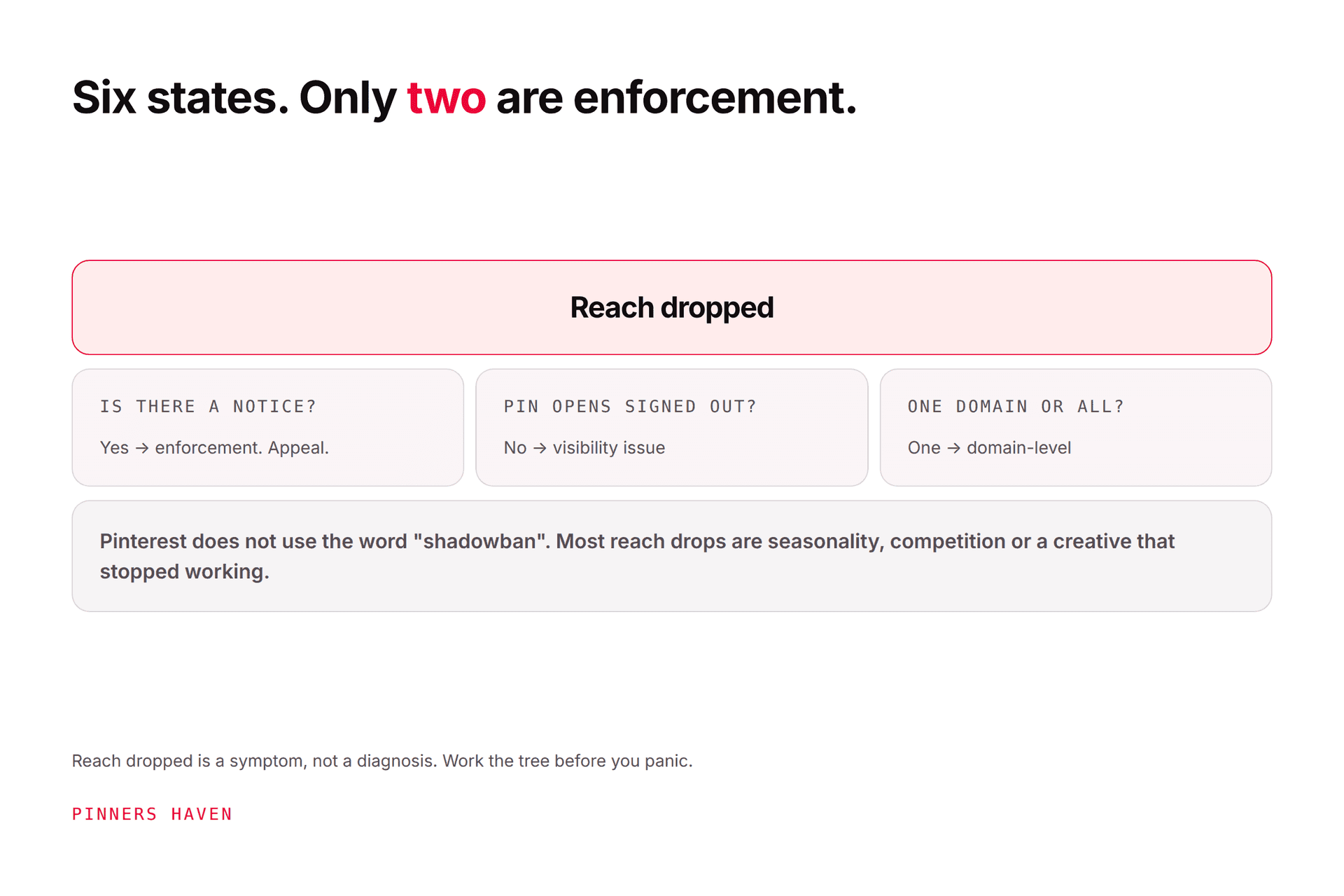
A fall in impressions does not prove an algorithm penalty. Seasonality, a viral pin returning to earth, a changed filter, fewer new pins, softening demand, duplicate publishing, or account enforcement all draw the same shape.
Start with this 10-minute diagnosis
Before you conclude anything, make sure you are comparing like with like. Open Pinterest Analytics and set two equal periods side by side. Then work down this list:
Date range — compare 28 days against the preceding 28 days, or the same seasonal window last year. A 7-day view against a 30-day view is not a drop, it's arithmetic.
Real-time estimates — either exclude the last 48 hours or include them consistently in both periods. Pinterest documents that these figures are estimates and subject to change.
Content type — separate organic from paid and earned. A finished ad campaign looks exactly like a penalty.
Source — compare "Your Pins" with "Other Pins" from a claimed account.
Saved content — note whether Include saved Pins is toggled on.
Claimed accounts — confirm the correct site or account is selected.
Device, format, age, gender — clear any filter you set weeks ago and forgot.
Pinterest also notes that some audience and filtered views exclude real-time data entirely, which is why two views of "the same" week can disagree.
If the drop disappears at this stage, you never had a problem. That happens more often than anyone admits.

Impressions dropped, traffic dropped, or both?
This is the fork in the road, and it's the step almost everyone skips. These are four different failures with four different fixes:
What you see | What it means | Where to look |
|---|---|---|
Impressions down, outbound click rate stable | Fewer people saw the pins | Demand, publishing volume, top-pin decay, distribution |
Impressions stable, click rate down | They saw it and weren't sold | The promise, the design, the audience match |
Outbound clicks stable, sessions down | The clicks aren't arriving | Attribution, consent banners, redirects, page speed, outages |
Sessions stable, conversions down | They arrived and bounced | Landing-page relevance, stock, price, forms, checkout |
Pinterest defines an impression as the number of times pins or ads were on screen, and an outbound click as an action leading to a destination off Pinterest. They are not interchangeable, and treating them as one number is how people spend a month fixing the wrong thing.
You might be thinking: "my impressions dropped, so obviously my reach dropped." Not necessarily. If your click rate held steady while impressions fell, your content is still landing with the people who see it. You have a distribution problem, not a quality problem. Those get fixed very differently.
Seven reasons Pinterest impressions fall
1. A breakout pin cooled down
Sort Top Pins by impressions and compare each pin's contribution across both periods. This is the single most under-used check on the platform.
Here's the math that catches people out. Say you did 400,000 impressions last month and 250,000 this month, a 37% collapse, and it feels like the sky is falling. Now look closer: one pin from last spring did 180,000 last month and 40,000 this month. That one pin is the entire drop. Everything else went from 220,000 to 210,000, which is noise. You don't have an account problem. You have a concentration problem, and the fix is a wider base of pins, not an overhaul.
Pinterest's distribution guide confirms there is no set engagement window: a pin can gain activity hours, months, or years later. The flip side is rarely said out loud: an old surge can recede just as unpredictably, and nothing you did caused it.
2. Search demand changed
Seasonal topics climb before the event and fall after it, every year, on schedule. Language, location, holidays, formats, and trends all move engagement independently of anything you publish.
Compare year over year where you can, and check Pinterest Trends before assuming a technical cause. If your "Christmas tablescape" pins died in January, the algorithm is working correctly.
3. You published less original content
Pinterest currently recommends creating original content weekly, and this is where honest self-assessment matters. Count new destination-plus-creative combinations, not total saves. Re-saving old work to new boards does not count as a pipeline.
Be specific with yourself: how many genuinely new pins (new image, new copy) went out in the four weeks before the drop compared with the four weeks before that? Most drops we've seen trace back to a quiet fortnight two to six weeks earlier, not to anything that happened the week the graph fell.
This is also the failure that compounds silently. You get busy, you skip a week, nothing happens immediately, so you skip another, and the decline shows up a month later when you've forgotten the cause. Keeping a steady cadence is the entire game, which is the problem automating Pinterest safely is meant to solve.
4. Repetitive pins reduced distribution — or triggered a block
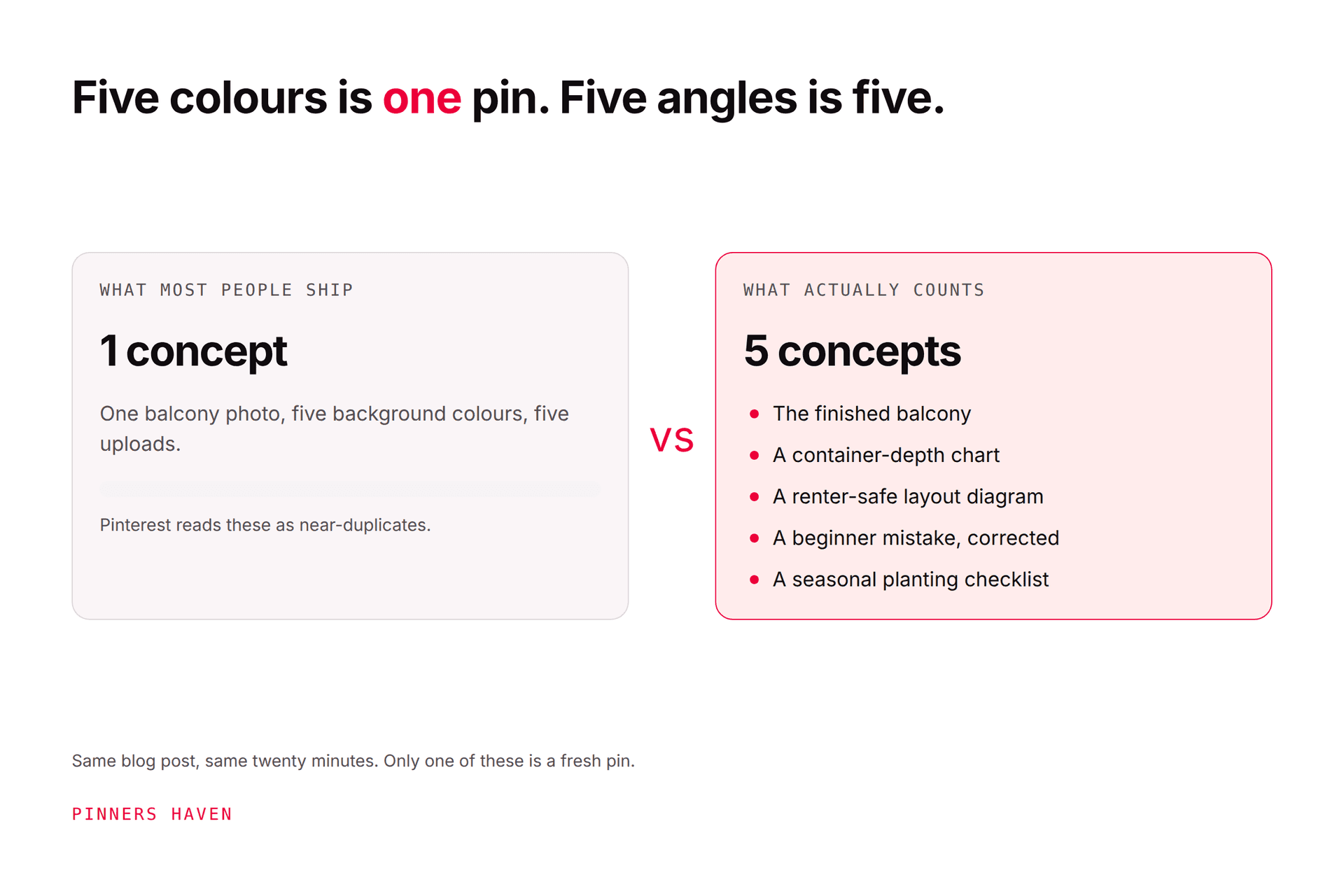
Pinterest warns against repeatedly saving the same pins or uploading content already on the platform, and says duplicate behavior can be flagged as spam and temporarily block pin creation.
Do not respond to a decline by blasting the same asset to twelve boards. This is the most common panic move and it is precisely the pattern Pinterest's filters look for. You will turn a soft decline into a hard one.
Pause the queue instead. Check your notifications. Then replace duplicates with genuinely different creative pointing at relevant destinations. If you're unsure what Pinterest actually counts as fresh, our fresh pins guide draws the line precisely. It is a lower bar than most people think, and a different one.
5. Your site is no longer claimed correctly
A claimed website ties your profile to pins from that domain and unlocks sharing insight. Pinterest's claim website guide covers the HTML tag, file, and DNS methods.
Claims break quietly. Check Settings after any migration, DNS change, domain change, theme change, or platform switch, and check it even if you don't remember doing one, because your host may have. Then open your final landing URLs with no shorteners and confirm nothing redirects somewhere surprising.
6. Content quality or intent drifted
A technically clean pin can still miss the search it was built for. Put your declining pins next to your winners and compare honestly:
topic and season
image clarity at 2:3, viewed on a phone
headline specificity — "storage ideas" loses to "renter-friendly small kitchen storage"
title and description language
board relevance
landing-page match
mobile page experience
Pinterest recommends high-quality images or video with relevant metadata. Keyword stuffing is not relevance, and it hasn't been for years. Our Pinterest SEO guide covers where terms actually belong.
7. Account or domain enforcement is involved
Look for hard evidence before you assume this one: publishing errors, warning emails, login notices, blocked links, removed pins, or a suspension message.
Do not infer a "shadowban" from an impressions chart alone. The term gets used for every unexplained decline and it explains almost none of them. We've pulled that apart in the Pinterest shadowban guide. If Pinterest has actually taken action, you will normally have a notice, and the path is to follow it. If you've had a spam warning specifically, work the spam-flag recovery guide instead of this one.
The thing that makes this hard
Notice what every cause above has in common: by the time the chart shows it, you're weeks late. A decayed winner, a broken claim, a quiet fortnight: all of them started long before the graph made them visible, and by then you've lost the clean baseline you needed to diagnose them.
That lag is the actual problem, and it's why we built Pinners Haven to watch reach week over week and email you the moment an account falls off a cliff, at a threshold you set. Same diagnosis as this article, arriving in week one instead of week five. It also runs a Freshness Meter on your templates, retiring each design after five to ten uses before sameness quietly drags your distribution down, which is cause #4 handled before it happens.
→ Start a 14-day trial — from $19/mo billed annually. No card needed; when the trial ends, publishing pauses until you pick a plan.
(Disclosure: we make Pinners Haven. We're not affiliated with Pinterest.)
A seven-day recovery plan
Work this in order. The sequencing matters more than the speed, because step one is what makes steps two through seven trustworthy.
Day 1 — preserve the baseline
Export the affected Analytics view before you change anything. Record filters, dates, top pins, top boards, impressions, outbound clicks, saves, and published volume. Screenshot every warning or error.
If you skip this day, you will spend the rest of the week unable to prove whether anything you did helped.
Day 2 — inspect winners and losers
Identify which pins explain the bulk of the absolute decline, not the percentage. Group them by destination, board, format, and topic, and settle the question from reason #1: is the fall broad, or concentrated in two or three pins?
Day 3 — test the website
Open your top destinations on an actual phone. Confirm status code, load speed, canonical URL, content, stock, forms, and that analytics is still firing. Re-check the domain claim.
Day 4 — audit the publishing log
Hunt for duplicates, bursts, irrelevant boards, broken links, copied material, or a scheduler that changed behavior after an update. Pause only the questionable items. Do not pause the whole account without a reason — silence is its own signal.
Days 5–7 — publish a controlled test
Create three to five genuinely original pins for proven, seasonally relevant pages. Vary one meaningful element, the visual angle or the headline, while keeping destination and intent clear. Space them out and document each variant.
Watch early technical delivery, but do not demand a ranking verdict after 24 hours. Pinterest says engagement has no fixed window, and it means it.
What not to do
Every item here is something we've watched someone do in a panic, and every one of them makes the diagnosis harder:
Don't delete underperforming pins. You are deleting your evidence and your long tail.
Don't double your posting volume overnight. Bursts read as robotic.
Don't stuff titles and descriptions. It doesn't work and it looks like what it is.
Don't buy saves, clicks, or followers. This converts a soft problem into an enforcement one.
Don't redirect old pins to unrelated destinations. That's a deceptive-link pattern.
Don't change topic, design, schedule, and landing page at once. You'll never know which one worked.
To be blunt about the pattern: the accounts that recover fastest are almost never the ones that overhauled everything. They're the ones that found the actual cause, fixed that, and published clean and consistent while it settled.
Frequently asked questions
Did the Pinterest algorithm change?
Possibly, but a chart cannot establish it. Rule out filters, estimates, seasonality, top-pin decay, publishing changes, site faults, and enforcement first. Pinterest does not publish every ranking adjustment, so "the algorithm changed" is unfalsifiable, which is exactly why it's such a comfortable explanation and such a useless one.
How long does recovery take?
There is no universal window, and be suspicious of anyone who gives you one. Technical corrections (a broken claim, a filter, a redirect) can restore accurate measurement almost immediately. Content-driven recovery moves on Pinterest's timeline, which spans hours to months.
Should I keep posting while impressions are down?
Yes, unless you have a warning, a technical fault, or a suspected duplicate-content pattern to clear first. Keep publishing useful original work. Just don't use volume as a substitute for diagnosis.
Are impressions the most important metric?
No, and over-weighting them is its own trap. Impressions measure visibility. Saves, outbound clicks, qualified sessions, leads, and sales measure whether the visibility was worth having. A pin with 100,000 impressions and 12 clicks is a design brief, not a win. Our Pinterest Analytics guide covers which metrics should actually change your next move.
Can a single pin really drag down my whole account?
Yes — see the worked example in reason #1. Concentrated accounts are volatile by construction. If one pin is more than a third of your impressions, your next month depends on that pin's mood rather than your strategy, and widening the base is the fix.
Diagnose before you rebuild
The fastest responsible move is to locate where the loss happened: measurement, distribution, click-through, website, or conversion. Fix only that. Preserve a clean baseline, correct what you've confirmed, publish a small controlled batch, and give it room.
That's how you end the week with evidence instead of another seven days of anxious changes.
If you'd rather not go through this again three weeks late, → see how Pinners Haven works — it watches your reach and tells you when the line breaks, so the diagnosis starts on day one.