Pinterest is a strong candidate when the customer benefits from seeing, planning, comparing, collecting, or learning before acting. Common fits include retail, food, home, weddings, travel, beauty, education, crafts, and visually demonstrable services. That is not an exclusive list.
Test three questions:
Do customers search for ideas, examples, or instructions related to the offer?
Can you create useful visual content without misleading them?
Is there a page that completes the promise and supports a business action?
If the answer to the third question is no, fix the destination before increasing Pin output.
Choose a leading outcome for the first campaign: qualified website visits, product-page discovery, email signups, inquiries, or purchases. Assign supporting metrics without confusing them for the goal.
For sales, impressions show exposure, saves show future interest, outbound clicks show off-platform intent, and checkout data shows commercial impact. Pinterest defines each of these separately in Analytics. Pinterest Analytics
Create or convert a free business account, complete the profile, claim an eligible website, and build focused public boards. Business accounts unlock Analytics and business tools. Pinterest business-account setup
Merchants can evaluate Product Rich Pins or catalogs. Catalogs require a claimed website and other merchant prerequisites, and availability varies by market. Service and content businesses can succeed with well-linked standard Pins without a product feed.
Organize searches into four stages:
Do not force every Pin to sell immediately. Discovery content can introduce the brand, but it still needs a logical next step.
Use Pinterest autocomplete, related searches, strong Pins, your site-search data, customer questions, and Pinterest Trends. Trends can show up to two years of history and changes over time, but its values are normalized rather than absolute volumes. Pinterest Trends
Start seasonal content while people are planning, not after the event has peaked. Keep evergreen topics running alongside seasonal campaigns so the account is not silent between moments.
5. Create a useful content mix
Use three connected groups:
Teach: checklists, tutorials, explanations, and mistakes.
Help choose: comparisons, examples, use cases, and buying guides.
Offer: product, service, lead magnet, or booking content.
One destination can support several original Pin angles. A nursery-design article might produce Pins about layout, storage, color, a small room, and a renter-friendly setup. Each should make a distinct promise rather than being a cosmetic duplicate.
The topic should agree across the image, overlay, title, description, board, URL, and destination page. Pinterest recommends adding relevant keywords to Pin titles and descriptions, board titles and descriptions, and website URLs, while publishing original content to relevant boards. Pinterest performance guidance
Use readable 2:3 creative, often 1000 by 1500 pixels. Keep the visual honest and the main benefit easy to grasp on a phone. Write for a person first; keyword repetition is not a substitute for clarity.
There is no authoritative universal Pins-per-day requirement. Choose a pace that your team can sustain with original creative, checked links, and editorial review. Schedule around campaign timing, then let performance determine where to expand.
A publishing tool should support the calendar, not replace the strategy or the final claims review. Pinners Haven generates the pin images and copy from approved pages, routes user-approved pins to the board you choose, spaces publication, and reports performance — while you keep the judgment about who the customer is and whether the destination deserves the traffic.
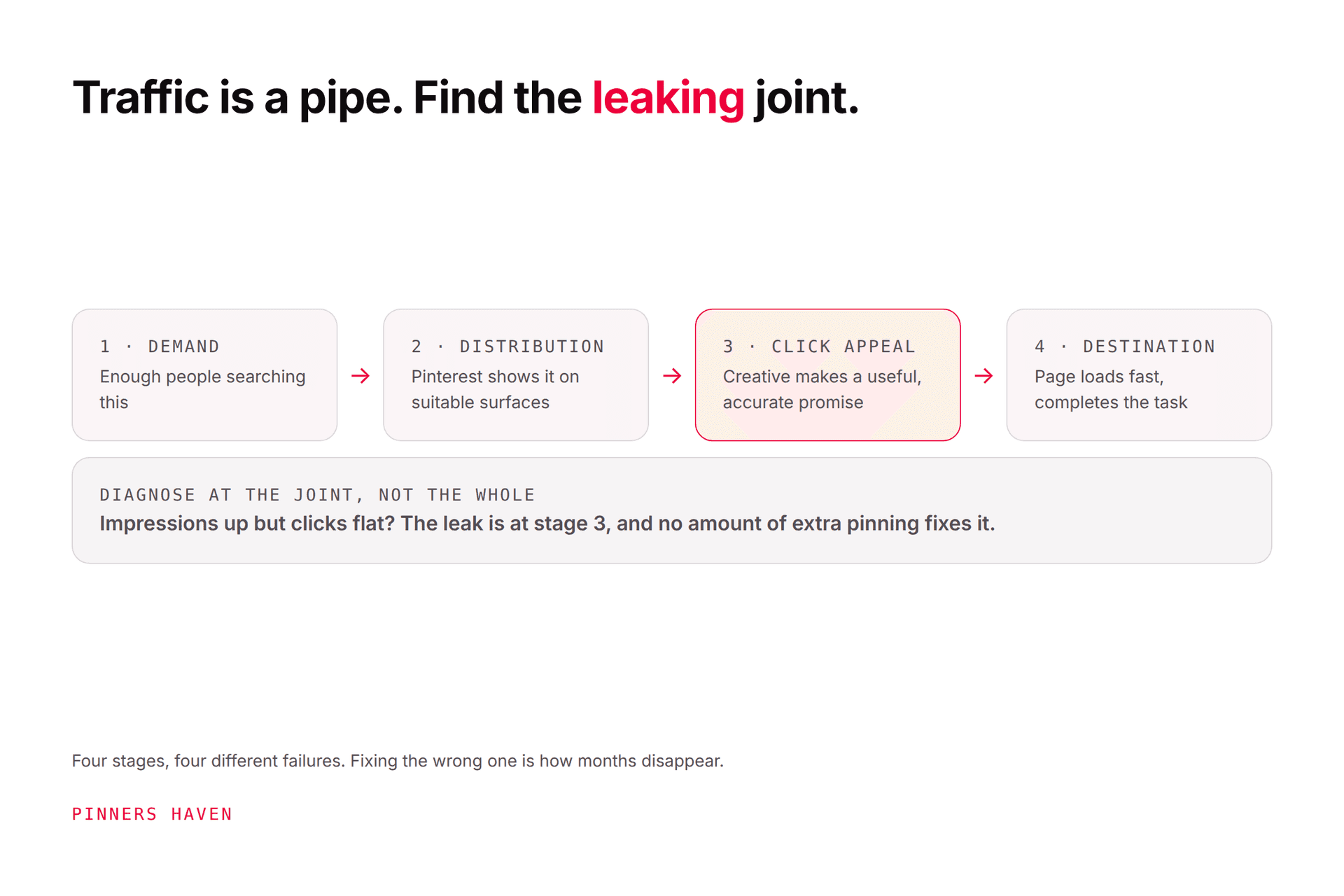
Group performance by topic, destination, format, and intent. Look for the weakest step:
low impressions: topic relevance, account context, or creative completeness;
impressions without saves or clicks: weak promise or visual;
Pin clicks without outbound clicks: unclear destination value;
outbound clicks without conversion: page mismatch or conversion friction.
Pinterest notes that real-time metrics are estimates and can change. Use reasonable comparison windows and do not overreact to a single day.
Organic Pins build a reusable content library and reveal message-market fit. Ads buy distribution and can accelerate a campaign with clear economics. They do not repair a weak page or irrelevant creative.
A practical sequence is: validate the offer and tracking, publish organic angles, identify qualified click and conversion patterns, then consider promoting proven creative. Keep organic and paid reporting separated before comparing their roles.
Days 1–30: foundation, research, boards, tracking, and the first coherent Pin set.
Days 31–60: expand the topics that earn relevant saves and outbound clicks; repair weak destinations.
Days 61–90: create new angles for proven topics, retire misleading or broken paths, and test paid amplification only if the conversion path is ready.
The best Pinterest marketing plan is not a bag of posting tricks. It is a connected system in which a real customer need becomes a search-focused Pin, a relevant board, a useful page, and a measurable action. Build that path first. Scale it only after it holds together.
Once the system exists, the constraint becomes feeding it. Every step above needs original pins with distinct copy, produced week after week — which is where most Pinterest marketing plans quietly stop. Pinners Haven runs that layer: twenty angles per topic, an SEO title and three to five unique descriptions per pin, original designs, and a Freshness Meter that retires each template after roughly 5–10 uses. It won't choose your customer or fix your destination; the strategy above stays yours.
→ See how it works
(Disclosure: we make Pinners Haven. We're not affiliated with Pinterest.)