Pinterest Keywords: How to Find Searches That Convert
Pinterest keyword research means finding the phrases people actually use, then mapping each one to a pin and a destination that satisfies it. Start with customer problems, expand with autocomplete and Trends, classify the intent, and prioritise terms your content can genuinely serve.
Joe Nyambura
Founder & operator, Pinners Haven · August 18, 2026
On this page21 sections
- What makes a keyword worth targeting
- How to find Pinterest keywords
- 1. Build seed topics from the business, not a tool
- 2. Expand with Pinterest autocomplete
- 3. Compare direction in Pinterest Trends
- 4. Mine boards and strong pins
- 5. Add your own performance data
- Classify the intent
- Cluster and prioritise
- Map keywords to the pin's fields
- The research worksheet
- The angle problem
- Seven common mistakes
- Frequently asked questions
- Does Pinterest have a keyword tool?
- Are Pinterest Trends numbers search volumes?
- How many keywords should one pin target?
- Should every keyword get its own page?
- How do I find low-competition Pinterest keywords?
- How long before a keyword shows results?
- Research for decisions, not decoration
Pinterest keyword research means finding the phrases people actually use, then mapping each one to a pin and a destination that satisfies it. Start with customer problems, expand with autocomplete and Trends, classify the intent, and prioritise terms your content can genuinely serve.
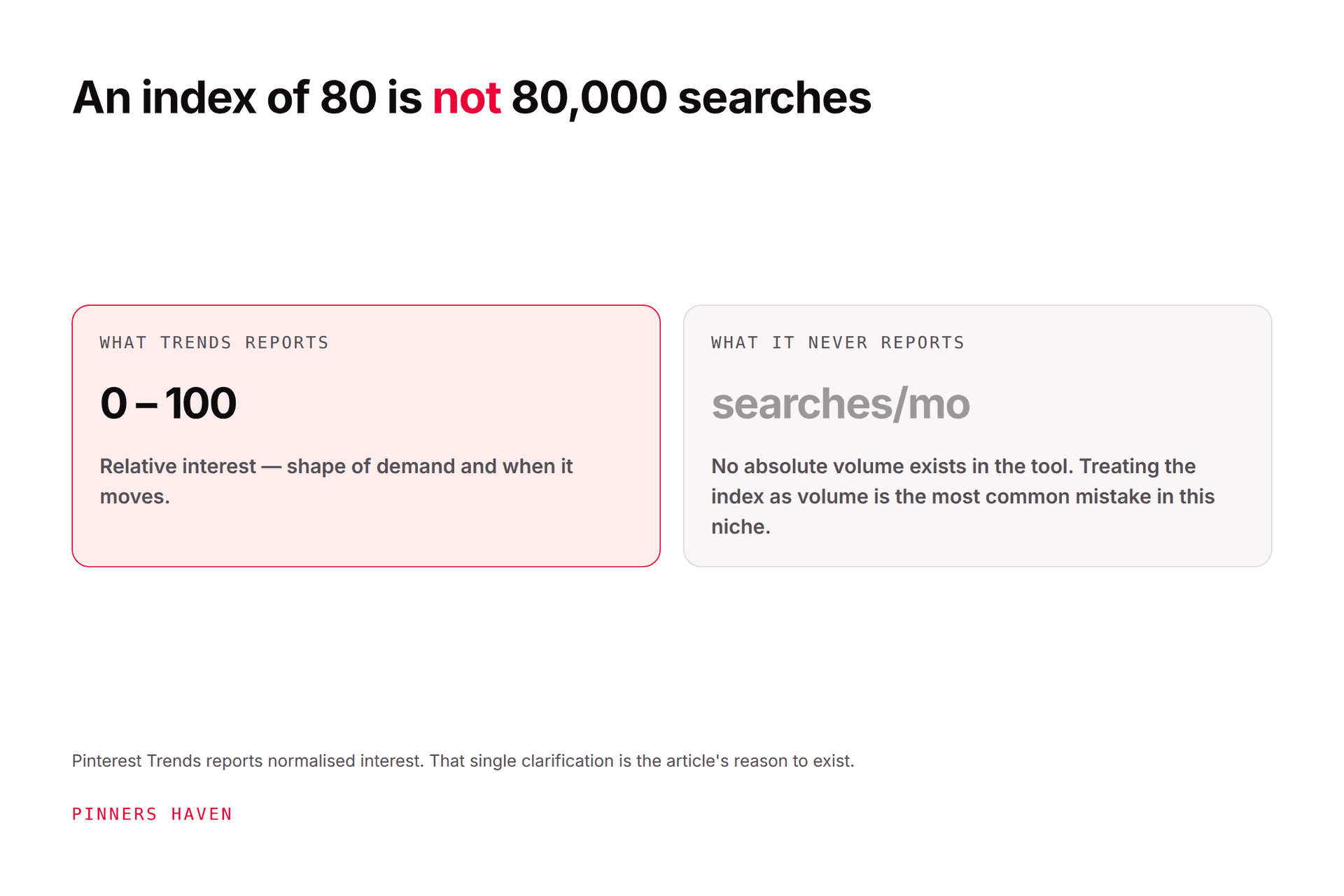
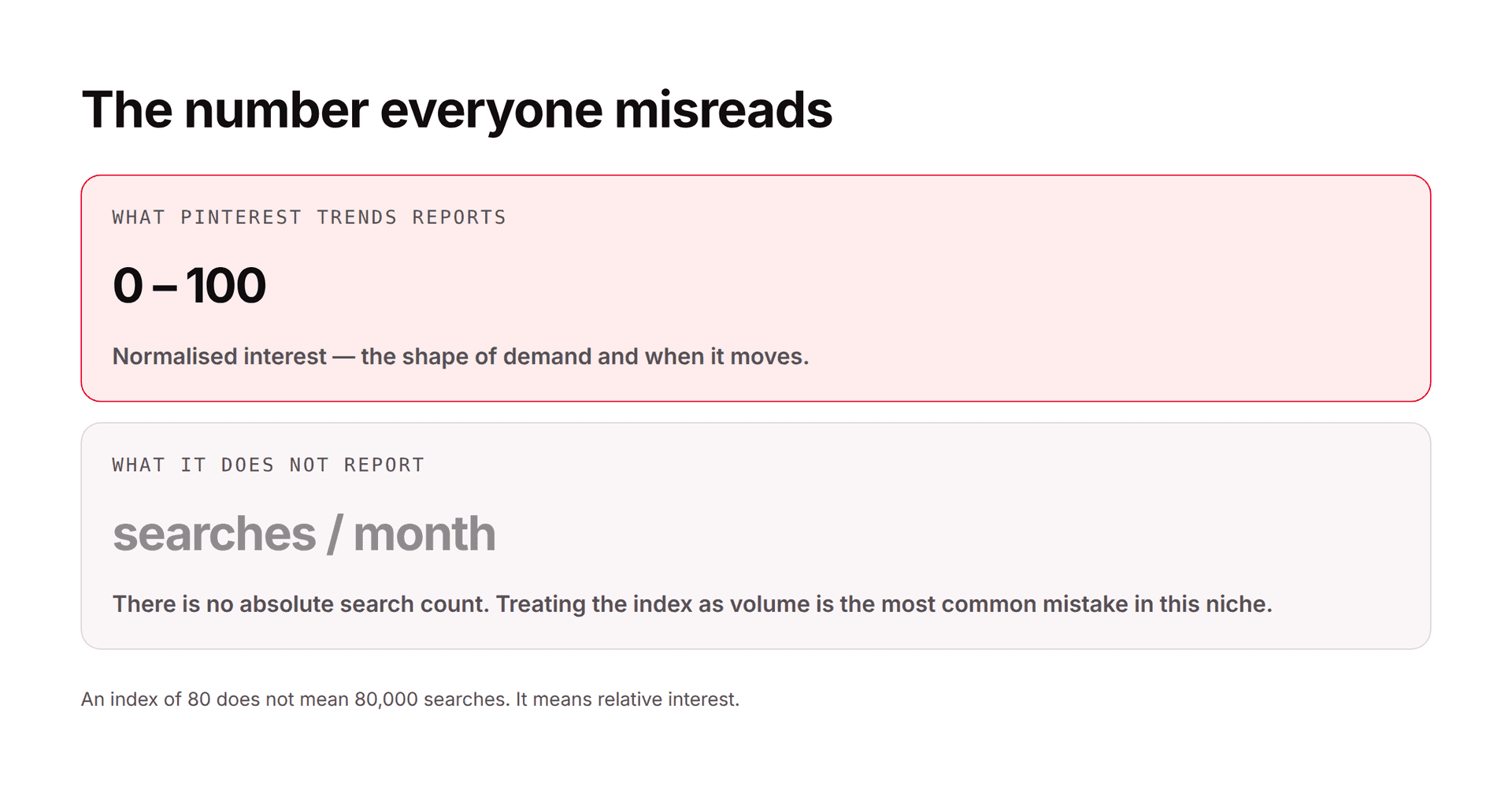
Before anything else, one correction that matters more than any tactic below. Pinterest Trends does not report search volume. It reports normalised interest — a ratio, not a count. A huge amount of Pinterest keyword advice quotes Trends figures as "monthly searches," and building a content plan on that misunderstanding is how people end up targeting terms they've badly misjudged.
And a keyword never converts by itself. Conversion comes from the fit between searcher, pin, destination, and offer.
What makes a keyword worth targeting
Four qualities, all required:
It describes something your audience genuinely wants.
You can create an original visual response to it.
You have a destination that completes the promise.
Its intent connects to a meaningful outcome for you.
"Home decor" is popular and useless — too vague to make a pin for, too broad to satisfy. "Warm neutral bedroom ideas for renters" hands you a room, a style, an audience, and a constraint. That's a brief, and it's far easier to serve well than to compete for.
Specific beats popular on Pinterest more than on almost any other channel, because the visual has to match the search too.

How to find Pinterest keywords
1. Build seed topics from the business, not a tool
List your products, the problems you solve, desired outcomes, audiences, formats, materials, seasons, occasions, and constraints. A meal-planning business starts with: weekly meal plan, budget dinners, freezer meals, family lunches, grocery list.
Then mine support emails, product reviews, sales calls, on-site search, and customer interviews. These reveal phrasing no generic tool knows about, and it's the closest thing to a genuine advantage in keyword research.
2. Expand with Pinterest autocomplete
Type each seed into Pinterest search and record the relevant suggestions. Add modifiers before and after. Don't collect phrases you can't serve — a spreadsheet of 400 keywords you'll never write for is a procrastination device.
Then search the terms and study what's actually ranking. If results for "capsule wardrobe checklist" are dominated by printable checklists, a vague fashion gallery is going to miss regardless of how good it looks.
3. Compare direction in Pinterest Trends
Pinterest Trends shows historical interest, seasonal patterns, and regional variation, with some views including up to two years of history. Values are normalised ratios. Features vary by market.
Use it to answer four questions:
Is interest steady or seasonal?
When does planning actually begin? (This is the most valuable thing it tells you.)
Which natural phrasing better matches this market?
Is a topic rising fast enough to be worth a test?
That second question is where the money is. Seasonal content published when the event happens is published far too late — Trends tells you when people start looking, which is usually six to ten weeks earlier than instinct suggests.
4. Mine boards and strong pins
Study board titles, pin titles, and the formats winning for your query. Extract recurring concepts, never competitors' sentences or designs. Pinterest lets desktop users filter searches to boards, which reveals how the topic is organised at a higher level — see finding boards.
5. Add your own performance data
Pinterest Analytics shows which pins and boards earn impressions, saves, pin clicks, and outbound clicks. Your site analytics shows what happened next.
Turn every winner into a question: did people respond to the topic, the visual format, the audience modifier, the season, or the offer? Then run one controlled test rather than ten guesses. This is the fastest-compounding part of the whole process and almost nobody does it.
Classify the intent
Intent | Clue | Example | What to make |
|---|---|---|---|
Explore | broad ideas, inspiration | patio ideas | curated guide |
Plan | how-to, checklist, layout | patio planting plan | tutorial or template |
Compare | best, versus, review | cedar vs metal planter | fair comparison |
Act | specific product or service | 24-inch cedar planter box | product or collection page |
Intent should also shape the pin's call to action. "See 25 ideas" fits exploration. "Check size and availability" fits an act-stage search. Using the same CTA across all four is a quiet conversion leak.
Cluster and prioritise
Group close variants sharing one intent and destination. "How to make a Pinterest board" and "create Pinterest board" are the same need and should share one strong guide — splitting them creates two thin pages competing with each other.
Score each cluster 1–3 on: audience fit, destination readiness, business value, creative potential, timing, evidence of demand, competitive feasibility.
This is a decision aid, not a formula. A lower-interest product phrase often beats a broad inspiration term if it brings ready buyers. Rank by business value, not by the biggest number.
Map keywords to the pin's fields
One primary topic, natural supporting language:
Title — clear promise with the main phrase or a close variant, front-loaded
Description — audience, benefit, context, and what the page contains
Text overlay — a short human hook, not a keyword dump
Board — the closest durable topic
Destination — a page that satisfies the same intent immediately
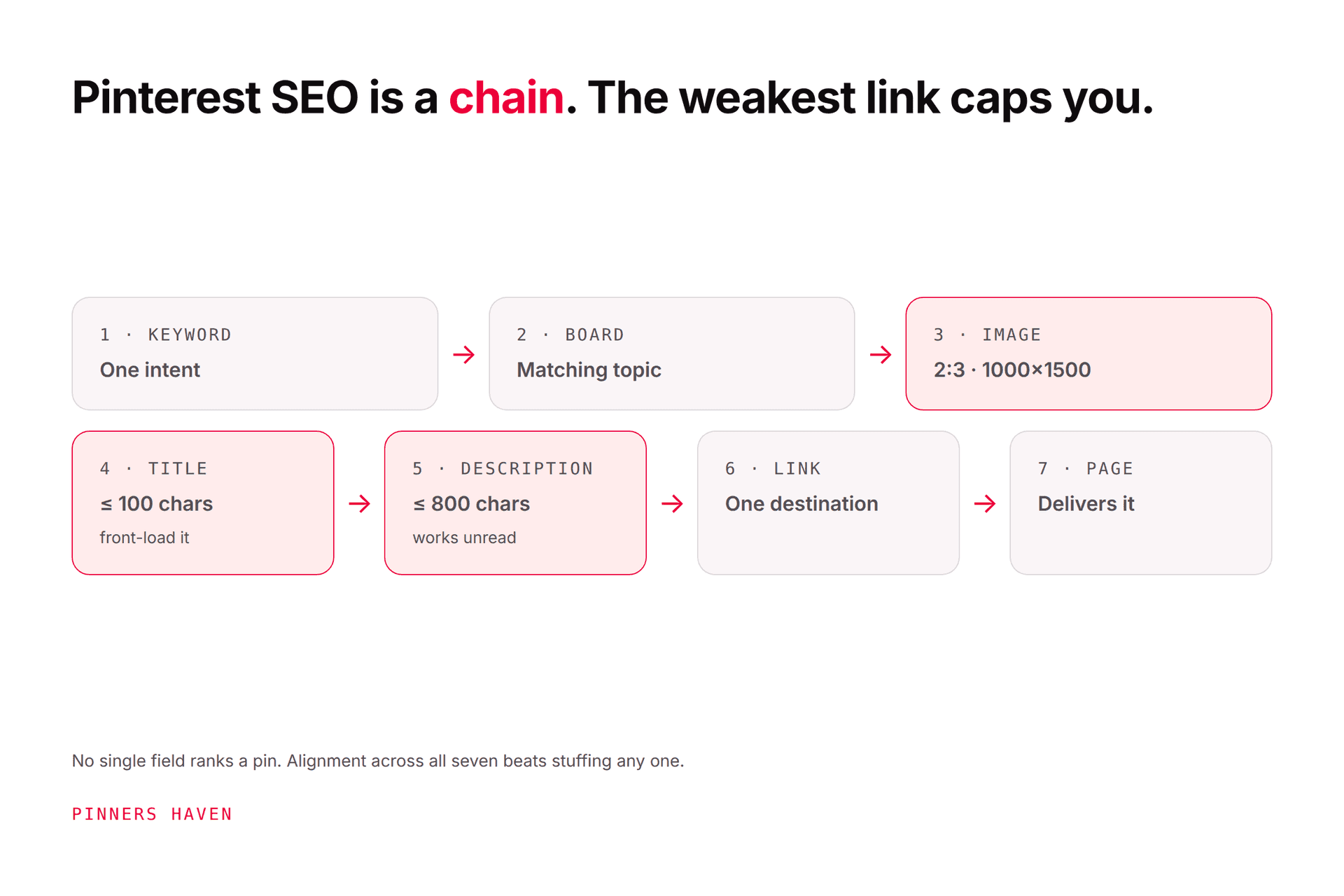
Pinterest recommends relevant keywords in pin titles, descriptions, board titles, board descriptions, and website URLs, per its performance guidance. Our Pinterest SEO guide covers the full chain.
The research worksheet
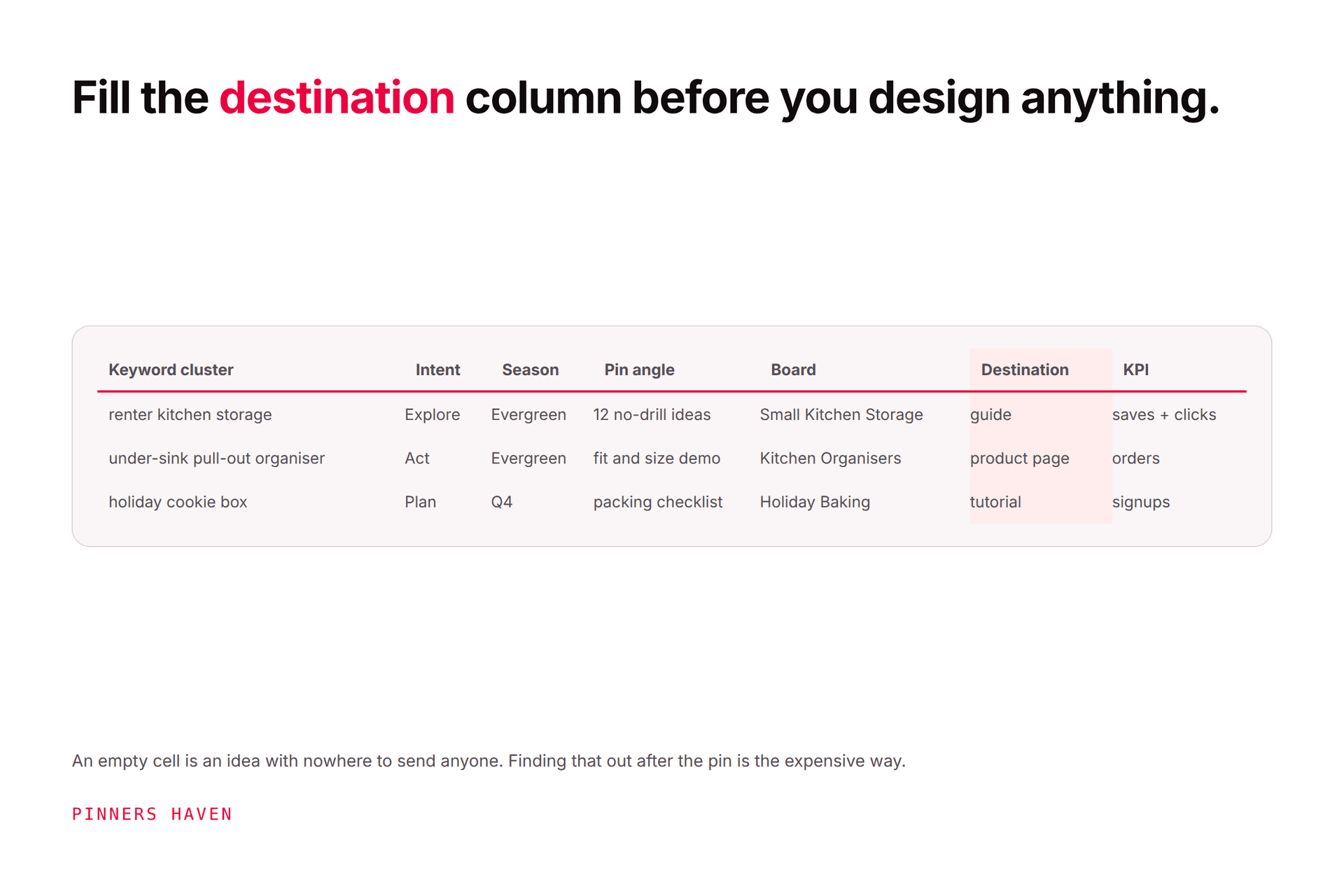
Keyword cluster | Intent | Season | Pin angle | Board | Destination | KPI |
|---|---|---|---|---|---|---|
renter kitchen storage | Explore | Evergreen | 12 no-drill ideas | Small Kitchen Storage | guide | saves + outbound clicks |
under-sink pull-out organiser | Act | Evergreen | fit and size demo | Kitchen Organisers | product page | orders |
holiday cookie box | Plan | Q4 | packing checklist | Holiday Baking | tutorial | signups |
Fill the destination column before design begins. An empty cell is an idea with nowhere useful to send anyone, and finding that out after you've made the pin is the expensive way.
The angle problem
Here's what limits most people, and it isn't keyword discovery.
You find a good cluster. You make one pin for it. That pin targets one phrasing, appeals to one motivation, and reaches whoever that particular angle happens to resonate with. Meanwhile the same page could legitimately serve "renter-friendly," "no-drill," "small kitchen," "budget," and "beginner" framings — five different searches, five different pins, one destination.
Serious accounts rank for hundreds of phrases. Most people target five, because writing five genuinely distinct angles per page is real work.
That's specifically what Pinners Haven automates: twenty angles per topic, each with its own keyword-optimised title and three to five unique descriptions, so one post opens many doors instead of one. You still choose the cluster and the destination — steps 1 and 2 above are judgment and stay yours.
(Disclosure: we make Pinners Haven. We're not affiliated with Pinterest.)
Seven common mistakes
Treating normalised Trends values as search volume
Chasing only broad, high-interest phrases
Making a separate thin article for every word-order variant
Copying competitor wording or creative
Using one destination for every intent stage
Declaring a keyword successful from impressions alone
Forcing exact phrases until the copy stops sounding human
Frequently asked questions
Does Pinterest have a keyword tool?
Pinterest offers autocomplete and Trends for organic research. Ads Manager has keyword targeting for campaigns, but paid targeting suggestions are not organic ranking data and shouldn't be used as a proxy. Our Pinterest keyword tool guide covers the options.
Are Pinterest Trends numbers search volumes?
No. Pinterest describes them as normalised search interest. Use them to compare direction and seasonality, never as absolute monthly volume. This is the single most common error in Pinterest keyword content.
How many keywords should one pin target?
One clear primary topic plus enough natural context to explain the pin. There's no credible universal count, and density is not a ranking factor. Cover more searches with more angles, not more keywords per pin.
Should every keyword get its own page?
No. Close variants with the same intent should share one comprehensive destination. Make a new page when the audience, the task, or the answer is genuinely different.
How do I find low-competition Pinterest keywords?
Look for specificity rather than obscurity: an audience constraint ("for renters"), a format ("checklist"), a limitation ("no drill"), or a scenario ("rented flat, no outdoor space"). These are less contested because they're harder to serve generically, which is exactly why you can win them.
How long before a keyword shows results?
No fixed window. Pinterest says pins can gain engagement months or years later, so early quiet is not failure. Judge a cluster over a full seasonal cycle rather than a fortnight.
Research for decisions, not decoration
The goal isn't the biggest spreadsheet. It's a short, defensible map from customer language to content you can publish and outcomes you can measure.
Start with ten strong clusters. Learn which ones produce qualified behaviour. Expand from the evidence, not the export.