Technically yes, and it's the least useful true answer available. Pinterest has profiles, followers and a feed, so it gets filed under social media by every marketing team on earth, and then the social media playbook gets applied to it and produces almost nothing.
JN
Joe Nyambura
Founder & operator, Pinners Haven · August 18, 2026
Technically yes, and it's the least useful true answer available. Pinterest has profiles, followers and a feed, so it gets filed under social media by every marketing team on earth, and then the social media playbook gets applied to it and produces almost nothing.
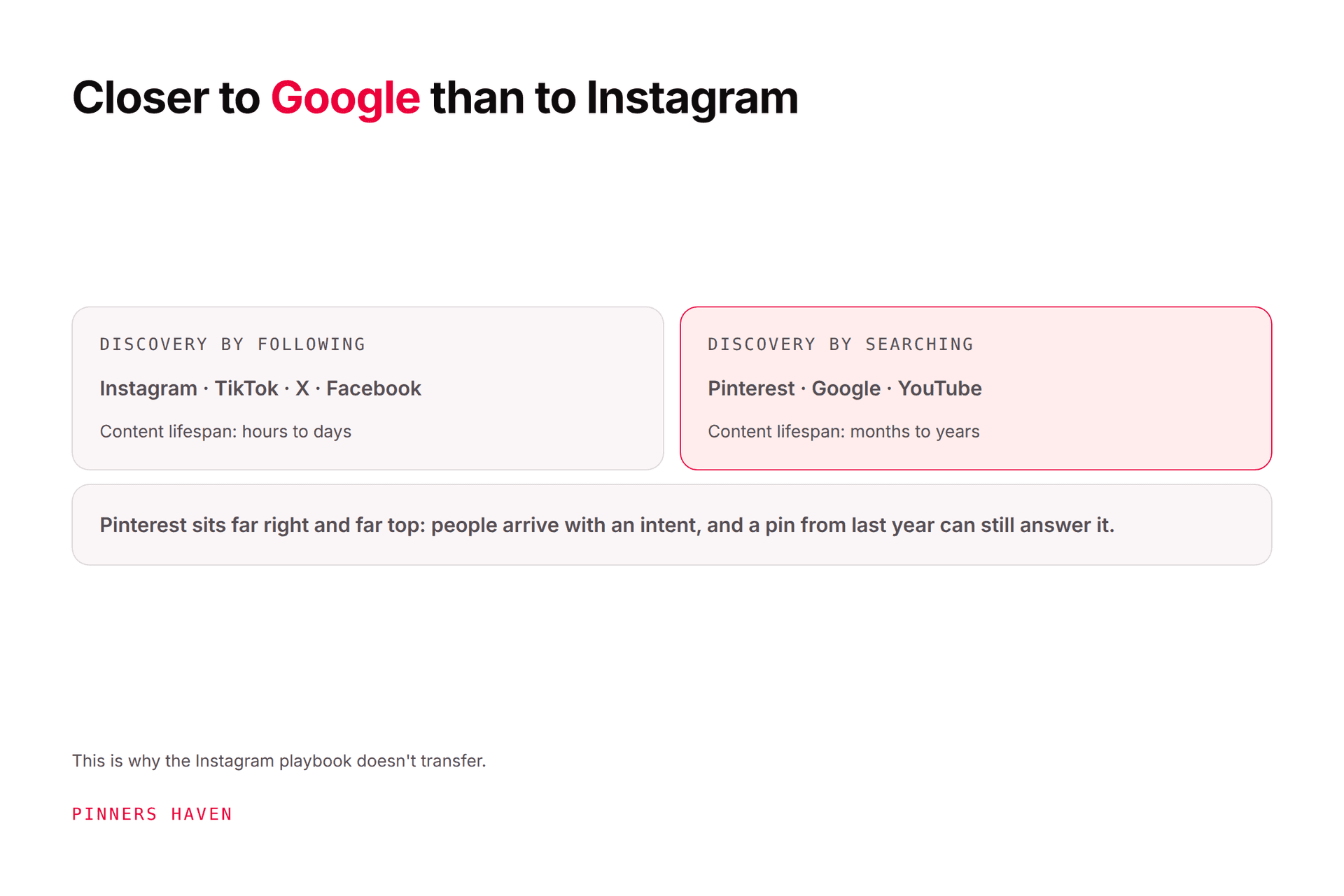
Pinterest is best understood as a visual search engine with social features attached. The two things that define a social network, that discovery is driven by who you follow and that content has a lifespan of hours, are both untrue on Pinterest. Discovery is driven overwhelmingly by search and interest-based recommendation, and Pinterest itself notes that pins can gain engagement months or years after publication. That combination makes it behave far more like Google or YouTube than like Instagram, and it changes essentially every strategic decision you'd make about it.
The three differences that actually matter
1. Discovery isn't follower-driven
On Instagram or TikTok, your reach is fundamentally shaped by who follows you and what the feed decides to amplify. Building an audience is the strategy.
On Pinterest, most distribution comes through search and interest-based recommendation. A brand-new account with no followers can have a pin surface for a relevant query, which is essentially impossible on a social feed.
Strategic consequence: stop optimising for follower growth. It's a lagging indicator here, not a lever. Our followers guide covers what following actually does and doesn't do.
2. Content doesn't expire
A tweet is dead in hours. An Instagram post is mostly done in 48. Pinterest content can keep accumulating saves and clicks for years, and Pinterest says so directly.
Strategic consequence: the economics invert. On social platforms, output volume is the game because everything decays. On Pinterest, a single well-targeted pin is an asset that compounds, which makes quality per pin worth far more than it is anywhere else. It's also why "post daily or die" advice doesn't transfer. See how often to pin.
3. The user is planning, not scrolling
People open Instagram to be entertained. They open Pinterest to work something out: what to cook, what to wear, how to lay out a room, where to go.
Strategic consequence: your content should answer rather than entertain. Specificity beats personality. A pin titled "7 vegetables that grow in 8-inch pots" outperforms a beautiful garden photo, which is the reverse of what works on a social feed.
Where it does behave socially
Being fair, the social features are real: profiles, followers, comments, sends, group boards, and a home feed influenced by who you follow.
They're just secondary. Followers give you a modest distribution floor and a signal of credibility. Comments are minor. Group boards have declined substantially in usefulness. None of these is where the traffic comes from, and building a strategy around them is the most common way marketers waste a year on Pinterest.
What this means practically
If you treat it as social media
If you treat it as search
Chase followers
Target queries
Post at the "best time"
Publish when the content is ready
Optimise for likes and comments
Optimise for saves and outbound clicks
Post trending content
Answer durable questions
Delete old posts
Keep everything; it still works
Measure engagement rate
Measure clicks and conversions
Use hashtags
Use keywords in natural language
The right-hand column is an SEO discipline. That's the honest summary of what Pinterest marketing is.
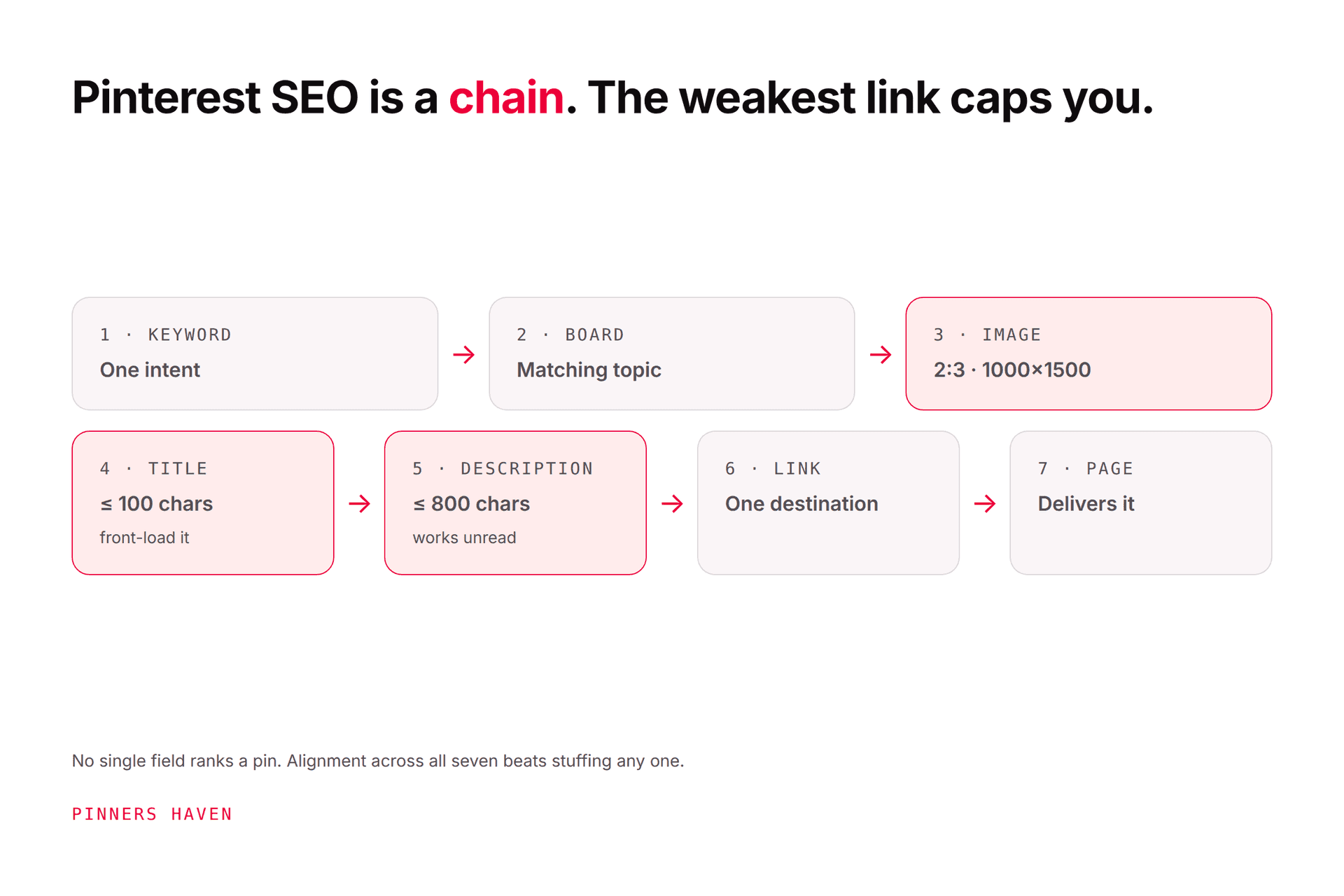
If you've done any search work before, that skill transfers here almost directly, which is good news that most people don't realise they have. Pinterest SEO is the starting point, and Pinterest keywords covers the research.
Does the classification matter for anything else?
Two practical places, yes.
Budget and team. If Pinterest sits with your social team, it'll be run on a social calendar and measured on engagement, and it will underperform. It usually belongs with whoever owns search and content.
Tooling. Social schedulers treat Pinterest as one more network to post to. That works mechanically and misses what the channel needs, which is keyword-led creative produced at volume against a content library. It's why general social tools and Pinterest-specific tools feel so different in practice. See Pinterest marketing tools.
Where the search framing leads
Once you accept Pinterest is a search channel, the work looks like SEO work: research the queries, produce content that answers them, cover a topic from several angles, and keep publishing so the library compounds.
That last part is where it gets laborious, because covering a topic properly on Pinterest means several distinct pins per page rather than one post.
Pinners Haven is built for that reading of the platform: you bring the keywords, and it writes up to 20 angles per topic, produces an SEO title with three to five unique descriptions per pin, designs original images, and publishes on a paced, account-safe cadence. It measures saves and outbound clicks rather than impressions, which is the right-hand column of that table made into a product decision. Nothing publishes until you approve it. From $19/mo billed annually, with a 14-day trial; no card is needed, and when it ends publishing pauses until you pick a plan.
(Disclosure: we make Pinners Haven. We're not affiliated with Pinterest.)
Frequently asked questions
Is Pinterest a social media platform?
It has social features and is usually classified that way, but it functions as a visual search engine. Discovery comes mainly from search and interest recommendations rather than from your followers, which is the defining difference.
Is Pinterest a search engine?
Functionally, largely yes. People arrive with an intent and type a query, results are ranked by relevance, and content stays useful for years. Treating it as a search channel produces much better results than treating it as a social feed.
Do followers matter on Pinterest?
Much less than on social platforms. They provide a small distribution floor and some credibility, but the bulk of reach comes through search and recommendations, so a new account can still get discovered.
Should Pinterest sit with my social team or my SEO team?
Usually SEO or content. Run on a social calendar and measured on engagement rate, Pinterest tends to underperform, because both the cadence and the metrics are wrong for how it actually works.
Why doesn't my Instagram strategy work on Pinterest?
Because Instagram rewards audience-building and timely content, while Pinterest rewards keyword-matched content with a long life. Reposting Instagram content to Pinterest without reworking the titles and formats is the most common version of this mistake.
Does posting time matter on Pinterest?
Far less than on social platforms, because content keeps circulating. It's worth testing as a tiebreaker rather than treating it as a primary lever. See best time to post.
File it under search
The classification question is only worth asking because of what follows from the answer.
Put Pinterest in the social bucket and you'll chase followers, post on a calendar, measure engagement and wonder why nothing converts. Put it in the search bucket and you'll research queries, write for intent, build a library and get compounding traffic.
It has a follow button. It is not a social network.