Coaching is a high-trust purchase. Nobody sees a pin, feels understood, and books a $2,000 package that afternoon. So the coaches who make Pinterest work don't try to sell from the pin at all.
JN
Joe Nyambura
Founder & operator, Pinners Haven · August 18, 2026
Coaching is a high-trust purchase. Nobody sees a pin, feels understood, and books a $2,000 package that afternoon. So the coaches who make Pinterest work don't try to sell from the pin at all.
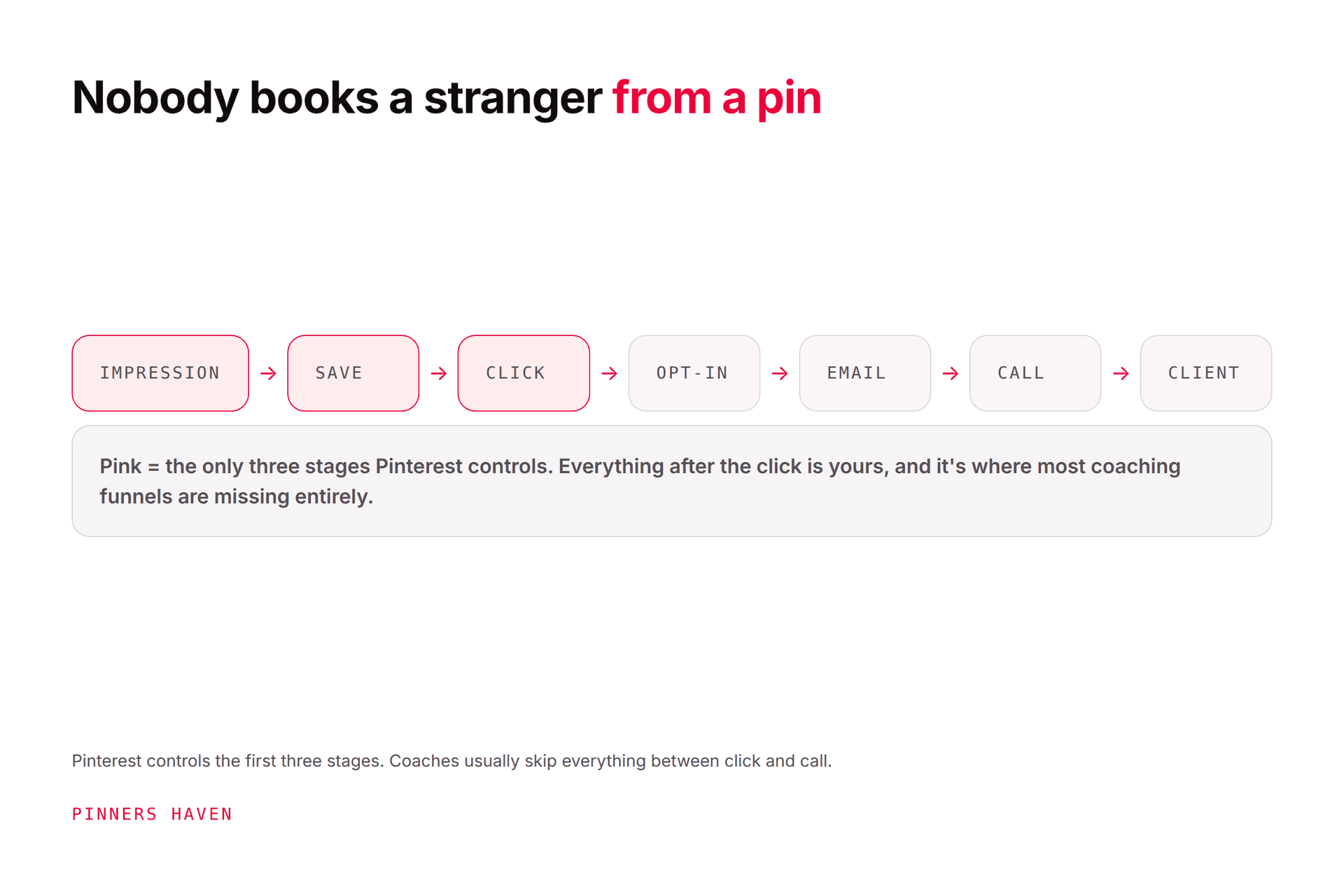
Pinterest works for coaches as a top-of-funnel lead source, not a booking channel. The realistic path is pin → useful free resource → email address → a sequence that builds trust → discovery call. Coaches who link pins directly to a services page or a calendar convert badly, because a stranger who has read one pin has no basis to book anything. The asset that makes this work is a genuinely useful free resource that solves one small, specific problem completely. Everything else is downstream of that.
Coaching also sits close to two areas where claims get people in trouble, so there's a guardrails section below that isn't optional reading.
The funnel, honestly
Stage
Who controls it
What usually breaks
Impression
Pinterest
Keyword too broad
Save
Your creative
Pin promises nothing specific
Outbound click
Your promise
The pin looked nice and said nothing
Opt-in
Your free resource
The resource is vague or doesn't exist
Email sequence
You
There isn't one
Discovery call
You
Asked for too early
Client
You
Not a Pinterest problem
The two bolded rows are where almost every coaching funnel fails, and neither has anything to do with Pinterest.
The free resource is the whole strategy
If you take one thing from this article: the quality of your free resource determines everything downstream.
A good one solves one small, specific problem completely. A bad one gestures at a big problem and withholds the answer to make you book a call. Readers can tell the difference immediately, and the second kind trains people not to trust you.
Weak resource
Strong resource
"Free coaching tips newsletter"
"The 12 questions to answer before leaving a job you're good at"
"5 secrets to confidence"
"A script for asking your manager for a title change"
"Discovery call"
"The 20-minute weekly review that stops Sunday dread"
"Free guide to success"
"A one-page decision matrix for choosing between two job offers"
Notice the right column is narrower, more useful, and more obviously connected to a specific person's actual evening. Notice also that giving away the complete answer doesn't cost you the client. It's the reason they believe you can help with the bigger version.
Niche down until it becomes searchable
"Life coach," "business coach" and "mindset coach" describe your profession. Nobody types them when they need help.
What people type is the problem, in their words, at the moment it's acute:
"how to know if I should quit my job"
"feeling behind at 35"
"how to stop overworking as a freelancer"
"what to say in a performance review"
"coming back to work after a career break"
Each of those is a page, a free resource, and several pins. None of them mentions coaching.
Our Pinterest niches guide covers scoring a niche properly. The coaching-specific test: can you write thirty pages about your client's problem without describing your methodology? If not, you're niched around yourself rather than around them.
Content that generates coaching leads
The self-assessment. "Twelve questions to answer before X." High save rate, high opt-in, and it does real work.
The script. Exact words for a hard conversation. Extremely saveable, because people want it available at the moment they need it.
The decision framework. A matrix or flowchart for a choice your clients face. Genuinely useful and hard to fake.
The "is this normal" piece. Naming an experience precisely. The highest-trust content a coach can publish, because recognition is the thing that makes someone think you understand them.
The realistic timeline. What change actually takes, honestly. Counter-positions you against the transformation industry and attracts better clients.
The myth correction. A common piece of advice in your field that doesn't work, and what to do instead.
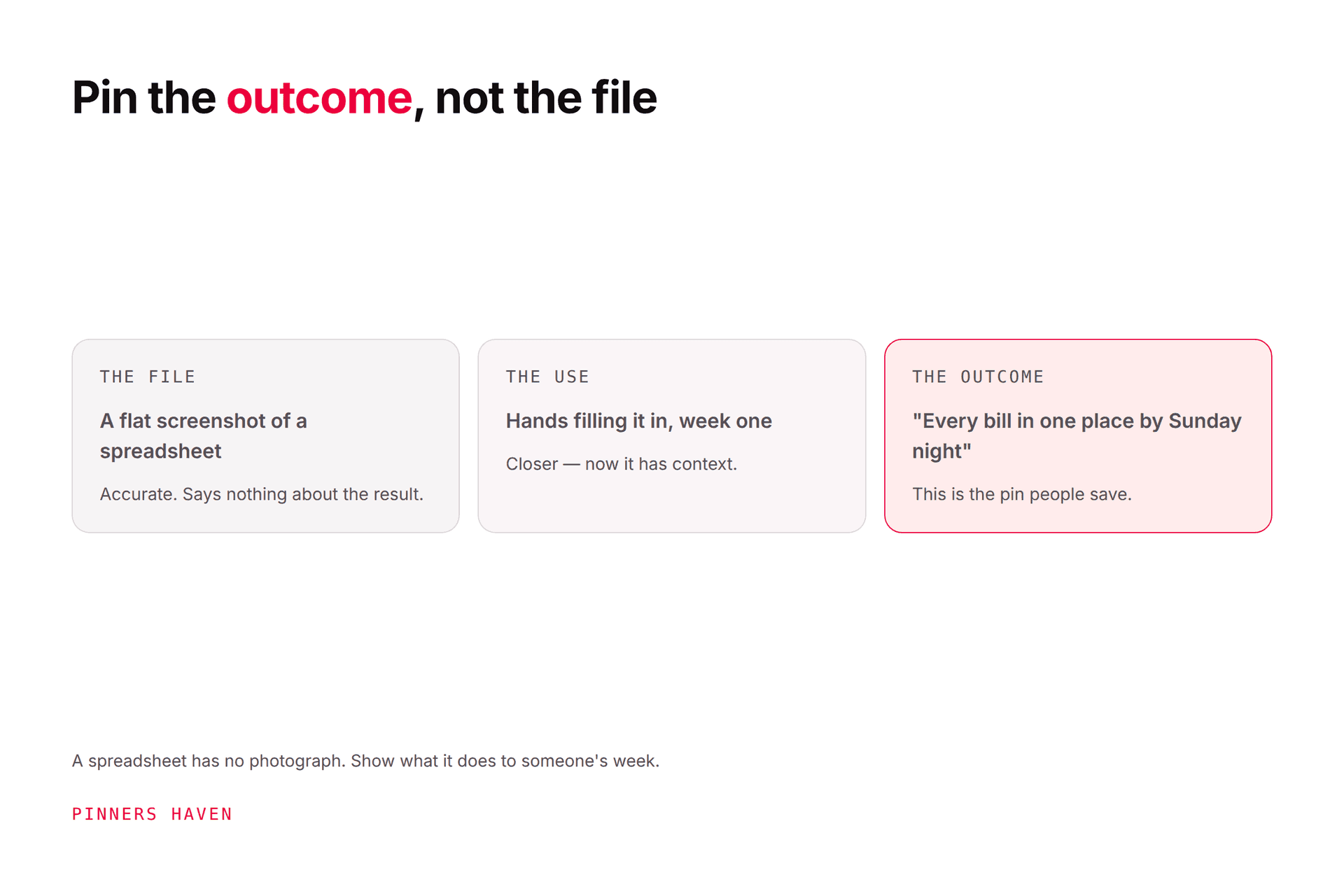
All six are illustrated with type and simple graphics rather than photography, which suits coaches who don't want to be the visual.
The guardrails, which matter here
Coaching sits adjacent to income claims, health claims and regulated advice, and this is the section to read twice.
No income claims. Not yours, not your clients'. Not "my client tripled her salary." If you reference outcomes at all, they must be truthful, typical, substantiated and appropriately qualified, and the FTC has detailed views about earnings representations.
No health, therapy or mental-health outcome claims. If your work borders on therapy, know where the line is in your jurisdiction and stay well clear of it. Coaching is not therapy and implying otherwise is a real risk.
No fabricated or embellished testimonials. Use what clients actually said, with permission, as they said it.
No fake scarcity. "Two spots left" when there aren't is straightforwardly deceptive, and Pinterest's commercial content guidelines prohibit deceptive claims.
Disclose affiliate relationships if you recommend tools.
Financial, legal or medical adjacency puts you in YMYL territory, where credentials and sources need to be visible.
Get proper advice for your jurisdiction and your modality. This is orientation, not a legal opinion.
The commercial argument for restraint: coaching buyers are sophisticated and have usually been burned. Honest, specific, unhyped content outperforms transformation language with exactly the people you want.
A 90-day plan
Weeks 1–2. Write one genuinely excellent free resource. Not five mediocre ones. Build the opt-in page and test it end to end, including the delivery email.
Weeks 3–4. Write six pages answering six specific client questions, each linking to the resource.
Weeks 5–8. Three or four distinct pin concepts per page. Publish steadily, not in a burst.
Weeks 9–12. Write the email sequence, if you haven't. Five to seven emails that continue being useful before anything is offered.
Then wait. Coaching enquiry cycles are long and cluster seasonally around January and September, so a single quiet month proves nothing.
Where solo coaches stall
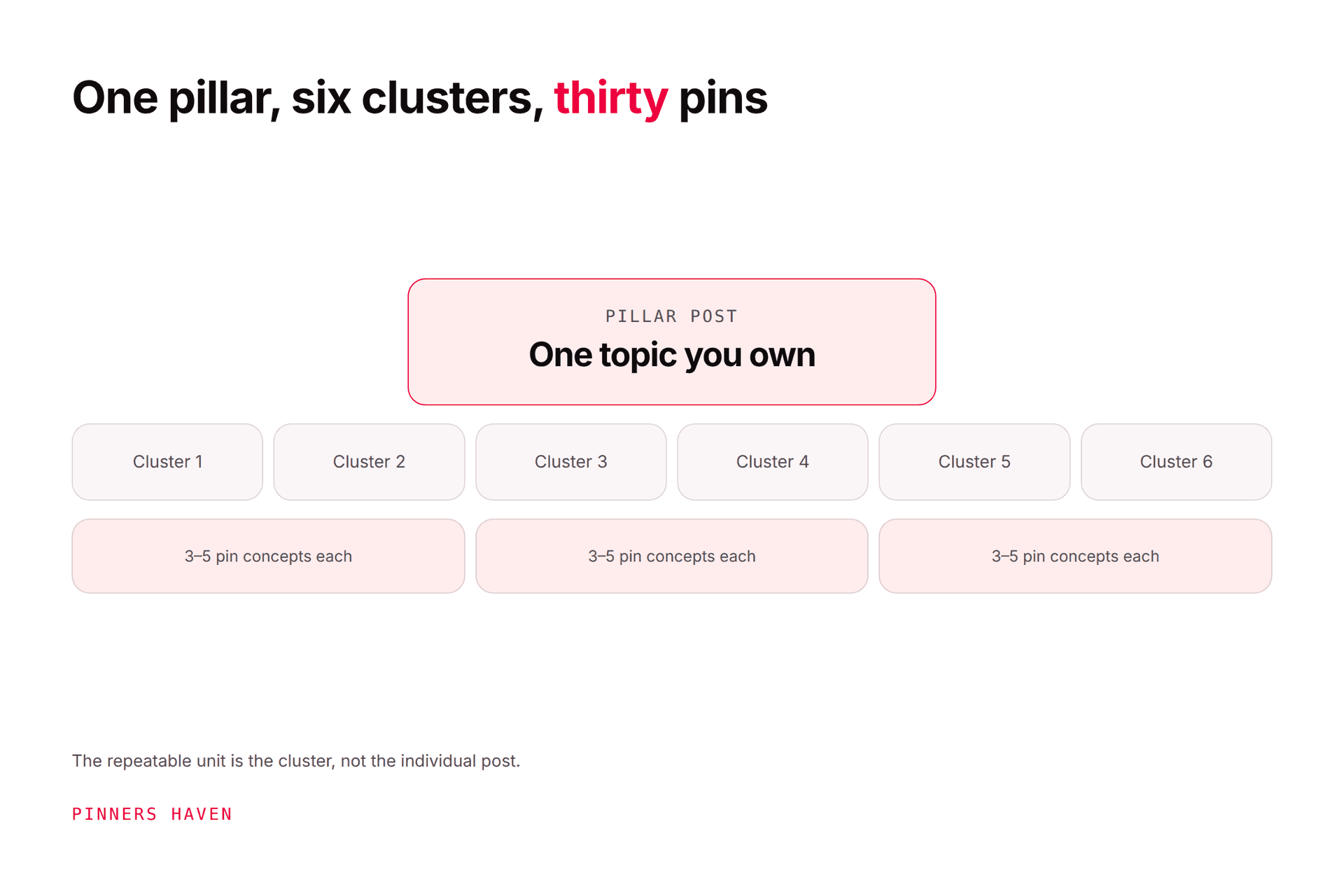
Six pages at four concepts each is 24 pins, which is fine. The trouble is that the coaching business itself is the job, and Pinterest is the thing that happens when there's a gap, which means it happens in January and then not again until May.
That inconsistency is the actual failure mode here. Not strategy, cadence.
Pinners Haven covers the production and publishing half: up to 20 angles per topic, an SEO title with three to five unique descriptions per pin, original designs on human-designed templates, and paced publishing through official OAuth with nothing going live until you approve it. The Freshness Meter retires designs after roughly five to ten uses. Solo is $41/mo billed annually for 3 sites and 900 pins a month, with a 14-day trial; no card is needed, and when it ends publishing pauses until you pick a plan.
What it cannot do, and for coaches this is the important part: it doesn't write your free resource, build your email sequence, or supply the judgement about what your clients actually need to hear. Those are the parts that convert, and they're irreducibly yours.
(Disclosure: we make Pinners Haven. We're not affiliated with Pinterest.)
Frequently asked questions
Does Pinterest work for coaches?
As a lead-generation channel, yes, particularly for coaches with a specific niche and a genuinely useful free resource. As a direct booking channel it works poorly, because coaching is a high-trust purchase and a pin can't build that.
Should coaches link pins to their booking page?
No. Link to a free resource that solves one specific problem, capture the email, and build trust before asking for a call. Direct-to-calendar links from cold Pinterest traffic convert very poorly.
What should a coach's Pinterest free resource be?
Something that solves one small problem completely: a set of questions, a script for a hard conversation, a decision framework, a one-page tool. Broad "tips" newsletters convert far worse than a narrow, obviously useful asset.
How do I get coaching clients from Pinterest?
Publish content about your client's problem rather than your methodology, offer a specific free resource, nurture by email, and invite a conversation once you've been useful several times. The pin's only job is to earn the click.
Can I share client results on Pinterest?
Only if they're truthful, permitted, appropriately qualified and not presented as typical when they aren't. Avoid income and health outcome claims entirely. This is the most common way coaches create legal exposure.
What kind of pins work for coaches?
Type-led graphics: question lists, scripts, frameworks, checklists and myth corrections. Coaching content is verbal, so the pin's job is to make a specific promise legible at thumbnail size rather than to look beautiful.
How long before Pinterest generates coaching leads?
Expect a season rather than a month, with enquiry peaks around January and September for many coaching niches. Build the email list first so that early traffic isn't wasted while trust accumulates.
Be useful first, at length
The coaching market is crowded with people promising transformation and short on people giving away something that actually works.
Pinterest rewards the second kind, because a genuinely useful resource gets saved, and a saved pin keeps working for years. Write the thing you'd be slightly nervous to give away free, put it behind an email address, and let it do the convincing you can't do in an image.