How to Grow on Pinterest From Zero (First 90 Days)
To grow on Pinterest from zero, spend the first 90 days building a library of original pins, each aimed at a real search and pointing at a page worth visiting, at a weekly cadence you can keep, and judge progress by saves and then outbound clicks rather than followers.
JN
Joe Nyambura
Founder & operator, Pinners Haven · August 17, 2026
You made the account last Tuesday. It has twelve followers, most of them people you know, and your first pins have single-digit impressions. Every "how to grow on Pinterest" guide you open seems to assume you already have traction and just want more. Breathe. Starting from zero is its own problem, and it has a shape you can plan around.
To grow on Pinterest from zero, spend the first 90 days building a library of original pins, each aimed at a real search and pointing at a page worth visiting, at a weekly cadence you can keep, and judge progress by saves and then outbound clicks rather than followers. Pinterest itself says to treat followers as "a supporting metric," to add original content every week, to fill in every pin field, and that there's "no set engagement window," so a pin can gain traction days or months after publishing. Expect impressions to move first, saves a few weeks later, clicks after that, and followers last. Judge the account at day 90, not day 10. Here's what moves when, what to do in each phase, and what "good" looks like at day 90 in honest ranges.
What "growth" means on Pinterest (it's not followers)
Pinterest published its own view of growth in The best ways to grow on Pinterest (January 2026), and the headline is the line about followers: "view followers as more of a supporting metric or nice-to-have." It tells creators to focus on saves, impressions, pin clicks, and outbound clicks instead. That's not modesty; it's how the platform works. Pinterest distributes pins by search and interest, so a pin from an account with 12 followers can reach the same searcher as a pin from an account with 12,000. Is Pinterest social media? explains why that single fact changes everything about how you grow here.
So "growing on Pinterest" means one thing: more of your pins being shown to, saved by, and clicked on by people searching for what you make. Pinterest's growth recommendations are all in service of that:
Add relevant keywords to the title and description of every pin, and fill in all the fields; Pinterest's audience-building guide says "Generally, we recommend filling in all of the Pin fields, every time you create one" and "Always add topics when it's an option."
Add more content every week. Fresh pins "help you reach new people regularly."
Curate into themed boards with proper titles and descriptions, and save pins to relevant boards that have already gained engagement.
Create savable, actionable content and ask for the save; saves drive future impressions.
Use trends, which Pinterest says last nearly twice as long as on other platforms.
Everything in the plan below is those six things, sequenced for an account that has nothing yet.
What moves first: a realistic timeline from zero
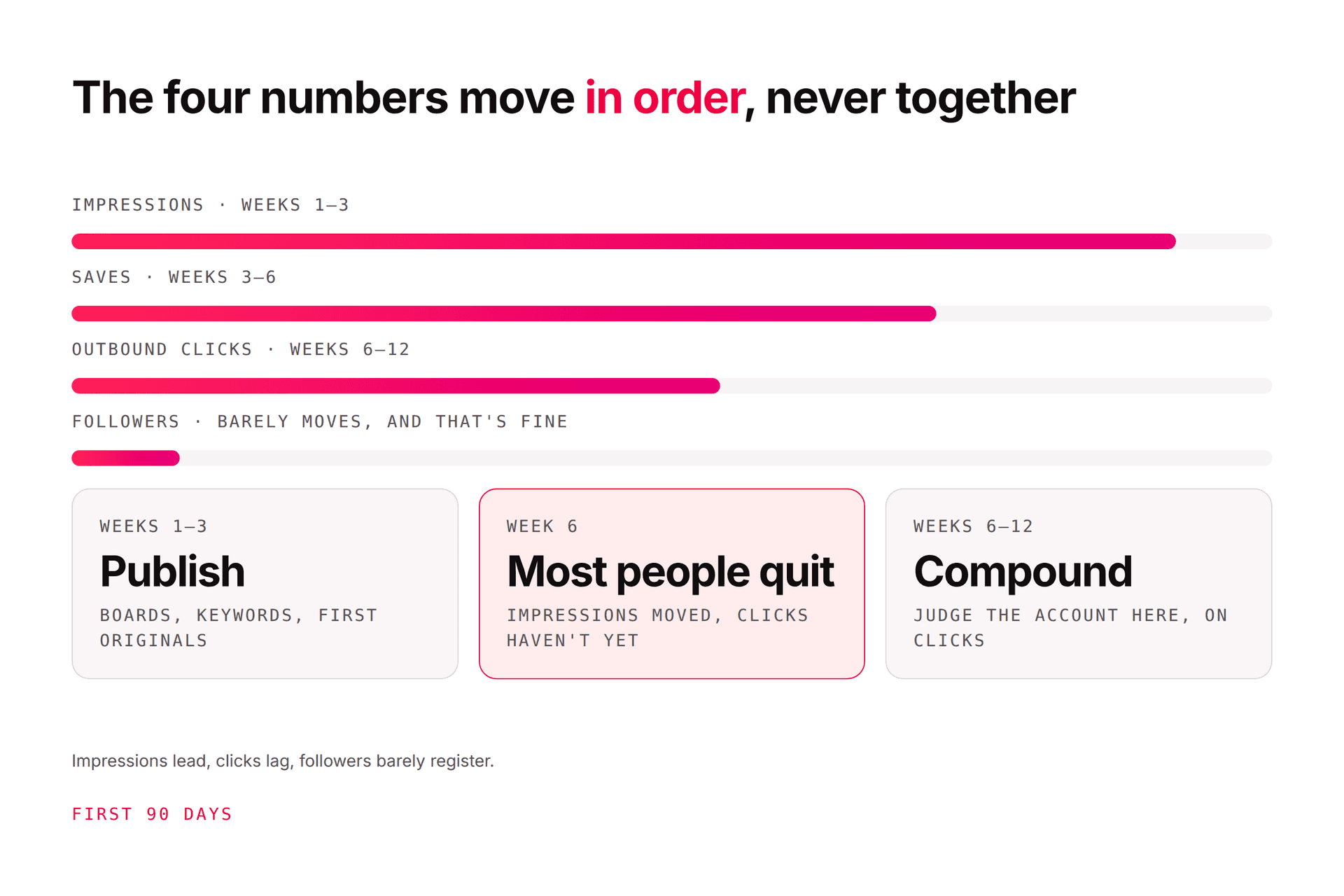
Here's the thing nobody tells you, and the reason most new accounts quit: the metrics don't move together. Pinterest's help centre says there's "no set engagement window"; a pin "can gain engagement hours, days, months, or even years after it's first published." On a brand-new account, from what we've seen across thousands of scheduled pins, the usual order looks like this. Niche, seasonality, and destination quality stretch or compress it; no one can promise the dates.
Metric
When it usually starts moving on a new account
What it means
Impressions
Weeks 1–3, a trickle, then uneven
Pinterest is testing your pins against searches. Noisy; don't read it daily
Saves
Weeks 3–6
People want it later. The first real signal that a topic and a visual work
Pin clicks
Weeks 3–8
Close-ups; interest in the promise
Outbound clicks
Weeks 6–12
The one that matters; traffic to your page
Followers
Last, slowly, as a by-product
A lagging indicator. Ignore it for 90 days
Two consequences. First, in weeks 1–2 your dashboard will look like nothing is happening, because nothing measurable is yet; that's normal. Second, at week six you'll have made the obvious pins, the numbers will still be small, and every guide will be telling you to "stay consistent." That's the moment the plan below is built to carry you through.
Phase 1 (days 1–14): foundation, and don't open Analytics
Get the account right once, so the library has somewhere to live.
Business account, claimed website.The setup guide has the steps. Claiming unlocks analytics for your domain and attribution on your pins.
Ten search phrases per board, from Pinterest's own search bar: autocomplete as you type, and the guided-search refinements under the bar after you search. Pinterest keywords if you want the full method; the search bar is enough for week one.
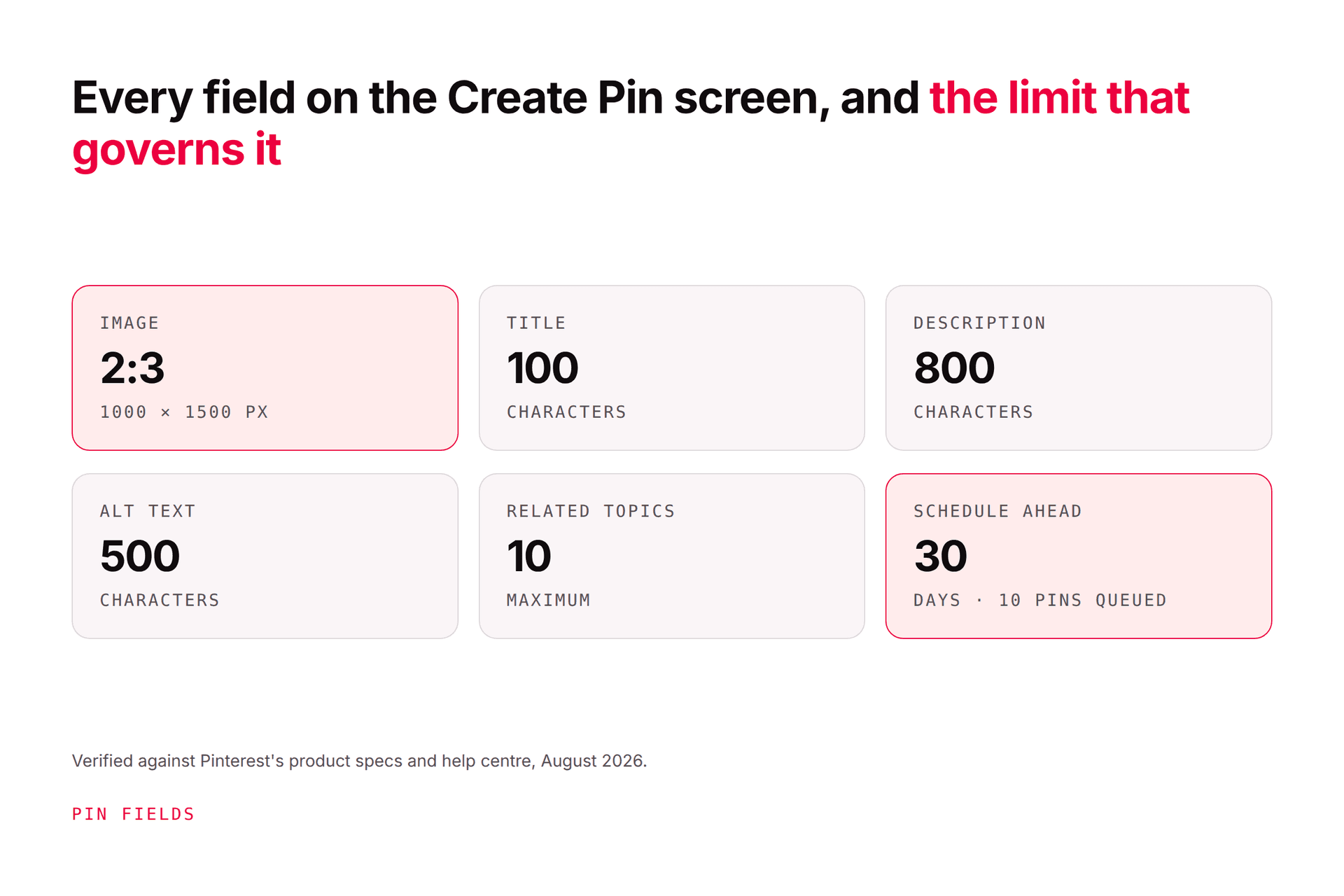
Your first ten original pins. Each a 2:3 image, title under 100 characters with the phrase front-loaded, a real description (not a keyword list), alt text, topics tagged, the exact page linked, the most specific board chosen. How to use Pinterest for business walks every field.
Do not open Analytics. There's nothing to learn yet, and a 4-impression pin on day three will make you change things that aren't broken.
You might be thinking, "ten pins in two weeks is nothing." It's ten more than most accounts have at two weeks, and every one of them is still working in month six.
Phase 2 (days 15–45): build the library
This is the phase that decides the account, and it's unglamorous: three to five original pins a week, every week. Pinterest's written guidance is weekly fresh content; the "15–25 a day" number comes from a 2020 webinar and how often to pin works through why a new account can't honestly sustain it anyway.
What "original" means matters more than the count. Each pin should be a different angle on a page, not the same graphic with a new background: a different search phrase, a different image, a fresh description. One good page can carry five to twenty honest angles over time; fresh pins on Pinterest draws the line between "fresh" and "clone." By day 45 you're aiming for 30 to 40 original pins across your boards.
Three habits from Pinterest's own guidance to build in now:
Save each pin to the most relevant board, and once a board has engagement, favour it. Pinterest says to save to "any relevant, existing board that has already gained engagement."
Make one pin a month around a trend.Pinterest Trends shows normalised interest (not volume); pick a seasonal topic four to six weeks before its peak.
Ask for the save in the description where it's natural ("save this for your next repot").
And three things not to do, because they feel like growth and aren't: don't repin other people's content as a strategy (distribution and clicks go to them), don't join follow-for-follow or "group board" schemes, and don't post in bursts then vanish. Pinterest rewards a steady feed of originals, and its spam systems notice the bursts. Post consistently without burning out is the systems answer.
From week three you can peek at Analytics, but only to confirm that impressions exist. No decisions yet.
Phase 3 (days 46–90): read it weekly, then double down
Now the data is worth something. Once a week, twenty minutes, look at the last 30 days in Pinterest Analytics: which pins earned saves, which earned outbound clicks, which earned impressions and nothing else.
Then three moves, every week:
Find the page or concept that's earning saves or clicks and give it three more angles. This is the whole growth mechanism. Pinterest is telling you what it can distribute; make more of that.
Fix the destination of anything earning pin clicks but no outbound clicks. The pin promised something the page didn't deliver fast enough.
Leave the rest alone. Pins mature over months; a quiet pin at day 60 isn't a failed pin.
Start batching with the native scheduler (10 pins, up to 30 days out) so your cadence survives a busy week; how to schedule pins covers it and the free ways past its limits. By day 90 you're aiming for 50 to 70 original pins, a few boards with real engagement, and a clear picture of which topics Pinterest wants from you.
The day-90 scorecard: what "good" honestly looks like
Nobody can give you numbers for your niche, so here's the shape rather than the figure. From what we've seen, a new account that has followed the plan usually has, at day 90:
50–70 original pins across 5–8 boards, all linked to real pages
Impressions in the thousands a month, not millions; uneven week to week
A handful of pins (three to ten) that clearly earn saves, and a pattern among them
Your first outbound clicks, concentrated on one or two topics
Followers that barely moved, which is fine, because Pinterest said so
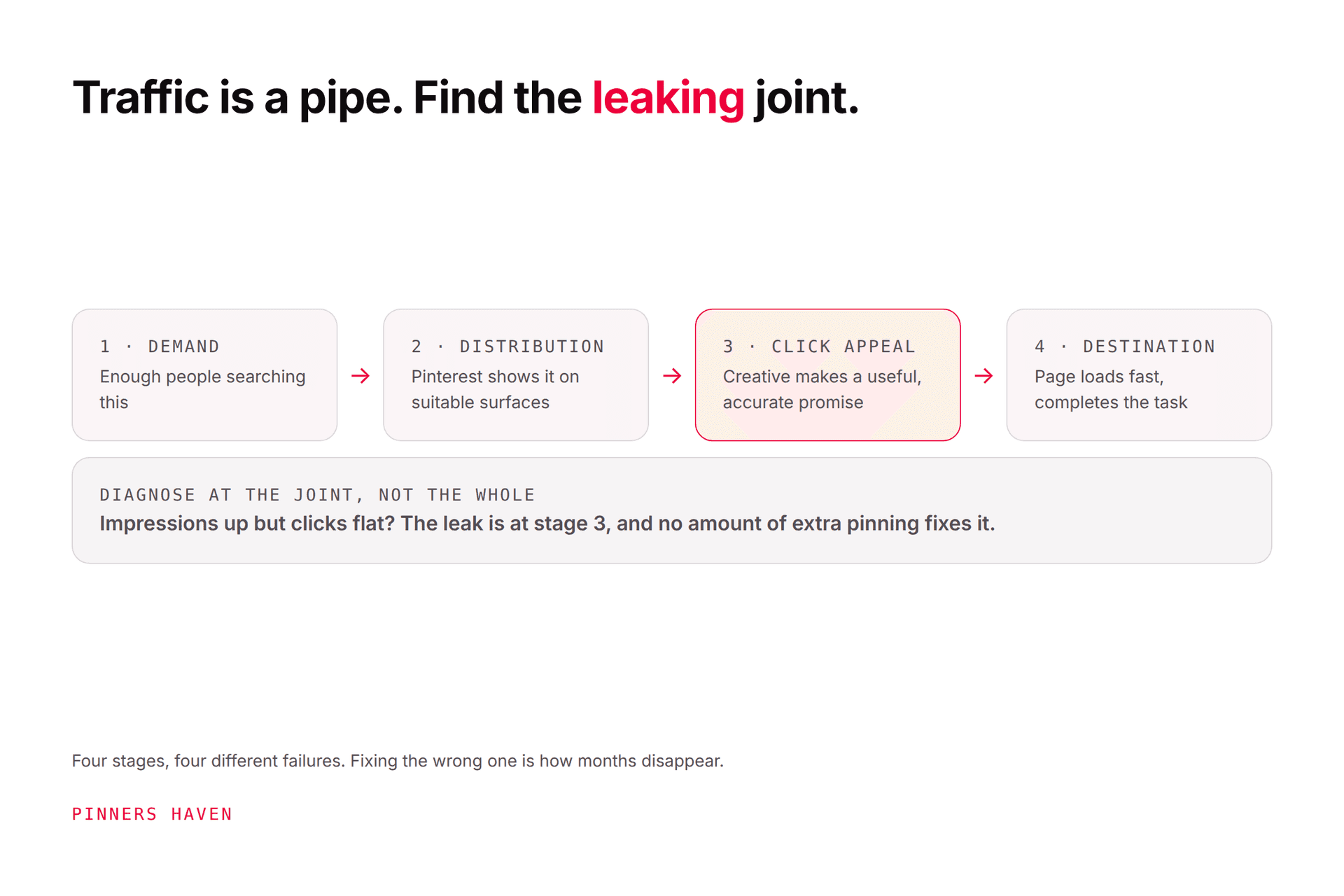
If you've got that, you've grown. Not because the numbers are big but because you now know what to make more of, and the 50 pins you've published keep working while you do. If you've got 70 pins and nothing earns a save, the problem is usually topic fit or destination, not effort; why your impressions are low on new pins is the diagnostic.
Five mistakes that stall new accounts
Judging at day ten. Impressions are noise for weeks. Saves at week six is the first honest signal.
Bursting. Forty pins in a weekend, then silence. Pinterest wants weekly; its spam filters dislike the burst.
Reposting one graphic. Same image, new colour, same link, ten times. That's one concept, not ten pins, and it reads as duplication.
Chasing followers. Follow trains, follow-for-follow, buying followers. Followers don't drive distribution; they're a by-product, and bots get accounts flagged.
Linking to the homepage. Every pin should land on the exact page it promised. A new account can't afford to waste the few clicks it gets.
Where new accounts actually quit, and the honest fix
Week six. The foundation is done, the obvious pins are made, each new one takes an hour, and the chart is still mostly flat. Everyone who has grown a Pinterest account from zero remembers that week, and the ones who got through it did one thing: they kept the library growing with originals when it felt pointless.
That grind is also the part that's mechanical enough to hand off. Pinners Haven takes a page or a topic and writes a keyword-led title and three to five distinct descriptions per pin, designs an original image on a human-designed template, and publishes on a paced, account-safe cadence, including a gradual warm-up for new accounts so a fresh profile doesn't go from zero to forty pins overnight. You approve each pin, you pick the boards, and you still do the Phase 3 reading; it keeps Phase 2 from being the place you stop.
(Disclosure: we make Pinners Haven. We're not affiliated with Pinterest.)
Frequently asked questions
How long does it take to grow on Pinterest?
Expect the first impressions within a couple of weeks, the first saves around weeks three to six, and the first outbound clicks around weeks six to twelve on a new account, with pins continuing to gain traction for months. Pinterest says there's no set engagement window. Judge a new account at 90 days on saves and outbound clicks, not at ten days on impressions, and expect your niche and season to stretch or compress those ranges.
How many pins a day should a new account post?
None daily, necessarily. Three to five original pins a week, every week, is a sustainable start; Pinterest's written guidance asks for fresh content weekly, not a daily quota. The "15 to 25 a day" figure dates from a 2020 webinar and would exhaust a new account's honest supply of original ideas in days. Consistency and originality grow accounts; bursts and reposts stall them.
Do you need followers to grow on Pinterest?
No. Pinterest distributes pins by search and interest rather than follower count, and it describes followers as a supporting metric. A new account with twelve followers can reach the same searchers as an established one if its pins match real searches and point at good pages. Followers grow as a by-product of pins that earn saves; they aren't the lever.
Why is my new Pinterest account getting no impressions?
Usually because it's new and pins take weeks to be tested against searches, not because anything is wrong. If it's been more than a few weeks with 30-plus original pins and still nothing, check topic fit (are you targeting phrases people actually search), the boards (named like searches, public), every field filled, and whether you've been bursting or reposting one graphic, which Pinterest's systems discount.
Should a new account join group boards to grow?
Not as a strategy. Group boards were a growth tactic years ago, but Pinterest now distributes by search and interest, and many group boards are low-quality and off-topic, which dilutes the context your pins inherit. Put the effort into your own focused boards and original pins; save pins to your own boards that have gained engagement, as Pinterest itself recommends.
Is it too late to start on Pinterest in 2026?
No. Pinterest reported 640 million monthly active users in Q2 2026, an all-time high, and it distributes by search rather than by who follows you, so a new account competes on pin relevance, not account age. What's harder than it used to be is growing with reposts and tricks; what works is original pins to good pages, which a new account can do from day one.
Build the library, read it in order, don't quit at week six
Growing on Pinterest from zero is a 90-day project with a predictable shape: foundation, library, read-and-double-down. The metrics move in order, the week-six dip is normal, and the account you have at day 90 is the one that keeps growing for a year, because every original pin in it is still out there working.
You've got the timeline and the plan. If the library-building grind is what you'd rather not do by hand, Pinners Haven makes the pins and warms the account up safely while you do the reading.