How Often Should You Pin on Pinterest?
You've read six articles and got six different numbers. One says 25 pins a day, another says 5, a Facebook group swears by 50, and every one of them sounds equally confident. Breathe. The disagreement isn't because the answer is unknowable. It's because almost nobody quotes Pinterest.
Joe Nyambura
Founder & operator, Pinners Haven · August 18, 2026
On this page16 sections
- What Pinterest actually says
- Where "15 to 25 pins a day" came from
- The arithmetic that breaks the daily number
- So what rate should you actually pin at?
- If your account is new
- Consistency is the variable that actually moves
- The limits Pinterest publishes, and the ones it doesn't
- When the bottleneck is production, not strategy
- Frequently asked questions
- How many pins should I post per day on Pinterest?
- Is 25 pins a day too many?
- Does Pinterest limit how many pins I can post a day?
- Should I pin every day?
- Is it better to pin a lot at once or spread it out?
- Does pinning more often make me rank higher?
- Pick a rate you'll still be running in March
You've read six articles and got six different numbers. One says 25 pins a day, another says 5, a Facebook group swears by 50, and every one of them sounds equally confident. Breathe. The disagreement isn't because the answer is unknowable. It's because almost nobody quotes Pinterest.
Pinterest's own written guidance is to publish original content weekly, not daily. Its Pin distribution help page says: "Create Pins frequently and consistently to grow your following and increase your reach. Aim to create original content weekly." There is no official daily quota, and the widely repeated "15 to 25 pins per day" figure does not appear in Pinterest's current documentation. Weekly is the documented floor. Anything above it is your choice, and the right number depends on how much genuinely original creative you can produce, not on a figure from someone else's blog.
That's the short answer. The longer one is more useful, because the popular daily numbers aren't just unsupported. They're in direct conflict with a different rule Pinterest does document, and the arithmetic below shows why.
What Pinterest actually says
Two Pinterest-owned properties give the same answer, which is about as close to official as this topic gets.
Its business help centre, on Pin performance and distribution:
"Create Pins frequently and consistently to grow your following and increase your reach. Aim to create original content weekly."
And the same page, immediately relevant to anyone considering a high daily rate:
"Try not to repeatedly save the same Pins or upload content that already exists on Pinterest. You may get flagged as spam and get temporarily blocked from creating Pins."
Pinterest's creator site says the same thing about cadence, describing consistent sharing as ideally weekly and framing scheduling as the way to turn sporadic posting into a steady cadence.
Read those two quotes together, because that's where the real guidance lives. Pinterest asks for frequent, consistent, original content and warns specifically about repetition. It sets a floor and a hazard, and leaves the middle to your judgement.
Where "15 to 25 pins a day" came from
That number is real, and it did originally come from Pinterest. It circulated from a Pinterest webinar in February 2020, where the guidance reported by attendees was to stay under 50 a day with a sweet spot around 15 to 25.
Two things about it, and this is the part the roundups skip:
It's six years old. Pinterest's distribution model, its stance on duplicates, and its published creator guidance have all moved since. Advice that isn't restated in writing tends to have been quietly retired.
It was a ceiling, not a target. "Don't exceed 50, and 15 to 25 is the sweet spot" is risk guidance for people already pinning heavily. It got reprinted as a daily goal for beginners, which inverts the meaning entirely.
You might be thinking: "But every big Pinterest account pins constantly." Some do. They also have hundreds of destination pages, a design team or a system, and years of library depth. Copying their output rate without their inventory is where accounts get into trouble, and the next section is the arithmetic that shows exactly how.
The arithmetic that breaks the daily number
Here's the thing nobody tells you: a daily pin target is really a daily idea target, and ideas are the scarce resource.
Every pin needs a destination, and each destination only supports so many genuinely distinct concepts before you're just recolouring. Our fresh pins guide works through that line in detail; the working conclusion is that two to four meaningfully different concepts per page is what most content honestly supports. Call it three for planning.
Now run the numbers. Assumption stated plainly: three defensible concepts per destination page.
Pins per day | Pins per month | New destination pages needed per month |
|---|---|---|
1 | 30 | 10 |
3 | 90 | 30 |
5 | 150 | 50 |
10 | 300 | 100 |
25 | 750 | 250 |
Two hundred and fifty new pages a month. Nobody is doing that.
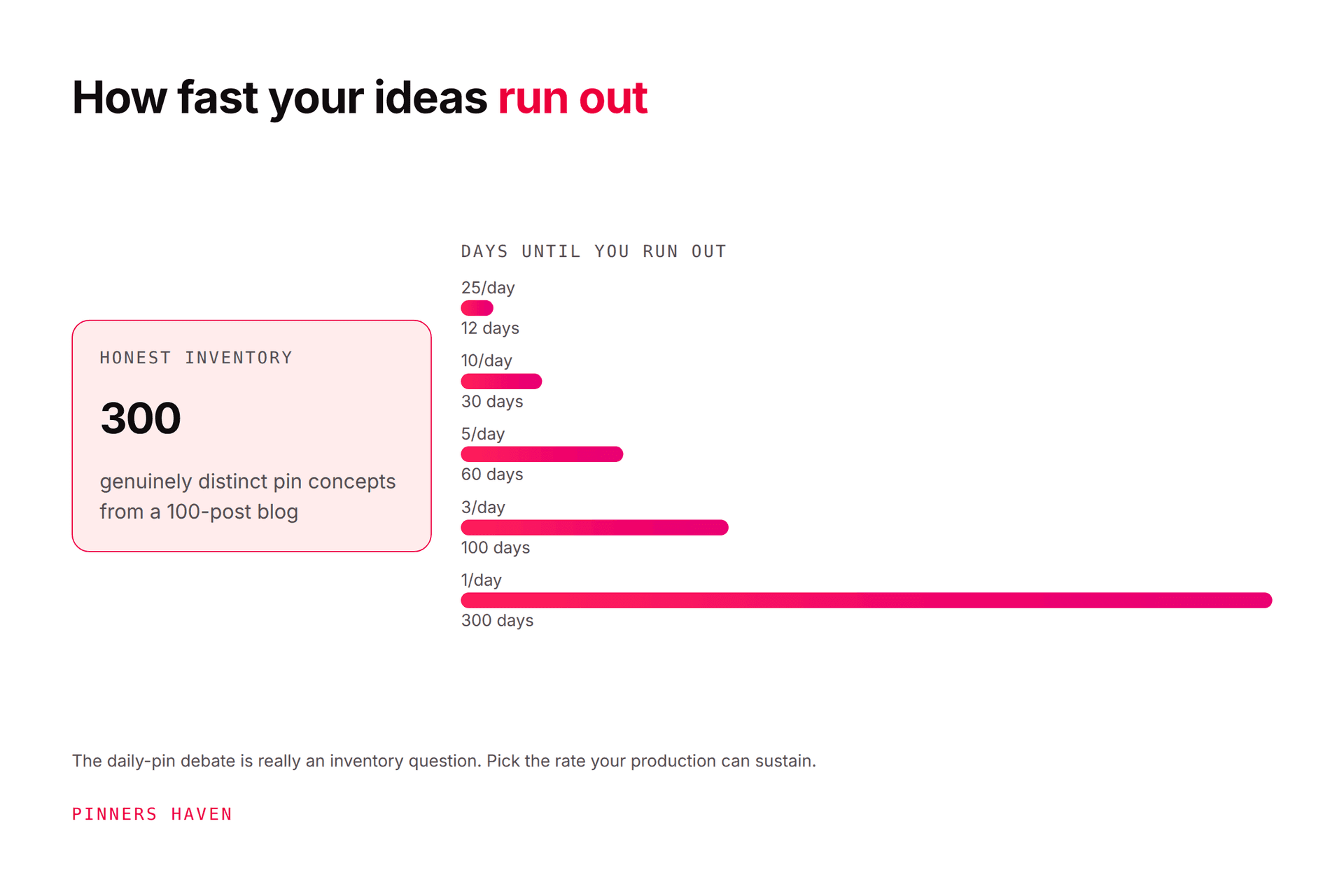
The obvious objection is that you don't need new pages, you can pin your back catalogue. True, and that's exactly the right move. But a back catalogue is a finite tank, not a tap. Take a blog with 100 published posts, which is a substantial site. At three concepts each, that's 300 honest pin concepts in total, ever.
Publishing rate | Days until the entire library is exhausted |
|---|---|
25 per day | 12 days |
10 per day | 30 days |
5 per day | 60 days |
3 per day | 100 days |
1 per day | 300 days |
At 25 pins a day, a 100-post blog runs out of things to honestly say in under a fortnight. After that, every additional pin is either a duplicate, a recolour, or a promise the page doesn't keep. All three are the behaviour Pinterest's own documentation warns will get you flagged.
That's the whole problem with volume-first advice. It doesn't fail because Pinterest hates frequent posting. It fails because it forces you into the one behaviour Pinterest explicitly penalises, and it does it in about twelve days.
So what rate should you actually pin at?
Work backwards from inventory. The formula is unglamorous and it works:
Sustainable daily rate = (honest concepts in your library) ÷ 90
Ninety days, because that's roughly the window you need to judge whether Pinterest is working for you at all, and you want to reach the end of it still publishing.
Your library | Honest concepts | Sustainable daily rate |
|---|---|---|
20 posts | ~60 | under 1 per day |
50 posts | ~150 | 1 to 2 per day |
100 posts | ~300 | 3 per day |
300 posts | ~900 | 8 to 10 per day |
1,000 posts | ~3,000 | 25 per day, sustainably |
Notice that 25 a day is a perfectly reasonable rate. For a site with a thousand posts. The number was never wrong in isolation, it was just detached from the only thing that makes it safe.
Then add whatever you publish new each month, at three concepts a piece. Four new posts a month buys you an extra 12 concepts, which is about 0.4 pins a day. That's the real growth rate of a one-person operation, and it's worth knowing before you commit to a schedule you'll abandon in week three.
If your account is new
Warm up. A brand new account publishing 20 pins on day one looks materially different to Pinterest than an established account doing the same thing, and new accounts have no track record to cushion them.
Start at one to three a day, hold it for a few weeks, and raise it gradually. The account-safety mechanics behind that are covered in our guide to safe Pinterest automation, and the warning signs to watch for are in what to do when you're flagged as spam.

Consistency is the variable that actually moves
The shape of your publishing matters more than the total. Three pins a day, every day, is 90 a month. Forty-five pins on two frantic Sundays is also 90 a month. They are not equivalent. The first is the "frequently and consistently" Pinterest asks for. The second is a burst pattern, and bursts of similar content sent to several boards are the most reliable way to trip the duplicate flag.
To be honest about the limits of that claim: Pinterest has not published a study showing steady beats bursty. What it has published is guidance asking for consistency and a warning about repetitive uploads, and burst publishing sits on the wrong side of both.
The limits Pinterest publishes, and the ones it doesn't
You'll find confident numbers all over the web: 2,000 boards, 200,000 pins, 50,000 follows. Worth knowing that Pinterest's own limits page does not state any of them.
Its limits for Pins, boards and follows page confirms that caps exist on boards and on how many accounts you can follow, tells you what to do if you hit one, and declines to publish the thresholds. On pins it is unambiguous in the other direction:
"There's no limit to how many Pins you can create or how many people can follow you."
So there is no daily pin cap to bump against and no total cap to fill. Which means the constraint on your pinning was never a number in Pinterest's system. It's the one in your content library.
When the bottleneck is production, not strategy
Everything above is a planning problem, and planning problems are solvable with a spreadsheet. The part that actually stops people is different.
Say you've done the maths honestly and landed on three pins a day. That's 90 pins a month, each needing a distinct concept, an original image, a keyword-led title, and a description that isn't a copy of the last one. Most people can plan that. Very few can produce it in month four, which is why so many Pinterest accounts have a beautiful first six weeks and then a cliff.
That production gap is what Pinners Haven is built for. It writes up to 20 angles for a single topic so one page yields real keyword surface instead of three recolours, generates an SEO title with three to five unique description variations per pin, designs original images rather than reusing one template, and publishes on a paced, account-safe cadence you set. Its Freshness Meter retires each design after roughly five to ten uses, so a template that's quietly worn out gets rotated before your reach pays for it. Nothing publishes until you approve it.
To be clear about what it does not do: it cannot invent inventory you don't have. If your library honestly supports one pin a day, a tool that produces 25 is a liability, not an upgrade. The arithmetic above is still the part that decides whether this works. Plans start at $19/mo billed annually, with a 14-day trial.
(Disclosure: we make Pinners Haven. We're not affiliated with Pinterest.)
Frequently asked questions
How many pins should I post per day on Pinterest?
There's no official number. Pinterest's written guidance asks for original content weekly and consistent publishing, without specifying a daily figure. A defensible rate is your library's total honest concepts divided by 90 days, which for most single-operator sites lands between one and five a day.
Is 25 pins a day too many?
It depends entirely on your library. For a site with around a thousand posts it's sustainable. For a 100-post blog it exhausts every distinct concept you have in roughly 12 days, after which you're publishing duplicates, and Pinterest documents that repeated uploads of existing content can get you temporarily blocked.
Does Pinterest limit how many pins I can post a day?
Pinterest's limits page says there's no limit on how many Pins you can create. It confirms that caps exist for boards and for accounts you follow but doesn't publish those numbers. The practical constraint is originality, not a daily counter.
Should I pin every day?
Daily publishing is a reasonable target if your content library supports it. It isn't required. Pinterest asks for weekly original content, and a steady weekly rhythm you sustain for a year beats a daily one you abandon in month two.
Is it better to pin a lot at once or spread it out?
Spread it out. Pinterest's guidance emphasises frequent, consistent publishing, and sending batches of similar pins to several boards in a short window is the pattern most associated with duplicate flags. Spacing costs nothing and removes the risk.
Does pinning more often make me rank higher?
Not directly. Pinterest's distribution guidance points to relevance, quality, and original content rather than raw volume, and it notes pins can gain engagement long after publication. Doubling output on the same handful of ideas usually raises your duplicate risk faster than your reach. Our Pinterest algorithm guide covers what distribution actually responds to.
Pick a rate you'll still be running in March
The honest answer to "how often should I pin" is that Pinterest asks for weekly, and everything beyond that is a budget you set against your own creative inventory.
Do the division. Take your published pages, multiply by three, divide by 90, and start there. If that gives you a number smaller than the one you were hoping for, that's not a setback. It's the first realistic Pinterest schedule you've had, and a rate you can actually hold is worth more than one you'll quietly abandon before the algorithm has had time to notice you.