How to Make Money Off Pinterest: 9 Methods That Pay
You can make money off Pinterest by selling Pinterest work rather than Pinterest traffic: as a Pinterest VA ($7–20 an hour, commonly $600–1,500 a month per client), a Pinterest manager (a few hundred to around $1,500 a month per client), a pin designer (from $5–10 a pin at the entry level, far more for specialists), a
JN
Joe Nyambura
Founder & operator, Pinners Haven · August 15, 2026
Most "make money on Pinterest" advice assumes you want to build a blog or a shop and wait a year for traffic. Maybe you don't. Maybe you're good at Pinterest, or could be, and you'd rather get paid for that directly: by the hour, by the pin, by the client, by the template pack. That's a different question with a different answer, and it's the one this page is about.
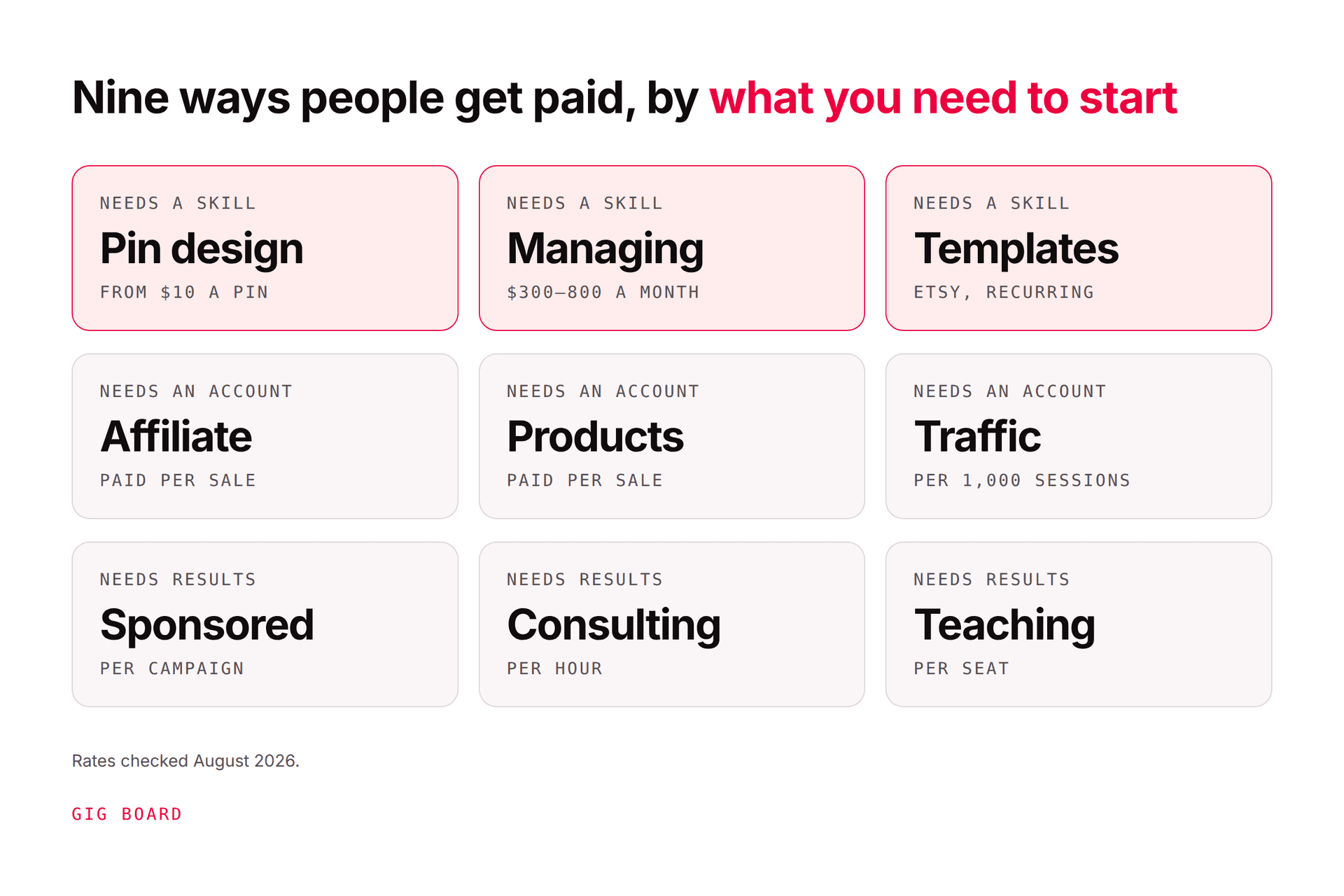
You can make money off Pinterest by selling Pinterest work rather than Pinterest traffic: as a Pinterest VA ($7–20 an hour, commonly $600–1,500 a month per client), a Pinterest manager (a few hundred to around $1,500 a month per client), a pin designer (from $5–10 a pin at the entry level, far more for specialists), a seller of pin templates ($8–13 a pack on Etsy, in volume), an auditor or strategist ($150–950 a session), an ads manager, a sponsored-pin creator, a content creator for brands' own accounts, or a teacher of all of the above. Every one of them starts the same way: a Pinterest account of your own that visibly works. Rates checked August 2026; sources in each section.
Disclosure: we make Pinners Haven, Pinterest publishing software that managers use to run client accounts. We'll say where it fits. This isn't financial or legal advice, and we're not affiliated with Pinterest.
Two ways to earn from Pinterest, and which one this is
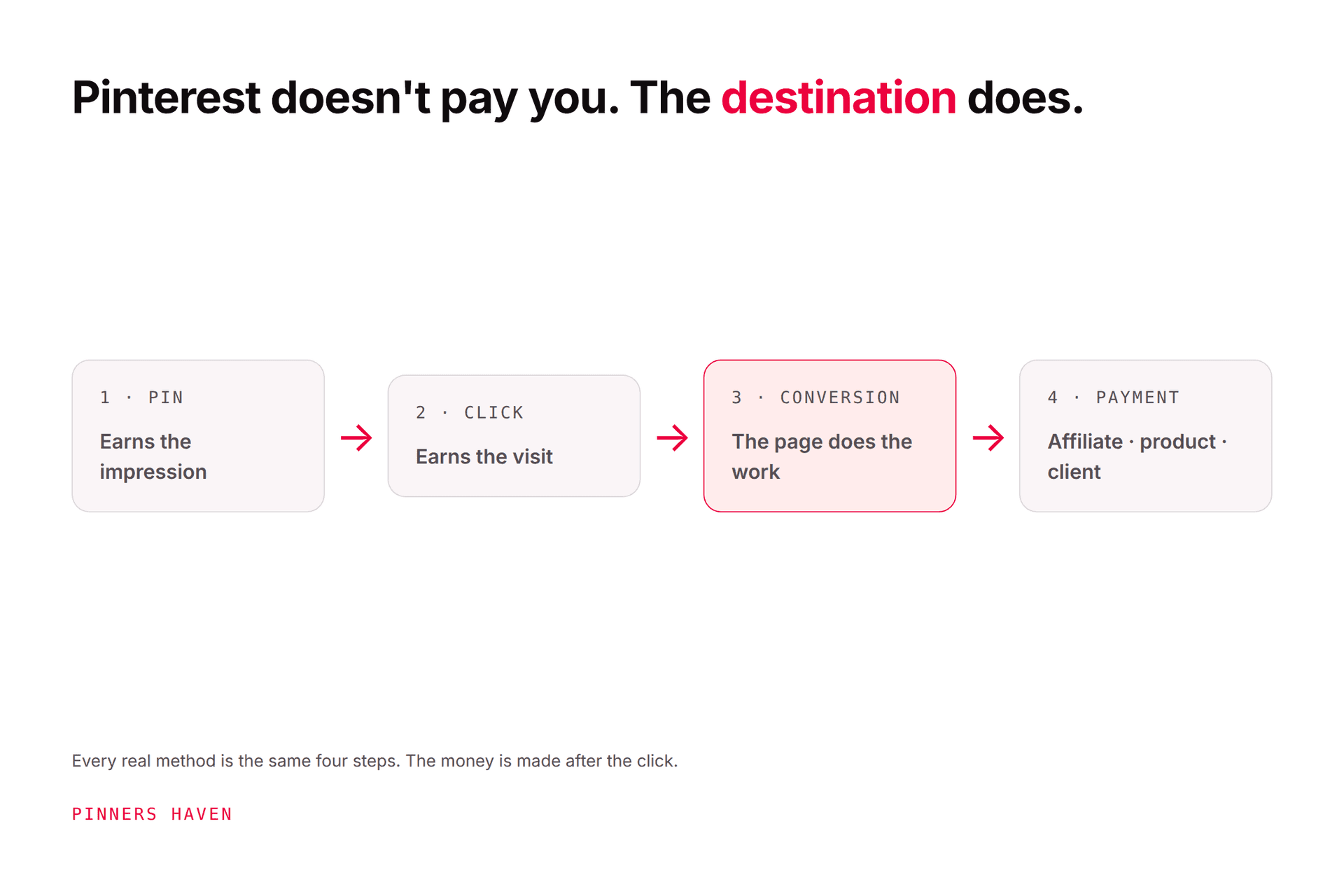
Pinterest money comes from one of two places. Either a pin sends traffic to something you own that earns (a store, a listing, a monetised site, an affiliate offer), or someone pays you for Pinterest work. The first is a business with a long ramp; we cover its seven models in how to make money on Pinterest and the no-blog version in make money with Pinterest without a blog. The second starts paying the month you land a client, which is why it's the one people in a hurry should look at first.
Here are the nine, roughly in order of how quickly you can start.
1. Pinterest virtual assistant
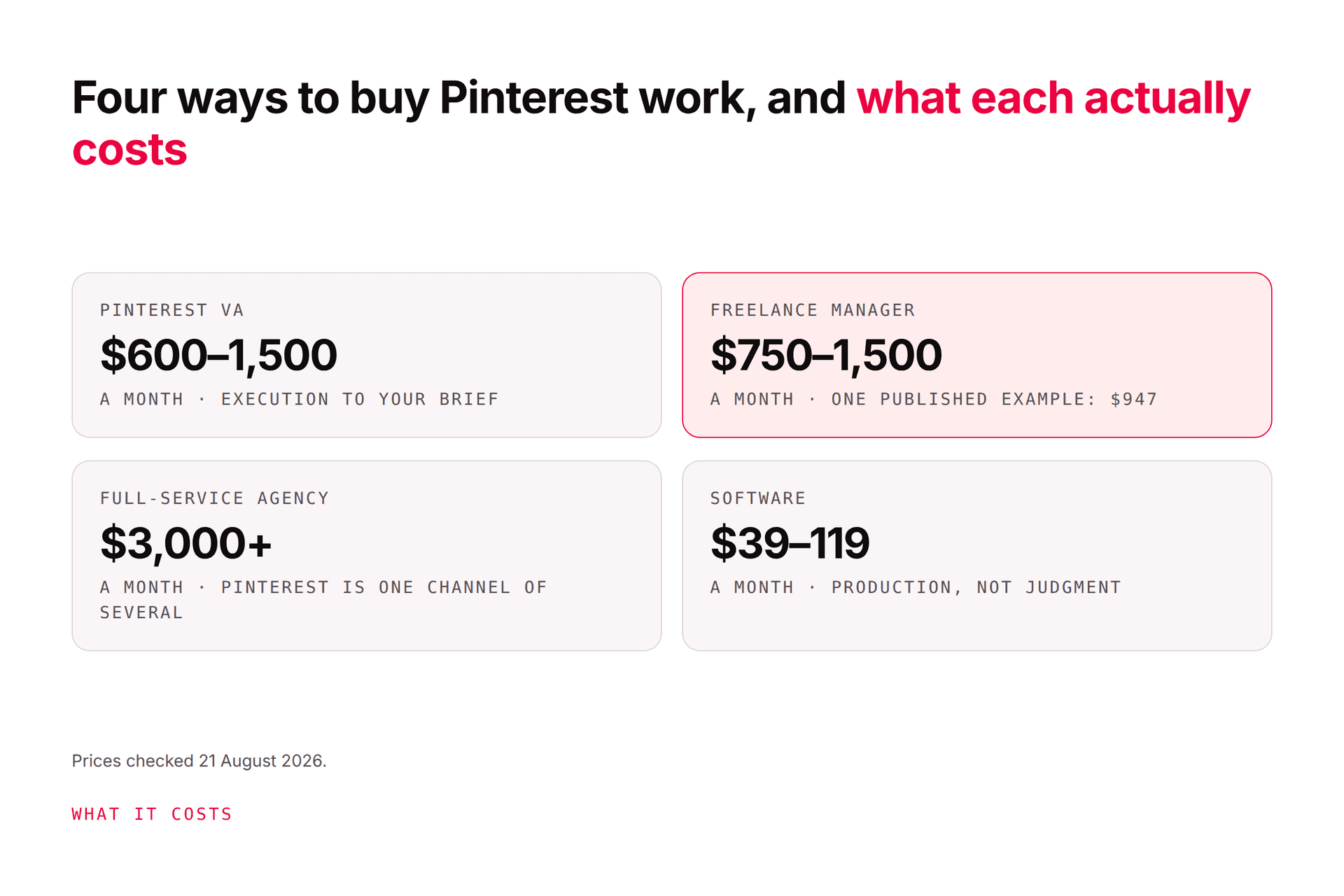
What you sell: execution. Designing pins to a brief, writing titles and descriptions, scheduling, board tidying, basic reporting. Who pays: bloggers, Etsy and Shopify sellers, coaches, small agencies. Going rate: $7–20 an hour, or about $600–1,500 a month per client according to a 2026 rate survey; our own homepage cites $300–800 a month per account as the range clients typically pay. Upwork's median VA rate is around $13 an hour, and US-based VAs charge $25 and up. Start: one paying client from your network, a clear scope ("20 original pins a month, scheduled, monthly report"), and a profile of your own that shows you can do it. The catch: you're paid for hours, and the hours are the tedious part. Most VAs either move up to management (below) or burn out at pin 400.
2. Pinterest manager
What you sell: execution plus judgment: keyword and board strategy, what to publish, reading the analytics, reporting that connects to the client's goal. Who pays: the same clients, once they've realised a VA can't tell them what to pin. Going rate: commonly a few hundred to around $1,500 a month per client, scaling with volume and whether strategy is included. One published example is $947 a month on a six-month commitment plus a $100 setup fee. Above ~$1,500 you're competing with specialist agencies. Start:what a Pinterest manager actually does is the job description; the short version is that the skill rewarded is search thinking, not social media management, and people arriving from SEO do better than people arriving from Instagram. The catch: every client wants results and you can only promise deliverables. Set that expectation in the first call or lose them in month three.
3. Pin designer
What you sell: pins, by the piece or the pack. Static, carousel, video, to the client's brand. Who pays: everyone above, plus agencies subcontracting design. Going rate: the floor is low. Fiverr gigs advertise custom pin design from $5–10 per pin or small pack; experienced designers with a recognisable style and a conversion track record charge many times that. Bulk packages are the norm. Start: a portfolio of 30 pins across three niches, shown at phone size, with a line on what each was for. Pin design ideas and pin design maker cover what makes a pin work at feed size, which is what separates a $5 pin from a $50 one. The catch: "300 pins from four templates" is the thing clients ask for and the thing that hurts their accounts under Pinterest's originality guidance. The designers who last sell concepts, not copies.
4. Sell pin templates
What you sell: Canva (or Photoshop) template packs for pins, on Etsy, Creative Market, or your own shop. Who pays: bloggers and sellers who'd rather DIY than hire you. Going rate: Etsy packs sell at roughly $8 for 10 templates to $13 for 100–200, which is under $0.20 a template. It's a volume business: the money is in many small sales of a few packs, not one big one. Start: one pack that solves a specific job ("20 recipe pin templates that work at thumbnail size") beats a 200-template everything-bundle. Pinterest templates: 100 design briefs is how we think about template jobs. The catch: everyone sells these, and the marketplace takes its cut. Your edge is specificity and a shop that itself ranks on Pinterest, which is also your proof of skill.
5. Audits and strategy sessions
What you sell: an hour or a document. You look at someone's profile, boards, pins, and analytics and tell them what's wrong and what to do first. Who pays: people who'll DIY the execution but can't see their own blind spots. Going rate: published examples run from $157 for an hour's Q&A to $947 for a written audit; a well-known food blogger lists Pinterest consulting at $297 an hour. Call it $150–950 depending on depth and your proof. Start: you need results of your own to point at, and a repeatable checklist: account, boards, keyword fit, pin originality, destination, analytics. The Pinterest SEO checklist is a reasonable spine. The catch: high margin, no recurring revenue. Most people pair it with management (2) or teaching (9).
6. Pinterest ads management
What you sell: running paid campaigns: targeting, creative, budgets, reporting. Who pays: ecommerce brands and course sellers with budget and a page that converts. Going rate: usually a retainer plus a percentage of ad spend, and it varies too much to quote honestly here. It scales with the client's budget, which is the appeal. Start: you need to have run campaigns with your own money first. Pinterest ads vs organic covers the economics a client will ask you about. The catch: ads amplify what's already working. If the client's organic pins don't earn clicks, their ads won't either, and you'll wear it. Qualify hard.
7. Sponsored pins on your own account
What you sell: your audience. A brand pays you to feature its product in pins you publish, tagged with Pinterest's paid-partnership tool. Who pays: brands in your niche. Going rate: third-party rate pages publish tiers like $50–300 per pin under 10k followers up to five figures for the largest accounts, and the one we checked states its figures "are generated algorithmically based on publicly available data and industry benchmarks." Treat them as an anchor for negotiation, not a price list. Brands increasingly benchmark on monthly views rather than followers. Start: an account with real reach in one niche and the business profile that unlocks the paid-partnership tool. Can you actually make money on Pinterest? grades which of these numbers to trust. The catch: this is the one method on the list that needs an audience first. It's a reward for having built one, not a way to start.
8. Content creation for brands' own accounts
What you sell: pins and short videos a brand publishes on its account. The UGC model, pointed at Pinterest. Who pays: brands and agencies who need a steady stream of native-looking pins and don't have an in-house creator. Going rate: priced per asset or per batch, like design (3) but with your face, voice, or hands in it. Quote like a designer with a premium for on-camera work. Start: a small portfolio of pins and 10–20-second videos in the style Pinterest rewards: the idea shown, not the brand shouted. Faceless Pinterest covers the hands-only and diagram formats that brands buy a lot of. The catch: usage rights. Agree in writing what the brand can do with the asset and for how long, or you've sold it forever for one fee.
9. Teach it
What you sell: courses, ebooks, coaching, workshops, a newsletter. Who pays: everyone who wants to do 1–8 themselves. Going rate: anything from a $27 ebook to $297-an-hour consulting, with everything in between. Start: results. Real ones, on your own account or your clients', that you can show. The proof-ladder in our numbers article is the standard your buyers should hold you to, so hold yourself to it first. The catch: this is where the "I make $10k a month on Pinterest" screenshots come from, and the market is rightly suspicious. Teach after you've done it, and say plainly what you earned doing what.
Which one first?
Match the method to what you already have:
You have…
Start with
Time and organisation, no portfolio yet
1. VA, on one client, while you build your own account
Design skill
3. Pin designer, then 4. templates as a product line
SEO or keyword brain
2. Manager, or 5. audits
An audience in a niche
7. Sponsored pins, plus 8. content for brands
A budget and ad experience
6. Ads management
Results you can prove
5. audits and 9. teaching, on top of whatever earned them
Most people stack two: design plus templates, or management plus audits. The stack that scales is management plus software, which brings us to the thing every method above shares.
Your own account is the résumé, and volume is the job
Here's the thing nobody tells you about the gig side: you're selling the ability to make Pinterest work, so your own profile is the interview. Five focused boards, original pins to real pages, visible outbound clicks in your analytics. Build that first, even modestly, with how to use Pinterest for business as the routine.
Then notice what methods 1, 2, 3, and 8 have in common: they're all paid for producing original pins in volume, per client, every month, and that's exactly the work that doesn't scale past about three clients without help. A manager running five accounts by hand is making 100-plus original pins a month, each with a distinct title and description, and that's where most Pinterest service businesses quietly cap out.
That's what Pinners Haven is built for. Per site, it writes up to 20 angles per topic, a keyword-led title and three to five distinct descriptions per pin, designs original images on human-designed templates, and publishes on a paced cadence through Pinterest's official OAuth, so you never hold a client's password. Nothing publishes until it's approved, which is the review gate your client is paying you for. Operator covers 25 sites at $124 a month billed annually; Portfolio covers 50 sites at $291. That's the shape that fits a roster, and it's how a manager charges per client for strategy while the production costs them around five or six dollars a site.
It won't land your clients, set your rates, or supply the strategy they're paying you for. Those stay with you, and they're the reason you can charge.
The rules that keep you in business
Authorised access, never passwords. Clients grant access through Pinterest's business tools or a tool's OAuth connection. A shared password looks like account compromise to Pinterest and can't be cleanly revoked. How to automate Pinterest safely covers the line.
Deliverables, not outcomes. Contract for pins, concepts, hours, reports. Never guarantee reach, followers, rankings, or revenue; Pinterest controls distribution and you don't.
Disclose sponsored and affiliate content in the pin, in plain language, every time. The FTC wants disclosures with the endorsement, not on an About page.
Originality. Don't sell or deliver template clones at volume; it's what Pinterest's guidance on repeatedly uploading existing content targets, and the client's reach is what pays for it.
Usage rights in writing for anything you create for a brand's account.
Frequently asked questions
What's the easiest way to make money off Pinterest?
Pinterest VA work: designing, writing, and scheduling pins to a client's brief, commonly at $7–20 an hour or $600–1,500 a month per client. It needs no audience and no website, only a profile of your own that shows you can do the work and one client from your network. It's also the lowest-paid rung, so most people use it to fund building the skills for management or design.
How much does a Pinterest manager make?
Commonly a few hundred to around $1,500 a month per client, depending on pin volume and whether strategy is included; one published retainer is $947 a month on a six-month term. With four or five clients that's a full-time income, and the ceiling is set by how many accounts you can run well, which is why managers pair strategy with software for production.
Can I make money on Pinterest without followers?
Yes, for most methods on this list. VA work, management, design, templates, audits, ads management, and creating content for brands' own accounts are all paid for skill, not audience. The exception is sponsored pins on your own account, where brands pay for reach. Your own profile still matters as proof of skill, but its follower count doesn't.
Do I need a website to get Pinterest clients?
No. Your Pinterest profile is the portfolio, and a one-page rate sheet or a marketplace listing (Upwork, Fiverr, Etsy for templates) is enough to take payment. A simple site helps once you're charging management rates, mainly as a place for case studies and a contact form, but it isn't the first step.
Is selling Pinterest templates still worth it?
It's a real but crowded market: Etsy packs sell for roughly $8–13 for 10–200 templates, so it's a volume business with a marketplace cut. It works best as a product line alongside design or management, with packs built for one specific job rather than everything-bundles, sold from a shop that itself ranks on Pinterest. As a sole income it's hard.
How do I charge: hourly, per pin, or monthly?
Hourly for VA work while you learn what things take. Per pin or per pack for design, with bulk pricing. Monthly retainers for management, scoped as a number of original concepts and pins plus reporting. Whatever the model, price deliverables you control and never outcomes you don't, and build a 30-day exit into early contracts so a bad fit doesn't cost either side six months.
Get paid for the skill, then decide about the traffic
The gig side of Pinterest pays sooner than the traffic side and teaches you the same things. Start with the method that matches what you've got, build an account that proves it, and charge for deliverables. If you later want the slower, compounding traffic business too, you'll be the rare person who's already run Pinterest for other people first.
You've got the nine doors. If management is the one you walk through, Pinners Haven runs the production line across your client roster while you supply the thing they're really paying for.