Faceless Pinterest: Build a Brand Without Becoming the Face
A faceless Pinterest account is a brand-led profile that doesn't depend on the owner's face, personal life, or on-camera presence. Original graphics, product images, diagrams, photos, checklists, hands-only video — published under a clear business identity.
Joe Nyambura
Founder & operator, Pinners Haven · August 18, 2026
On this page20 sections
- What a faceless account can be
- Step 1 — choose a narrow promise
- Step 2 — set up the account properly
- Step 3 — build a recognisable visual system
- The five formats that work faceless
- Step 4 — publish destinations worth visiting
- Step 5 — plan boards around problems
- Step 6 — run a reviewed weekly workflow
- Where faceless operators hit the wall
- Step 7 — choose a monetisation path
- A 30-day launch
- Nine common mistakes
- Frequently asked questions
- Do I have to show my face on Pinterest?
- Can a faceless Pinterest account make money?
- Is a faceless account anonymous?
- Should I use a personal or business account?
- Can I use AI images on a faceless account?
- How often should I pin?
- Let the work be the personality
A faceless Pinterest account is a brand-led profile that doesn't depend on the owner's face, personal life, or on-camera presence. Original graphics, product images, diagrams, photos, checklists, hands-only video — published under a clear business identity.
Two corrections before the strategy, because the "faceless" niche is full of people selling around them.
Faceless is not anonymous. A Pinterest business profile is public, the platform still requires authentic non-deceptive behaviour, and if you're making commercial claims you may have legal disclosure duties regardless of whether your face appears anywhere.
Faceless is not a business model. It's a production choice. It removes a barrier for people who don't want to be on camera; it doesn't remove the need for a real niche, useful destinations, and an offer that converts. Nobody's income is guaranteed by not showing their face.
With those straight, it works genuinely well, and Pinterest is the platform where it works best, because the content was never about you in the first place.
What a faceless account can be
a recipe publication using food photography
an interiors brand using room images and diagrams
a craft business using hands-only demonstrations
a software company using screenshots and workflows
a travel publisher using licensed destination photography
a product-curation site using original comparisons
an educational brand using charts and checklists
What it must not be: an impersonation of an expert, customer, celebrity, or invented founder. Pinterest's Community Guidelines prohibit accounts that impersonate or misleadingly represent affiliation with a person or organisation.
"Faceless brand" is fine. "Fictional woman named Sarah who tested all these products" is not, and it's the line people cross without thinking about it.
Step 1 — choose a narrow promise
Complete this sentence:
We help [specific audience] achieve [specific outcome] with [type of useful content].
"Home inspiration" is too broad to build anything on. "Rental-friendly storage plans for small apartments" hands you boards, destinations, visual formats, and products to evaluate.
Choose a niche with recurring search questions, enough visual material you can create or license, destinations that add more than the pin does, a realistic revenue path, and either expertise or a documented research process.
Our niches guide helps with the shortlist, though no niche guarantees traffic or income, and anyone presenting one as a sure thing is selling a course.
Step 2 — set up the account properly
Pinterest's business account guide confirms business accounts provide the Business Hub and Analytics. The profile is public.
Use a distinctive brand name, a logo or recognisable symbol, a plain-language bio, a username close to the brand, a verified destination website, and a professional contact address.
Pinterest says public profile information can include photo, name, bio, pronouns, website, username, and business contact details; its personal-data guide separates that from private account data.
You can keep your face off the profile. You cannot hide who is responsible for commercial claims where law or platform rules require identification.
Step 3 — build a recognisable visual system
Three to five repeatable templates. Not one copied forever, and not a new look every week — both fail, in opposite directions.
Define: two typefaces, a small colour palette, safe logo placement, headline length, image treatment, source and product-label rules, a mobile text-size minimum, and photography standards.
The five formats that work faceless
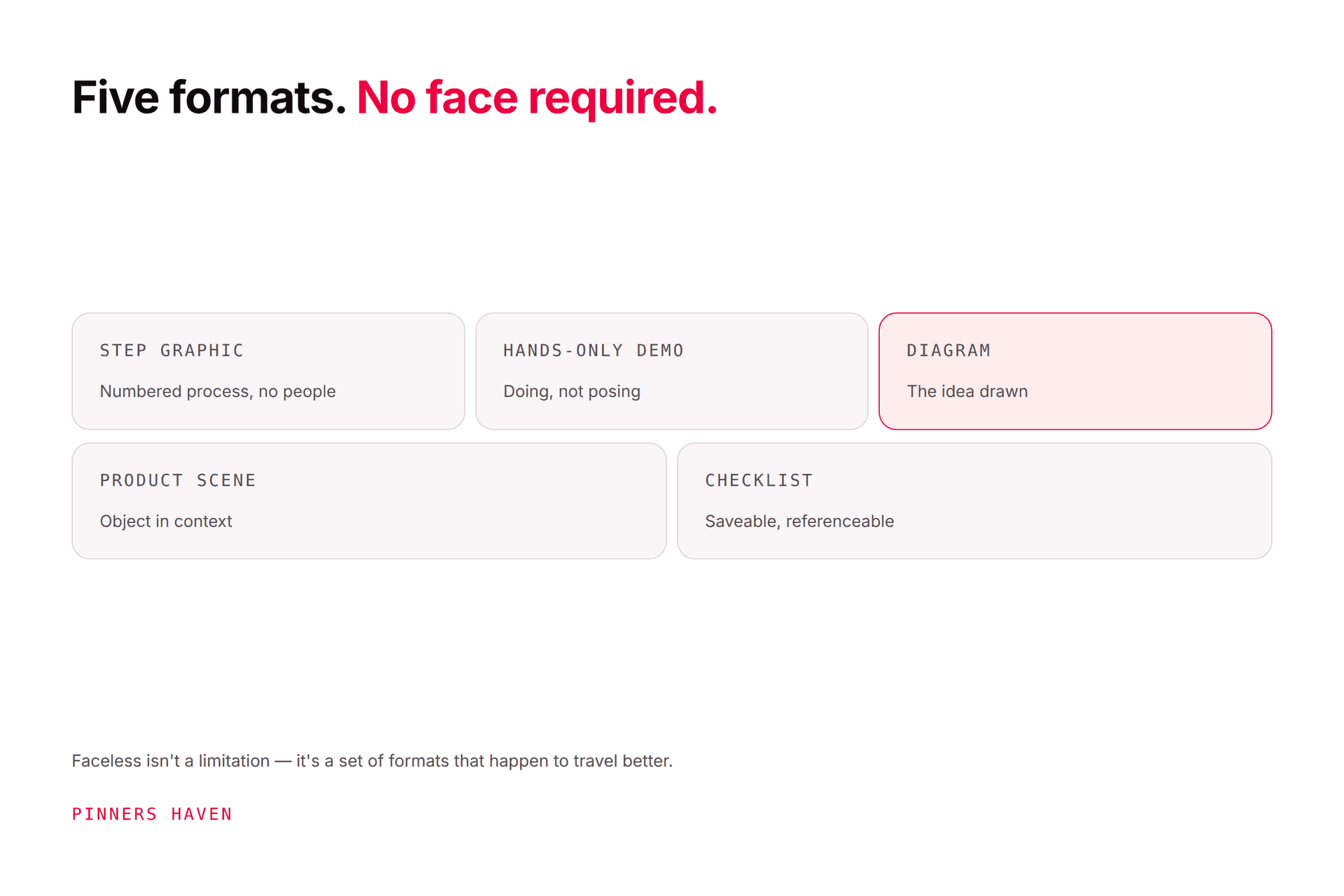
Step graphics: a process in three to five clear stages, linking to detailed instructions.
Before-and-after layouts — only genuine transformations, with permission and matching conditions. Never fabricate results with generated images. This is the single fastest way to destroy a faceless brand's credibility, because you have no personal reputation absorbing the damage.
Hands-only demonstrations — film the object, screen, recipe, or craft with the presenter off camera. Caption for sound-off viewing.
Diagrams and checklists — answer a focused question, then offer the printable, calculator, or full explanation on the destination.
Product scenes and comparisons — owned or licensed images, affiliate and sponsored relationships disclosed, prices matched to the live destination.

Step 4 — publish destinations worth visiting
This is where a faceless brand earns the trust a face would otherwise carry, and it's not optional.
Pinterest's spam rules require linked websites to be safe, trustworthy, original, and valuable. A faceless account cannot lean on generic pins pointing at thin, copied, or ad-heavy pages — there's no personality holding it together, so the work has to.
Each destination needs a direct answer near the top, original instructions or tests or data or photography, clear editorial responsibility, source links where claims need support, updated facts, fast mobile loading, and a next step matching the pin's promise.
Claim the domain via Pinterest's claim process.
Step 5 — plan boards around problems
Boards should reflect audience problems, not internal departments. A small-apartment brand:
Small Bedroom Storage
Rental Kitchen Organisation
Entryway Ideas for Apartments
No-Drill Wall Storage
Studio Apartment Layouts
Publish several destinations within a cluster before expanding to the next. That builds a coherent library and makes performance interpretable.
Step 6 — run a reviewed weekly workflow
Select two proven audience questions.
Update or create the destination pages.
Produce three materially different pin concepts per page.
Review rights, facts, spelling, link, board, disclosures.
Schedule the six approved pins with spacing.
Check delivery and outbound results.
Where faceless operators hit the wall
Step 6, repeated, is the entire model, and it's uniquely brutal for faceless brands.
A creator-led account can post a phone video and it's on-brand. A faceless brand can't. Every single pin has to be designed, because design is the whole identity. Three original concepts a week, forever, with no shortcut available.
That constraint is why so many faceless accounts look excellent for two months and then go quiet.
Pinners Haven exists for that shape of problem: twenty angles per topic, an SEO title and three to five unique descriptions per pin, original designs built on human-designed templates so the output stays on-brand rather than reading as generic AI, and a Freshness Meter retiring each template after roughly 5–10 uses. Portfolio operators running several faceless sites are the specific case Operator ($124/mo, 25 sites) and Portfolio ($291/mo, 50 sites) are built around.
The review gate matters more here, not less. Generated imagery and commercial claims on a faceless account carry more risk precisely because there's no personal voice for a reader to calibrate against. Nothing publishes without your approval.
→ Start a 14-day trial — from $19/mo billed annually. No card needed; when the trial ends, publishing pauses until you pick a plan.
(Disclosure: we make Pinners Haven. We're not affiliated with Pinterest.)
Step 7 — choose a monetisation path
Affiliate — original comparisons, use-case guides, tested recommendations, commissions disclosed clearly. See our affiliate guide.
Products or services: your own shop, booking page, software, course, or templates, when they directly solve the searched problem. Keep price, availability, contact, refund, and delivery details easy to find.
Advertising or sponsorship — only after building real traffic and an identifiable audience. Disclose material relationships in both the pin and the destination.
Email — offer a relevant checklist, calculator, or mini-course rather than a generic signup. Say what subscribers get and protect their data.
Revenue depends on qualified traffic, offer fit, conversion, margins, and cost. Never publish a profit promise in a profile or a pin.
A 30-day launch
Week 1 — audience promise, business identity, domain, profile, five boards, brand templates, and a rights log.
Week 2: three strong destination pages, two or three concepts each.
Week 3 — publish a reviewed, spaced calendar. Test links and mobile pages after every release.
Week 4 — compare impressions, saves, pin clicks, and outbound clicks in Analytics against site sessions and conversions. Pick the next cluster from evidence.
Nine common mistakes
inventing a fake personal expert
using unlicensed or scraped imagery
publishing AI errors without review or disclosure
copying the same template and destination endlessly
linking generic pins to unrelated offers
buying followers, saves, or clicks
hiding affiliate or sponsorship relationships
measuring only impressions
calling the account anonymous when the business has legal disclosure duties
Frequently asked questions
Do I have to show my face on Pinterest?
No. Pinterest is arguably the best major platform for this, because the content is about the idea rather than the creator. A brand can publish useful visual content with no headshot and no on-camera founder.
Can a faceless Pinterest account make money?
It can support affiliate, product, service, advertising, sponsorship, or email strategies. Income is not guaranteed, and being faceless neither helps nor hurts that: the destination and the offer decide it.
Is a faceless account anonymous?
No. Your business profile is public, Pinterest knows who holds the account, and commercial disclosure obligations apply the same as anywhere. "Faceless" means off-camera, not untraceable.
Should I use a personal or business account?
Business, for anything commercial — it provides Analytics and business tools and is governed by Pinterest's business terms.
Can I use AI images on a faceless account?
Within Pinterest policy, rights, disclosure rules, and local law. Review every asset, and never generate fabricated results, testimonials, products, or people. See what "AI modified" means.
How often should I pin?
At a pace your original, reviewed material supports. Pinterest recommends creating original content weekly and publishes no optimal daily count. See how often to pin on Pinterest for how to convert your library size into a daily rate.
Let the work be the personality
A faceless brand still needs a point of view. It shows in which questions you choose to answer, the examples you pick, the care in the visuals, and whether the destination is accurate.
That's what builds recognition — without requiring the owner to become the product.