Can You Actually Make Money on Pinterest? Real Numbers + Case Studies
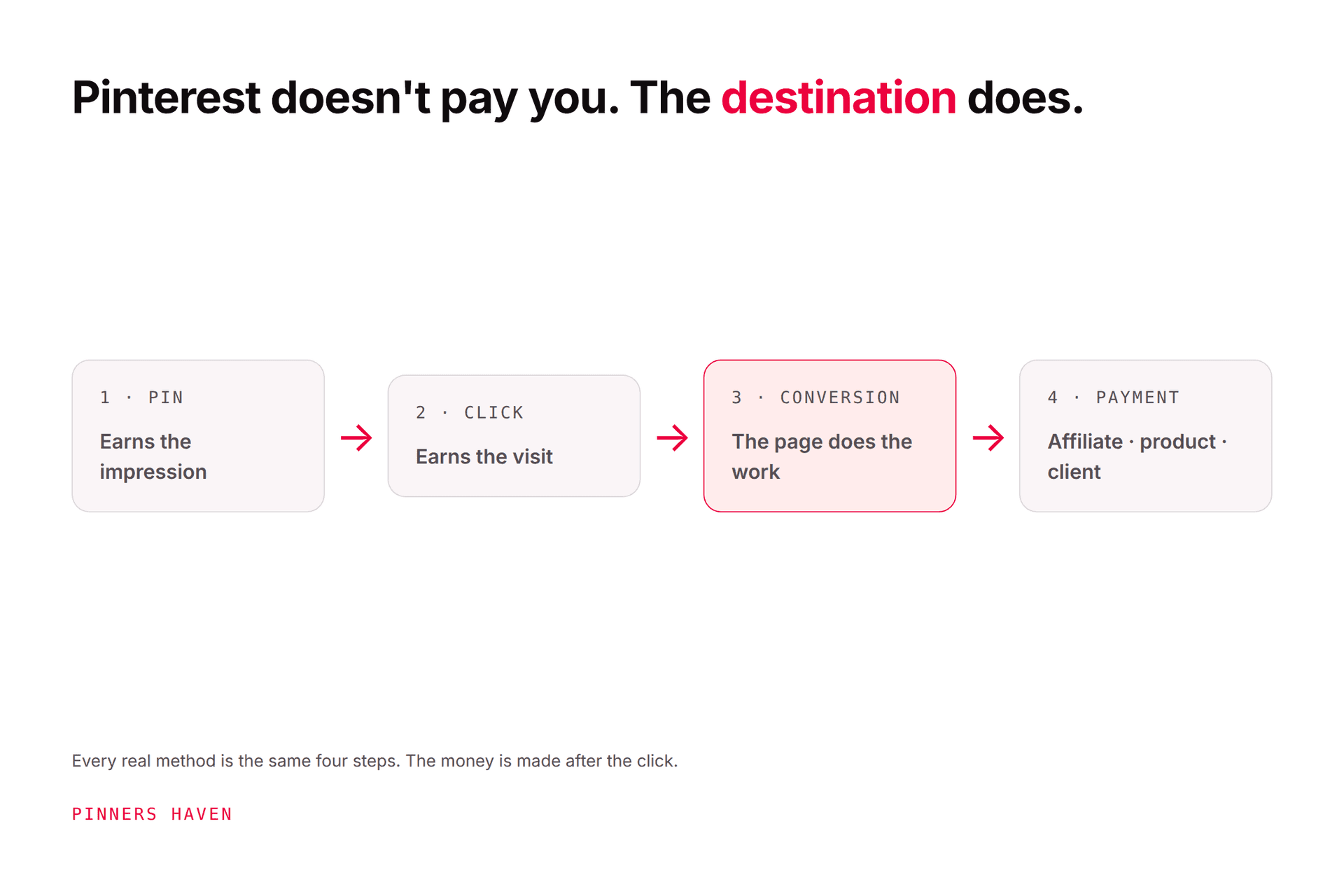
Yes, people make money on Pinterest, but Pinterest doesn't pay them; the thing their pin links to does. Pinterest's own creator guidance lists four routes: affiliate links, product tags, brand partnerships, and traffic to a monetised site. Its one direct-payment programme, Creator Rewards, ended on 30 November 2022.
JN
Joe Nyambura
Founder & operator, Pinners Haven · August 19, 2026
You've seen the pins: "How I make $10k a month on Pinterest," over a photo of a laptop on a beach, linking to a $27 guide. You've also seen the forum threads where people post 400k monthly views and $0. So you typed the honest question into the search bar, and you'd like an honest answer before anyone tries to sell you anything.
Yes, people make money on Pinterest, but Pinterest doesn't pay them; the thing their pin links to does. Pinterest's own creator guidance lists four routes: affiliate links, product tags, brand partnerships, and traffic to a monetised site. Its one direct-payment programme, Creator Rewards, ended on 30 November 2022. Published, checkable income reports show Pinterest-driven content sites earning anywhere from a few hundred dollars to five figures a month, almost always through display ads on the destination, and the same reports show that traffic falling 20–33% year on year. Most of the bigger numbers you'll see online are estimates or sales pages, not data. Here's how to tell which is which, what the real numbers look like, and how to get your own.
Disclosure: we make Pinners Haven, Pinterest publishing software. This article doesn't promise income and isn't financial, tax, or legal advice. We're not affiliated with Pinterest.
How the money actually flows
Pinterest's creator guidance (updated July 2025) says it plainly: affiliate links "let you earn commission when people on Pinterest click on the product links in your Pins and make purchases"; product tags link products below your pins; brand partnerships mean "you get paid to showcase a brand or product"; and driving traffic to a monetised site "can help increase how much you earn." Notice what isn't there: any payment from Pinterest for views, saves, or followers.
There used to be one. Creator Rewards paid creators for making Idea Pins to monthly prompts, and Pinterest shut it down on 30 November 2022. Nothing has replaced it for ordinary creators. So when a guide says "get paid by Pinterest," it's describing 2022.
That leaves four real routes, and a blunt consequence: the money is only ever as good as the page the pin points at. Our full guide to the seven ways covers the methods; this article is about whether they pay.
The proof ladder: how to read any "I made $X on Pinterest" claim
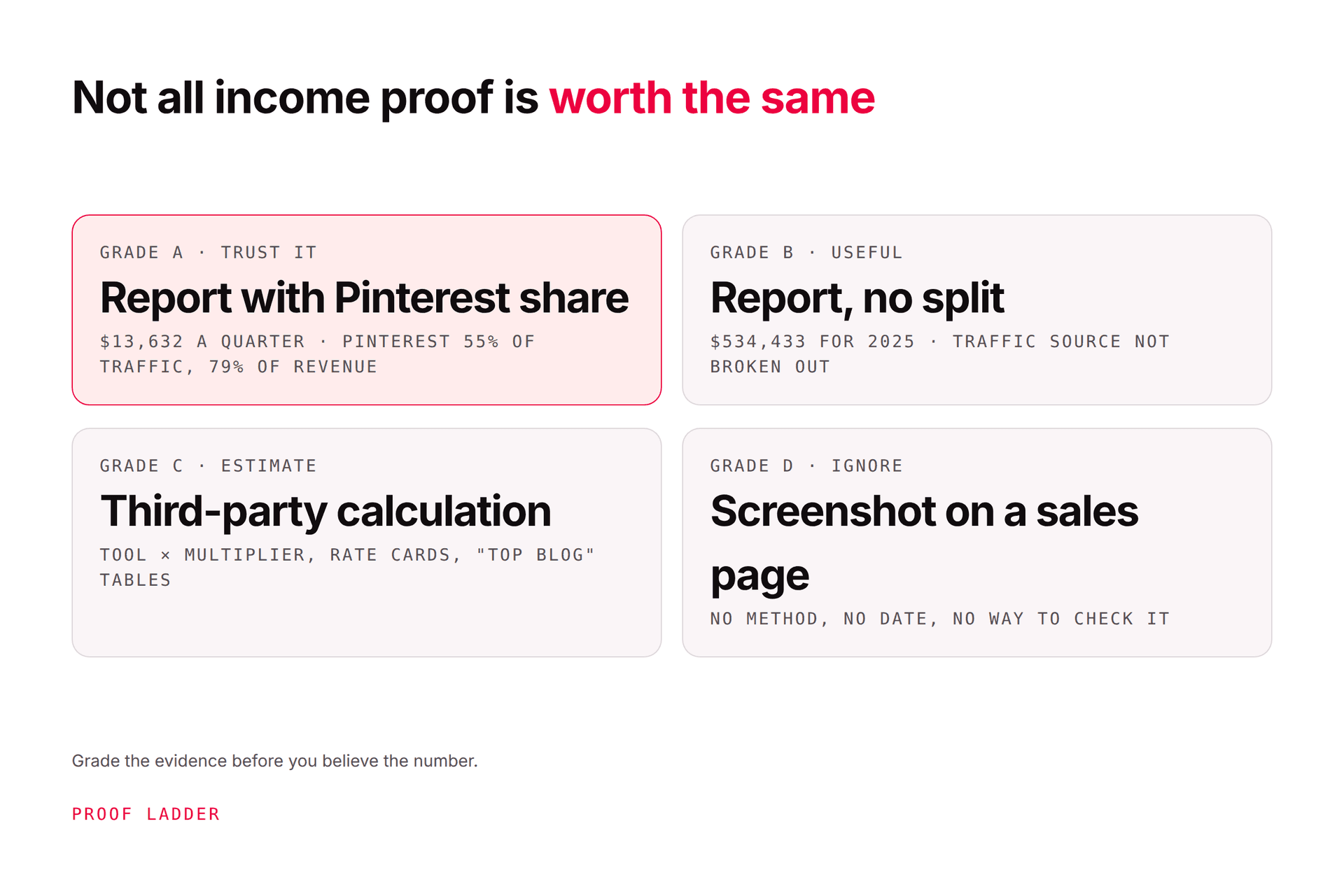
Before the numbers, a tool for the rest of your life on the internet. Every Pinterest income figure belongs on one of four rungs:
Grade
What it is
How much to trust it
A
A published income report that shows revenue and Pinterest's share of traffic
As much as you trust the author's analytics. This is the best evidence that exists.
B
A published income report without a Pinterest breakdown
Proves the business; doesn't prove Pinterest's part in it
C
A third-party estimate: a traffic tool, a multiplier, a "rate calculator"
Orientation at best; often arithmetic on top of guesses
D
A screenshot on a page selling a course or guide
Unverifiable by design; treat as marketing
Most of the SERP for this question is Grade C and D. Below is what Grades A and B actually say.
Real numbers, graded
Grade A: Partylicious, a party-dessert food blog
Sophia Assunta publishes quarterly income reports. Her Q1 2025 report (published August 2025) shows $13,632 in income for the quarter, $13,319 of it display-ad revenue, on about 240,000 sessions. The line that matters for us: Pinterest "typically accounts for 55% of overall traffic, which makes up a whopping 79% of my total revenue."
Run the arithmetic and that's roughly $55 of ad revenue per thousand sessions over the quarter, and Pinterest contributing on the order of $3,500 a month. A real, working, Pinterest-dependent business.
And then the other half of the same report: sessions were down 33% year on year, with about 70,000 fewer Pinterest sessions than the same quarter in 2024, and her own words: "I have no idea if this traffic will recover, or if this is the new normal for Pinterest." Revenue only fell 15% because ad rates rose. That's the most honest single data point we've found, because it shows both the upside and the risk in one page.
Grade B: Midwest Foodie, a food blog at scale
Kylie's 2025 income report (January 2026) shows $534,433 for the year, $519,412 of it ad revenue, on an average of 523,000 sessions a month. That works out to roughly $83 of ad revenue per thousand sessions, which tells you what a mature food site with premium ad management earns per visit.
It's Grade B for our purposes because the report doesn't split out Pinterest; she references a Pinterest strategy she still uses (and sells as an ebook and $297-an-hour consulting) but doesn't quantify its share. Traffic was down about 20% on 2024, with higher RPMs making up the difference. So: a six-figure content business where Pinterest is a known part of the mix, and a reminder that the people teaching Pinterest usually also sell teaching Pinterest.
Grade B, older: The She Approach
Ana's milestone report describes around $4,200 a month on average with "65,000 monthly pageviews driven by Pinterest and SEO." Useful as a mid-scale example, though it's older and doesn't separate the two sources.
Grade C: the "top Pinterest blogs" tables
You'll find roundups claiming, for example, that Apartment Therapy earns $72,000–$112,000 a month from Pinterest traffic. Read the methodology: one such table takes SimilarWeb's desktop estimate, multiplies it by "a general multiplier of 10.5" to guess total traffic, then multiplies by an assumed RPM. That's not data. It's a guess times a guess times an average, and the page's own disclaimer says actual figures "can be much higher or lower."
Grade C: sponsored-pin rate cards
"What brands pay Pinterest creators" pages publish tiers like $50–300 per pin for accounts under 10k followers, up to $5,000–30,000 for the largest. The one we checked (dated today, as these pages tend to be) carries a footer stating the figures "are generated algorithmically based on publicly available data and industry benchmarks." Treat them as a negotiating anchor, not a market.
First-party, and modest on purpose: us
We run Pinners Haven on our own portfolio. The founder's public number is that it "made $100 a month from a single site before I ever showed it to anyone." That's small, and it's the ceiling of what we'll claim, because it's the one figure we can stand behind. Our site also quotes three named customers: an affiliate operator across 38 sites, a personal-finance blogger who went from 0 to 210k monthly views, and an Etsy seller at 3.1x saves year on year. Views and saves, not dollars, which is why we don't present them as income. Grade them as what they are: testimonials, not audits.
What the real numbers have in common
Read the Grade A and B examples again and a pattern shows up that no sales page mentions:
It's almost all display-ad revenue on a content site. Pinterest sends the visit; an ad network pays for it. The pins aren't the business; the pages are.
Pinterest can be the majority of traffic and most of the revenue, which is wonderful right up until it drops.
It drops. Both 2025 reports show double-digit traffic declines, softened by higher ad rates. Pinterest distribution changes, and accounts that don't notice for a month lose a month.
Revenue per visit is the lever. $55 versus $83 per thousand sessions is the difference between niches and ad networks, and it's why the same traffic earns wildly different amounts.
Nobody on a Grade A rung started last month. Partylicious launched in 2018. These are libraries of hundreds of posts and thousands of pins.
The unglamorous arithmetic
Here's how to turn "can you" into "could I." None of this is a forecast; it's the formula with honest ranges plugged in.
Ad revenue route: sessions from Pinterest × revenue per thousand sessions. Premium ad management typically wants 50,000 monthly sessions to apply (Mediavine's published threshold), with a lower-tier programme at 1,000 premium sessions. At 20,000 Pinterest sessions a month and $25–55 per thousand, that's $500–1,100 a month. At Partylicious scale, it's $3,000–4,000.
Affiliate route: outbound clicks × conversion × commission. 5,000 outbound clicks a month at a 1% conversion and an $8 commission is $400. Same clicks at 3% and $30 is $4,500. The click count is Pinterest's job; the other two numbers are the offer's, which is why affiliate on Pinterest lives or dies on what you link to.
Product route: clicks × conversion × margin. A $19 digital product at a 2% conversion on 3,000 clicks is $1,140, minus platform fees. Pinterest for digital products has the seasonality that moves that conversion number more than the creative does.
Notice that every formula has Pinterest supplying one term and your destination supplying the rest. That's the whole answer to "can you make money on Pinterest": Pinterest can reliably supply the first term. Whether the others exist is up to you.
Who actually makes money, and who makes screenshots
From what we've seen across thousands of scheduled pins, and from the reports above, the people earning real money share a shape: a destination worth visiting, a library of original pins aimed at real searches, built over months, measured on outbound clicks and revenue per visit rather than monthly views. They rarely post income screenshots, because they don't need to.
The people posting screenshots are mostly selling the method. Some of them also earn from Pinterest, so it's not a scam by definition, but the screenshot is Grade D evidence for a Grade A claim, and the product for sale is usually the thing that made the money. Apply the ladder and move on.
The part nobody puts in the headline: volatility
If Partylicious's report teaches one thing, it's that a Pinterest-dependent income can lose a third of its traffic in a year while the owner does nothing wrong. Sometimes it's Pinterest changing distribution; sometimes it's a template overused for six months; sometimes it's a spam filter nobody noticed. The difference between the operators who recover and the ones who don't is usually how fast they saw it.
That's the part we built software for. Pinners Haven keeps the pin supply original (a Freshness Meter retires each template after roughly five to ten uses, before the sameness costs reach) and watches each account's reach week over week, emailing you when it falls past a threshold you set, instead of you discovering it in a quarterly income report. It won't make a thin site earn and it won't guarantee a number; nothing honest will. What it does is keep the one term Pinterest supplies, the clicks, flowing and watched.
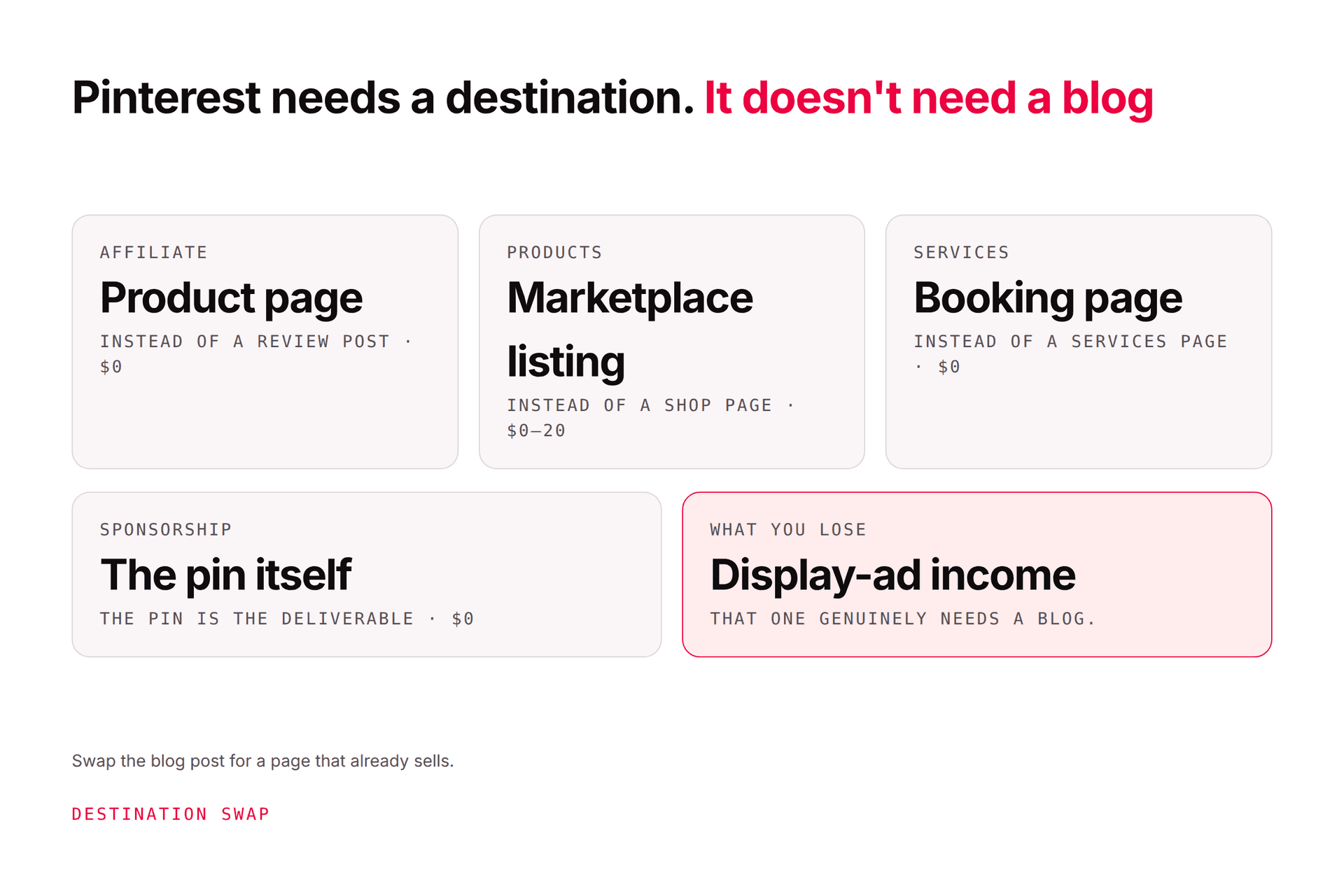
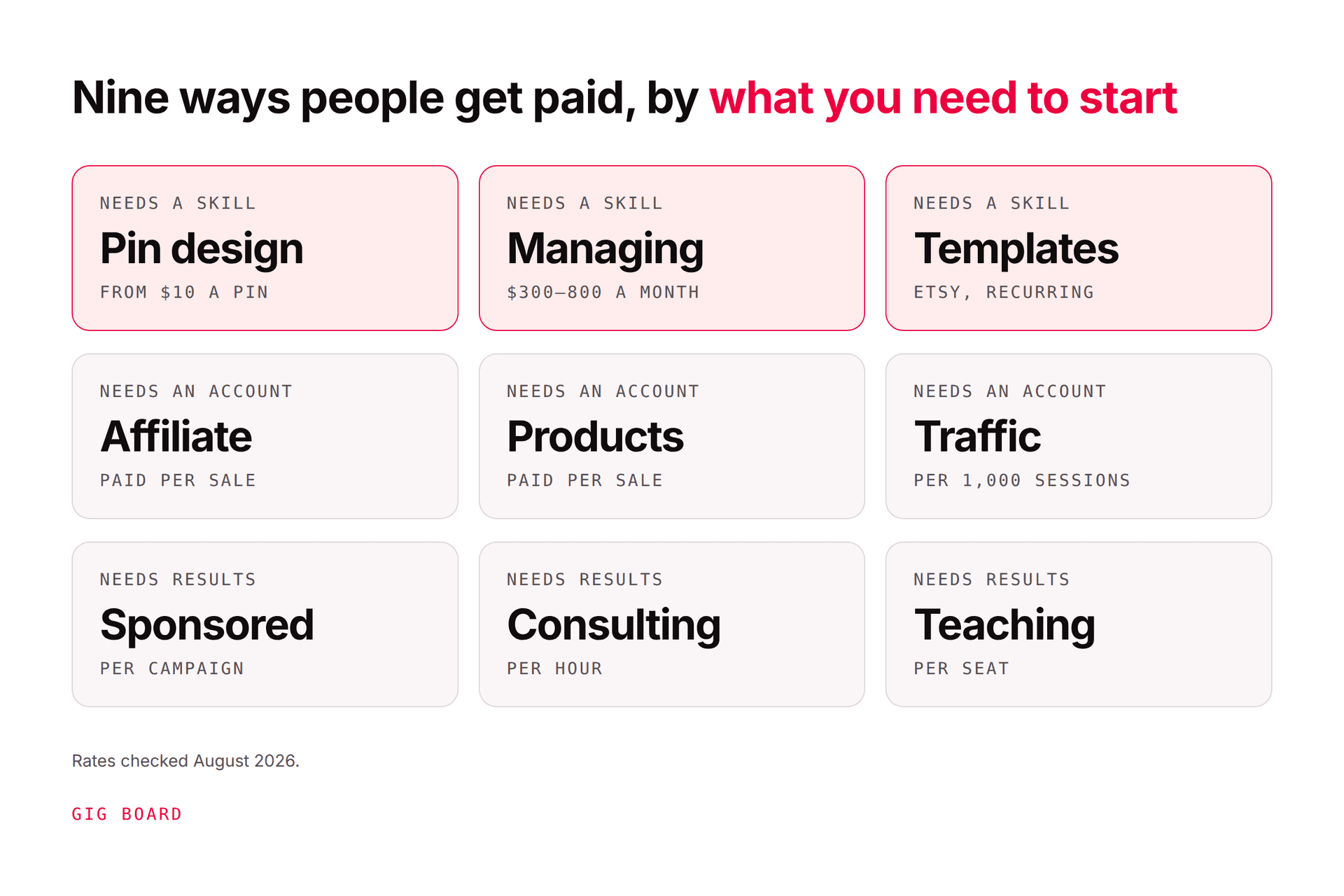
Borrowed figures, including the ones above, tell you what's possible. Only your own tell you what's likely. The baseline experiment in our full guide is the method: one offer, one audience, 20 original pins in 30 days, then record impressions, outbound clicks, and what the destination did with them, and compute revenue per outbound click. If you don't have a site, the no-blog version swaps the destination; if you'd rather be paid for Pinterest skills than Pinterest traffic, the nine ways people get paid for Pinterest work is the other door.
A month of your own data outranks every screenshot on the internet, including any you'll ever see from us.
Frequently asked questions
Can you really make money on Pinterest?
Yes. Published, checkable income reports show Pinterest-driven content sites earning from a few hundred dollars to five figures a month, mostly through display ads on the destination, with Pinterest sometimes supplying over half the traffic. The money comes from what the pin links to (ads, commissions, products, bookings, brand deals), not from Pinterest itself, and the same reports show that traffic can fall by a third in a year.
Does Pinterest pay you for views or followers?
No. Pinterest's creator guidance lists affiliate links, product tags, brand partnerships, and traffic to a monetised site as the ways to earn; there's no payment for views, saves, or followers. Its one direct-payment scheme, Creator Rewards, ended on 30 November 2022. Any claim that Pinterest pays per view describes a programme that no longer exists.
How much do people make on Pinterest?
Documented examples range widely. One food blogger's published Q1 2025 report shows about $13,600 for the quarter with Pinterest at roughly 55% of traffic and 79% of revenue; a larger food site reported $534,000 for 2025 without breaking out Pinterest's share. Most figures online, including "top blog" tables and sponsored-pin rate cards, are estimates rather than data. Your own number depends on your destination's revenue per visit far more than on Pinterest.
How many followers do you need to make money on Pinterest?
None, for affiliate, product, service, or traffic routes: Pinterest distributes pins by search and interest rather than follower count, and publishes no follower minimum for linking or selling. Followers and monthly views matter mainly for brand partnerships, where sponsors benchmark on reach. Accounts with small followings can earn if their pins reach searchers and their destination converts.
Can a beginner make money on Pinterest?
Yes, but not quickly and not by posting alone. The documented earners built libraries of original pins over months pointing at pages worth visiting. A beginner's realistic first goal is a measured baseline: 20 original pins in 30 days, outbound clicks tracked, revenue per click computed. That tells you whether your niche and destination can pay before you scale the effort.
How long does it take to make money on Pinterest?
There's no reliable fixed timeline. Pins take weeks to be distributed and months to mature, and seasonality matters in most niches, so judging at 90 days is more honest than at 30. The published earners in this article have been publishing for years. Expect the first sales or commissions to be small and to tell you more about your offer than about Pinterest.
Yes, with a destination, a library, and a ledger
Can you make money on Pinterest? Yes. Real people publish real reports proving it, and the same reports prove it's neither passive nor guaranteed. The route is a page worth sending people to, a steady supply of original pins, and a spreadsheet that tracks what each click was worth. Everything else on the subject is either that, or a screenshot.
You've got the ladder and the arithmetic. If you'd like the pin supply handled and the reach watched while you build the part that earns, that's what Pinners Haven is for.