How to Make Money on Pinterest in 2026 (Complete Guide)
Suggested excerpt: Pinterest does not turn impressions into a paycheck by itself. Compare seven practical revenue paths and build the Pin-to-payment system behind them.
Joe Nyambura
Founder & operator, Pinners Haven · August 18, 2026
On this page38 sections
- The one thing to understand before you try to monetize Pinterest
- Seven ways to make money using Pinterest
- 1. Sell physical products
- 2. Sell digital products
- 3. Earn affiliate commissions
- 4. Monetize a blog or content site
- 5. Sell a service or generate leads
- 6. Offer Pinterest management or creative services
- 7. Work with brands on sponsored content
- What does not count as a reliable Pinterest income stream
- Impressions by themselves
- Running Pinterest ads
- Posting old-style Idea Pins and waiting for platform rewards
- Repinning other people's work without a destination or offer
- Spam shortcuts
- Which Pinterest money-making method should you choose?
- The math that connects Pinterest traffic to revenue
- How to start making money on Pinterest: a six-step plan
- 1. Create a free Pinterest business account
- 2. Choose one audience, one money path, and one action
- 3. Build the destination first
- 4. Research the search and make an original Pin
- 5. Publish consistently without turning the account into a machine gun
- 6. Review clicks and conversions, then follow the winners
- Rules that protect your account and your reader
- Disclose commercial relationships plainly
- Add original value
- Keep the Pin and destination aligned
- Check every set of rules that applies
- How long does it take, and how much can you make?
- Frequently asked questions
- Do you get paid on Pinterest?
- How many followers do you need to make money on Pinterest?
- Can you make money on Pinterest without a blog?
- How do beginners make money on Pinterest?
- Is a Pinterest business account free?
- Can you make money on Pinterest without showing your face?
- Build the destination before you chase the views
Suggested excerpt: Pinterest does not turn impressions into a paycheck by itself. Compare seven practical revenue paths and build the Pin-to-payment system behind them.
People make money on Pinterest by using Pins to send potential customers to something that earns: a product page, affiliate offer, monetized article, booking page, or brand partnership. Pinterest supports external links, affiliate links, product tags, and paid-partnership labels, but each model has a different payment trigger. The platform helps people discover your content. Your destination and offer do the selling.
The seven practical routes are:
Sell physical products.
Sell digital products.
Earn affiliate commissions.
Monetize a blog or content site.
Sell a service or generate leads.
Offer Pinterest management or creative services.
Create sponsored content for brands.
That distinction matters. A Pin with 100,000 impressions and nowhere useful to go can earn nothing. A Pin with modest reach that sends the right people to a well-matched offer can produce sales.
This guide will help you choose one model and build the short path from search to payment. No mystery income. No screenshots from somebody else's best month.
Disclosure: we make Pinners Haven, Pinterest publishing software. We'll show where it fits and where it doesn't. This article does not promise income and is not financial, tax, or legal advice. We're not affiliated with Pinterest.
The one thing to understand before you try to monetize Pinterest
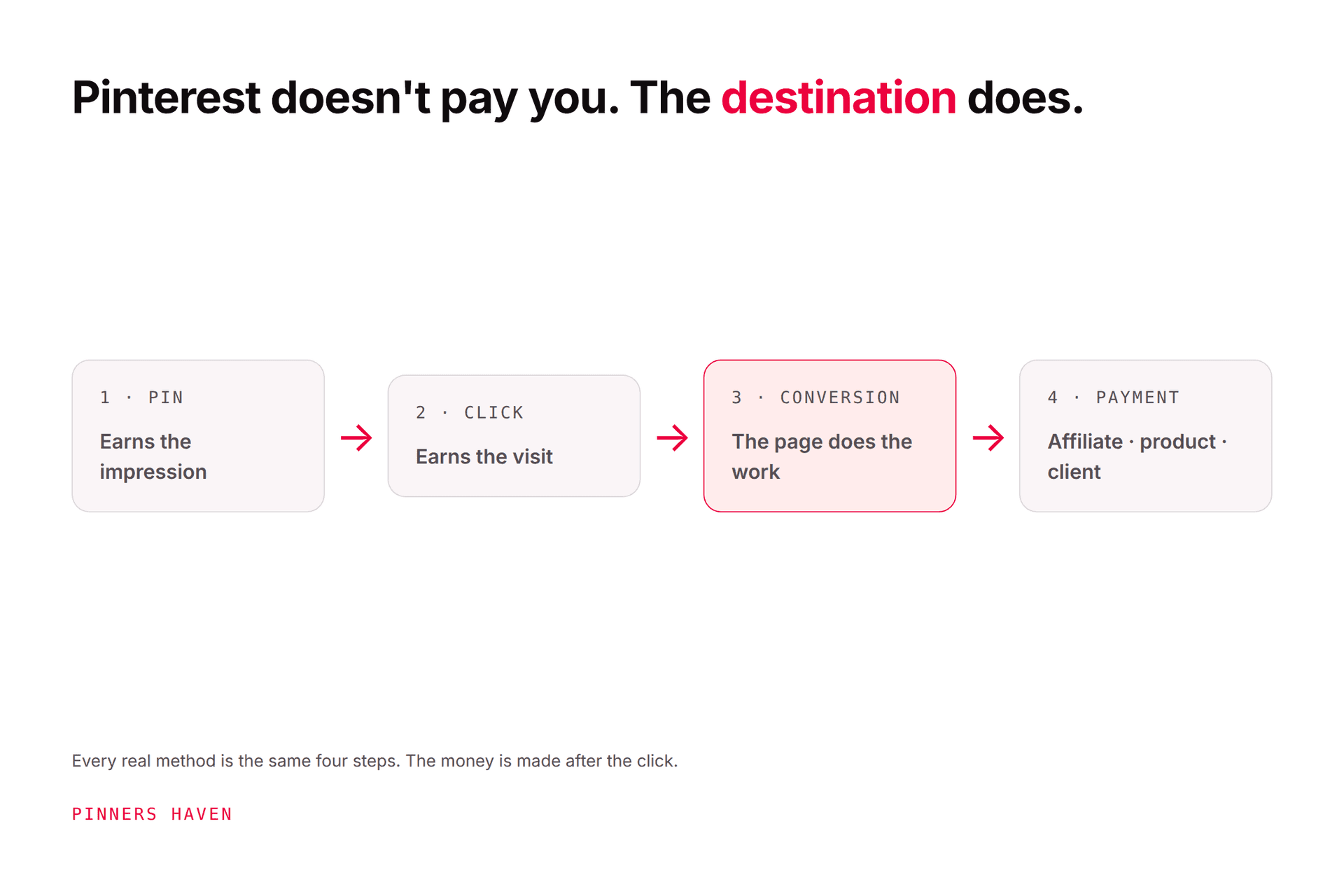
Pinterest is the discovery layer, not the entire business. A money-making Pinterest system has four connected parts:
Pin -> destination -> conversion -> payment
The Pin earns attention from someone searching or browsing.
The destination delivers what the Pin promised.
The conversion is the useful action, such as a purchase, signup, or booked call.
The payment comes from your store, client, advertiser, affiliate program, or brand partner.
Pinterest's own creator guidance describes external site traffic, affiliate links, product tags, and brand partnerships as ways creators and businesses can earn. It recommends linking Pins to destinations that can create value, including product pages, subscriptions, memberships, and monetized websites. Pinterest: How to make money on Pinterest
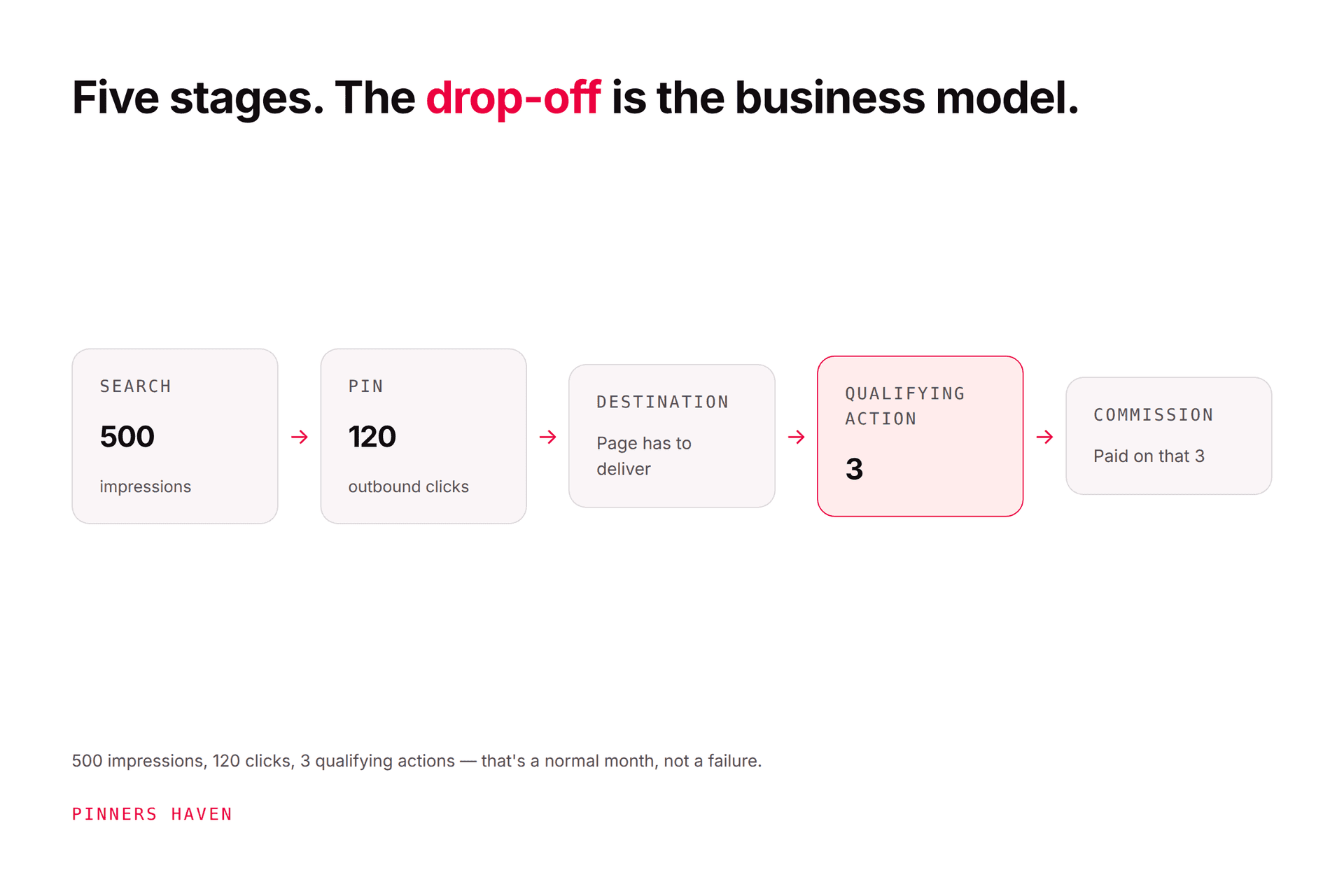
This is also why your monthly-view count can be a vanity metric. Impressions tell you how often Pins appeared on screen. Pinterest defines outbound clicks as actions that take people to a destination outside Pinterest. If revenue is the goal, outbound clicks sit much closer to the cash register. Pinterest Analytics metric definitions
Saves and impressions still matter. They can show that an idea resonates. But they are leading indicators, not a payment method.

Seven ways to make money using Pinterest
There is no universal “best” method. The right one depends on what you already have: a product, expertise, a website, an audience, or none of those yet.
Method | What triggers payment | Best destination | Setup | Your control |
|---|---|---|---|---|
Physical products | A completed order | Product or collection page | Medium to high | High |
Digital products | A completed order | Focused sales page | Medium | High |
Affiliate marketing | A qualifying action under program terms | Product page, review, or roundup | Low to medium | Low to medium |
Monetized blog | Ad views, affiliate sales, subscriptions, or product sales | Useful article | High | Medium to high |
Services and leads | A deposit, booking, or signed engagement | Service or booking page | Medium | High |
Pinterest client work | A project, package, or retainer | Portfolio or service page | Medium | High |
Brand partnerships | A negotiated sponsorship agreement | Sponsored Pin or campaign page | High | Medium |
1. Sell physical products
If you already sell on Etsy, Shopify, or your own store, Pinterest can introduce shoppers to the exact item or collection that matches their search. You earn when that visitor completes an order, not when the Pin receives an impression.
The strongest product Pins make the next step obvious. A Pin titled “Minimalist Wedding Welcome Sign Template” should land on that sign or a tightly related collection. Dropping the visitor on a generic shop homepage makes them repeat the search you just helped them finish.
Pinterest supports product Pins and product tagging. A business account can tag products in organic Pins, and merchants can use catalogs to connect product information to Pinterest. Pinterest product-tagging instructions Pinterest Pin types and Product Pins
A practical example: an Etsy seller who makes wedding stationery could create separate Pins for garden weddings, black-tie receptions, destination weddings, and last-minute printable signs. The product may be similar, but each Pin meets a different reason for buying.
Best fit: You have inventory or made-to-order products with clear visual appeal.
Watch out for: Pretty inspiration Pins that attract saves but hide the product, price context, or next step.
Full walkthrough in how to sell on Pinterest without ads.
2. Sell digital products
Digital products include printables, templates, patterns, presets, workbooks, guides, memberships, and courses. The Pin leads to a sales page or marketplace listing; the completed purchase creates the revenue.
This path gives you more control than affiliate marketing because you own the offer and set the price. It also asks more of you. You must create the product, support the buyer, handle refunds, and improve the page when traffic does not convert.
Specificity does the heavy lifting. “Get organized” is fog. “Sunday meal planner for a family of four” gives Pinterest a topic to understand and gives the buyer a reason to click.
Start with one small product that solves one visible problem. A sprawling course library sounds impressive, but it can wait. First prove that your Pin, promise, and checkout page belong together.
Best fit: You can turn a repeatable skill, process, or asset into a downloadable or teachable product.
Watch out for: Building a large product before confirming that people search for the problem it solves.
3. Earn affiliate commissions
Affiliate marketing lets you recommend another company's product and earn under that program's terms when a reader completes a qualifying action. You can send people directly from a Pin to an eligible product page or route them through a useful review, tutorial, or comparison on your site.
Pinterest explicitly allows affiliate links. Its current creator instructions say to join an outside affiliate program, generate a unique product URL, and use that as the Pin's destination. Pinterest also says the destination should go directly to the relevant product detail page, and some link shorteners may not be supported. Pinterest affiliate-link guide
Permission is not a license to carpet-bomb the feed. Pinterest's affiliate rules require original content, transparent commercial intent, authentic account use, and moderation. Repetitive affiliate Pins in large volumes can run into its spam policy. Pinterest Commercial and Branded Content Guidelines
The affiliate program's rules matter too. A merchant may restrict direct social links, trademarks, images, or paid promotion even when Pinterest itself permits the link. Read both sets of terms before publishing.
Then disclose the relationship where people can see it. The US Federal Trade Commission says a disclosure should sit with the endorsement, use plain language, and be hard to miss. Hiding it on an About page or after a “more” click is not enough. FTC disclosures for social media influencers
Best fit: You understand a product category well enough to help somebody choose, compare, or use a product.
Watch out for: Thin product Pins that add nothing beyond the merchant's own image and claim.
The compliance detail — two rulebooks, and where disclosure has to sit — is in our Pinterest affiliate marketing guide.
4. Monetize a blog or content site
In this model, Pinterest sends readers to an article and the website earns through display ads, affiliate links, sponsorships, memberships, email offers, or owned products. The Pin creates the visit. The website carries the commercial load.
Pinterest includes monetized websites and blogs in its current creator guidance. It advises creators to link Pins to pages that drive value and to make the content complement the destination. Pinterest creator monetization guidance
That last part is where many traffic plans wobble. A Pin promising “12 Small Kitchen Storage Ideas” should lead to those 12 ideas, quickly, on a page that works well on a phone. If the page opens with three popups, a slow hero video, and no visible answer, the visitor will leave before an ad or offer has a chance.
A blog also gives you room to earn in more than one way. A tutorial can carry ads, recommend a relevant product, invite the reader onto an email list, and later introduce an owned template. Do not stack every monetization layer on day one. Start with the one that fits the reader's intent.
Best fit: You enjoy publishing useful search-led content and are willing to build a website asset over time.
Watch out for: Chasing pageviews while ignoring mobile speed, email capture, and what the visitor does next.
5. Sell a service or generate leads
You do not need a store or a high-traffic blog to make Pinterest commercially useful. A consultant, photographer, designer, coach, agent, or local business can create Pins around the problem a future client is already trying to solve.
A service Pin should lead to a specific service page, case study, useful lead magnet, or booking page. “Our Services” asks the visitor to work too hard. “Kitchen Remodel Consultation for Small Nairobi Apartments” tells the right person exactly where they have landed.
The economics differ from ad-supported content. A service business may need only a few qualified enquiries, while a display-ad site normally depends on a much larger traffic base. That does not make services easy. Your portfolio, positioning, response time, and sales process still decide whether an enquiry becomes a client.
Best fit: You already have a marketable skill and proof that you can deliver it.
Watch out for: Broad inspiration content that attracts people who enjoy the idea but will never hire you.
6. Offer Pinterest management or creative services
If you can research Pinterest topics, design effective Pins, organize boards, schedule content, or interpret analytics, you can sell that work to businesses that would rather not do it themselves.
Pinterest can play two roles here. It can send prospects to your service page, and your own account can show how you think. A useful audit, before-and-after creative example, or anonymized reporting walkthrough says more than calling yourself a “Pinterest guru.”
Package the work around an outcome you can influence without promising revenue. Examples include a keyword and board audit, a monthly Pin-design package, publishing support, or performance reporting. Be precise about what the client supplies, what you deliver, and what Pinterest results remain outside your control.
Best fit: You have hands-on Pinterest skills but do not yet have a product or large audience.
Watch out for: Claiming certification, partner status, or guaranteed growth you cannot document.
7. Work with brands on sponsored content
Brand partnerships pay a creator to produce or publish content connected to a brand. This route usually depends on a clear niche, a credible portfolio, an audience the brand wants to reach, and the ability to make useful content without turning every Pin into an advert.
Pinterest's paid-partnership tool labels sponsored Pins, but it does not find the sponsor or negotiate the fee for you. Pinterest states that the creator and brand establish the partnership outside the platform. The creator can then tag the brand, which must approve the relationship before its name appears with the label. Pinterest paid partnerships for creators
There is no responsible universal rate card. Compensation varies with the creator, scope, usage rights, exclusivity, production work, and campaign terms. Put the agreement in writing and disclose the relationship clearly.
Best fit: You have an identifiable audience and a body of work that proves you can influence attention or action in a specific niche.
Watch out for: Accepting a poor-fit sponsor that spends the trust you built for a one-off fee.
What does not count as a reliable Pinterest income stream
A few ideas keep resurfacing in make-money content even though they do not form a durable 2026 plan.
Impressions by themselves
Pinterest Analytics defines an impression as a Pin or ad appearing on screen. It is an exposure metric, not a sale. Treat impressions as the top of the funnel, then inspect outbound clicks and what happened after the visitor reached your site or store. Pinterest Analytics
Running Pinterest ads
Ads can help a business buy distribution and acquire customers. They are an expense before they are a return. Pinterest describes ads as Pins that businesses pay to promote, so “run ads” belongs in a customer-acquisition plan, not in a list of ways Pinterest pays creators. Pinterest: About ads
Posting old-style Idea Pins and waiting for platform rewards
Some older guides still refer to Creator Rewards, a program tied to Idea Pin goals. That program ended in November 2022. Pinterest's current monetization material focuses instead on external traffic, affiliate links, product tags, and brand partnerships. Pinterest's current creator monetization page TechCrunch's 2022 closure report
Pinterest does run selective initiatives and contests from time to time. Those can be opportunities for eligible creators, but a limited application program is not an evergreen business model.
Repinning other people's work without a destination or offer
Curation can build a useful board. It does not automatically create a commercial relationship between the viewer and you. If there is no owned offer, eligible affiliate relationship, service, monetized destination, or sponsor agreement, there is no clear payment trigger.
Spam shortcuts
Fake accounts, coordinated saves, repetitive mass affiliate posting, and paid engagement are not growth hacks. Pinterest prohibits artificial traffic manipulation and can remove, limit, or block content or accounts that violate its commercial guidelines. Pinterest commercial-content policy
Which Pinterest money-making method should you choose?
Start with the asset you already have, not the model that produced the loudest screenshot on social media.
You have physical inventory: Send searchers to exact products or collections.
You have a repeatable process or asset: Package one focused digital product.
You know a product category: Build useful affiliate comparisons or tutorials.
You already publish articles: Add the monetization layer that best matches each article's intent.
You have no site at all: Point pins at a destination that already sells — a listing, a checkout page, a booking page. Making money with Pinterest without a blog covers what replaces the blog for each path, and what you give up.
You'd rather sell the skill than the traffic: Pinterest work itself is billable. Nine ways to get paid for Pinterest work covers management, design, templates and audits — no audience of your own required.
You have expertise but no audience: Offer a service and create buyer-stage Pins around the problems you solve.
You know Pinterest operations: Sell a defined management, design, or audit package.
You have niche reach and a portfolio: Approach suitable brands with a campaign idea.
If two routes look equally good, choose the one with the shortest honest path to a transaction. A designer who can sell a $300 audit does not need to wait for a blog to attract enough traffic for meaningful ad revenue. A shop owner does not need to become an influencer before linking to products.
Give the chosen model a focused testing window. Sixty to ninety days is enough to publish, collect data, and spot whether the system is moving, but it is not an earnings deadline. Do not switch business models every time one Pin has a quiet week.
Our Pinterest niches guide scores twelve of them against demand, visual fit, content depth, and offer fit.

The math that connects Pinterest traffic to revenue
When the hype gets noisy, come back to three numbers:
Outbound clicks x destination conversion rate x earnings per conversion = revenue
Imagine a product receives 1,000 outbound clicks from Pinterest in a month. If 2% of those visitors buy and the seller keeps $15 per order after product costs and platform fees, the arithmetic is:
1,000 x 0.02 x $15 = $300
That is a hypothetical example, not a forecast. Change any input and the result changes.
The formula gives you three useful levers:
Earn more relevant outbound clicks. Improve topic selection, creative, and the clarity of the Pin's promise.
Improve the destination conversion rate. Make the page faster, more specific, more trustworthy, and easier to buy from.
Improve earnings per conversion. Review pricing, margin, commission, order value, or the offer itself.
More impressions may help the first lever, but they cannot rescue a broken checkout or an offer nobody wants. Measure outbound clicks in Pinterest Analytics. Measure signups, orders, commissions, and revenue in the platform where the conversion happens.
[Graphic: show the hypothetical calculation with “example only” printed above it.]
How to start making money on Pinterest: a six-step plan
1. Create a free Pinterest business account
A business account is free and gives you access to Pinterest Analytics and business tools. You can create a new one or convert an existing personal account. If you convert, Pinterest says your Pins and followers remain, although the business profile must be public. Pinterest business-account setup
Keep the profile focused. A visitor should be able to tell what you sell, teach, or help with before scrolling.
Full walkthrough in our Pinterest business account guide.
2. Choose one audience, one money path, and one action
“People who like home decor” is too wide. “Renters looking for removable kitchen upgrades” gives you clearer products, topics, boards, and Pin concepts.
Then choose the action that matters: buy the product, read the article, download the guide, book the call, or visit the affiliate offer. One Pin can have many benefits, but it should have one obvious next step.
3. Build the destination first
Do not design 40 Pins and decide later where they should go. Open the product, article, or service page on a phone and ask:
Does the first screen deliver what the Pin promised?
Is the next action obvious?
Does the page load cleanly without covering the answer?
Can the visitor trust the seller, author, or service provider?
Is tracking installed on the destination platform?
If you own a website, claiming it can connect your Pinterest profile with Pins saved from that domain and provide insight into how often its content is shared. Pinterest requires control of the domain or its source code, so most marketplace storefronts cannot be claimed directly. Pinterest: Claim your website
4. Research the search and make an original Pin
Use Pinterest search and Pinterest Trends to understand the words, seasons, and formats surrounding the problem. Then make a Pin that adds something useful: a clear outcome, a comparison, a visual demonstration, a checklist, or a specific product use.
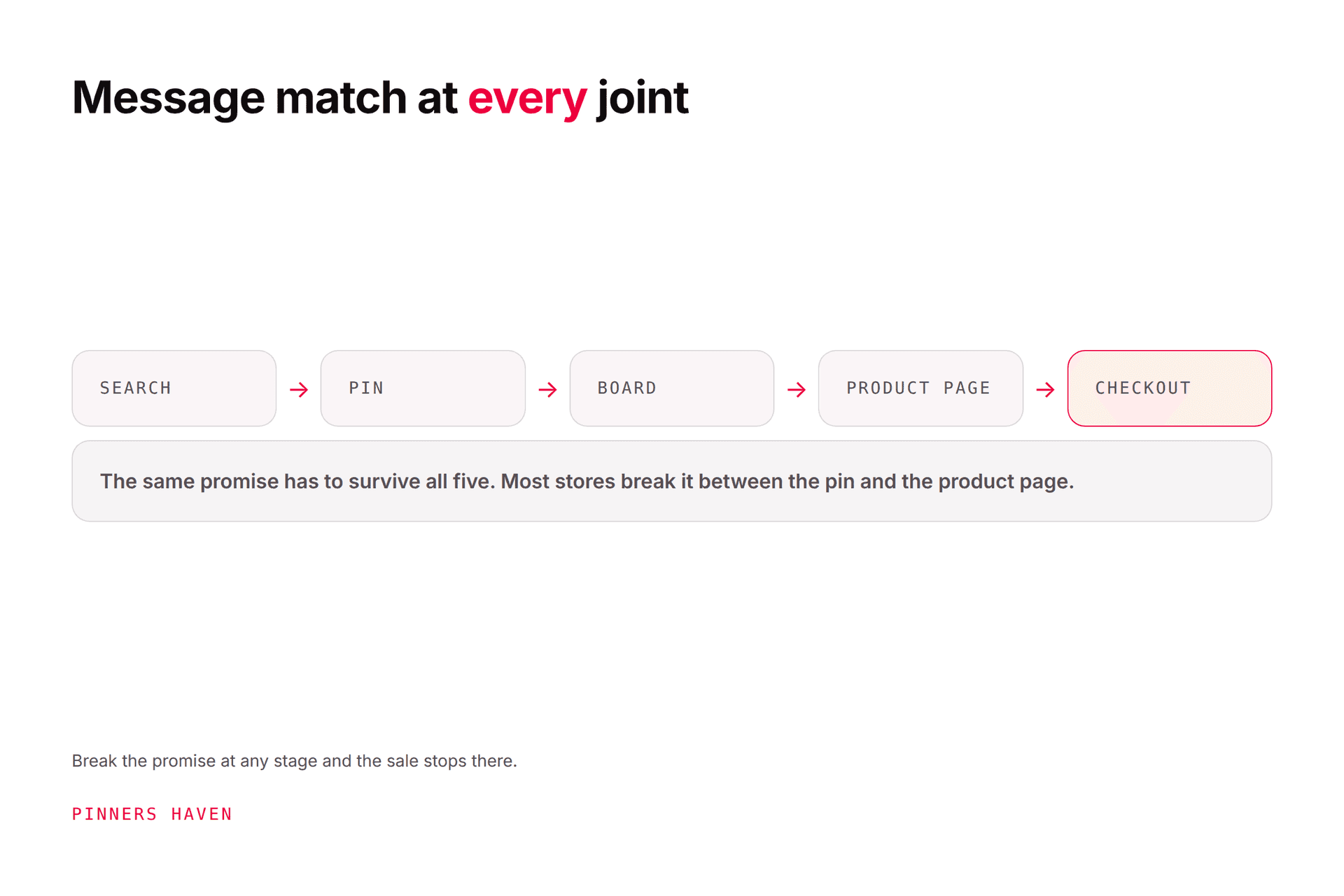
The Pin title, image, and destination should tell one continuous story. If the graphic promises a free checklist and the page sells a course without the checklist in sight, no scheduling trick will repair the mismatch.
5. Publish consistently without turning the account into a machine gun
Consistency gives you enough attempts to learn which topics and creative angles work. It does not mean flooding Pinterest with near-identical affiliate Pins or sudden bursts designed to manipulate distribution. Pinterest tells affiliates to add original value, avoid artificial traffic tactics, and use affiliate links in moderation.
That consistency requirement is the operational bottleneck, and it's where most people quit around month three.
It's the gap Pinners Haven was built to close: twenty angles per topic so one destination yields genuinely different pins rather than recolours, a keyword-optimised title and three to five unique descriptions per pin, original designs on human-designed templates, and a Freshness Meter that retires each template after roughly 5–10 uses. Publishing runs on a paced cadence through official OAuth, and nothing goes out until you approve it. From $19/mo billed annually.
It does not create the product, fix the sales page, or guarantee revenue. Those are the parts that actually decide whether you earn anything, and they stay yours.
Our safe automation guide covers doing this without tripping Pinterest's duplicate rules, and what counts as a fresh pin defines the line.
6. Review clicks and conversions, then follow the winners
After publishing, separate Pinterest performance from destination performance.
High impressions and few outbound clicks usually point to the Pin, topic, or promise.
Healthy outbound clicks and few conversions point to the destination or offer.
A few sales from modest traffic may signal a strong offer that deserves more creative angles.
No impressions gives you little evidence about the offer because the Pin did not earn distribution yet.
Review patterns across a useful sample, not one afternoon. Make new Pins around the topics and promises that send qualified traffic, and improve or retire the destinations that repeatedly fail to convert.
Rules that protect your account and your reader
Money content has a simple trust test: would the reader feel tricked after the click? If yes, do not publish it.
Disclose commercial relationships plainly
Pinterest requires disclosure for paid partnerships and transparency for affiliate content. The FTC also says material relationships should be disclosed clearly and close to the endorsement. Use plain terms such as “ad,” “sponsored,” or a direct affiliate disclosure. Do not bury the relationship among hashtags or on a separate profile page. Pinterest commercial guidelines FTC disclosure guidance
Add original value
Use your own demonstration, comparison, styling idea, photograph, test, or explanation. Pinterest's affiliate rules specifically call for original content that adds value. That rule is good marketing anyway. A buyer needs a reason to trust your recommendation instead of clicking the first identical product image.
Keep the Pin and destination aligned
Use an image you have the right to publish. Match the title and description to the actual destination. Check links periodically. If an affiliate program changes a URL or a product disappears, fix or replace the link.
Check every set of rules that applies
Pinterest policy is only one layer. Affiliate programs, marketplaces, merchants, sponsors, advertising regulators, and your jurisdiction may impose additional requirements. When money or tax treatment is material, ask a qualified local professional rather than a Pinterest thread.
How long does it take, and how much can you make?
There is no responsible universal timeline or earnings figure for Pinterest. Revenue depends on search demand, niche, creative quality, outbound clicks, destination conversion, margin or commission, offer strength, seasonality, and how consistently you improve the system.
That answer is less exciting than “$10,000 in 30 days.” It is also useful.
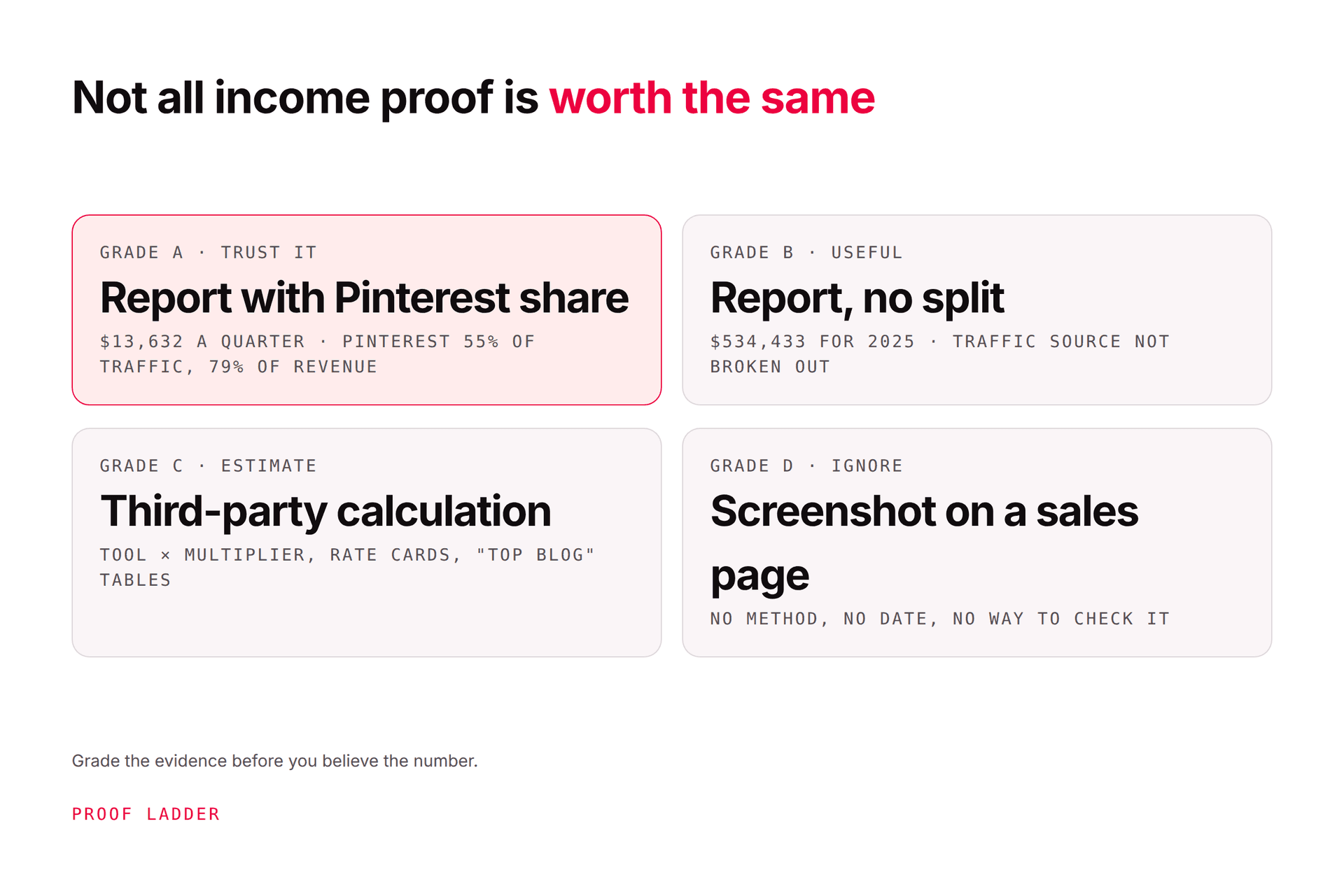
If you want figures that are checkable rather than screenshotted, published income reports with Pinterest's share broken out shows what a working Pinterest-dependent business actually earns, and how to tell a real report from an estimate.
Instead of adopting somebody else's income screenshot as your forecast, run a baseline experiment:
Pick one offer and one audience.
Publish a consistent set of original Pins for 30 days.
Record impressions, outbound clicks, and destination conversions.
Calculate revenue per outbound click.
Use the result to decide whether to improve the Pin, page, or offer.
The first month may produce sales, or it may produce only enough data to reveal a weak link. Both outcomes teach you more than a borrowed earnings claim.
Frequently asked questions
Do you get paid on Pinterest?
Pinterest offers monetization tools such as affiliate links, product tags, and paid-partnership labels, but ordinary impressions are not a general pay-per-view program. Most revenue comes from a purchase, commission, monetized site visit, client booking, or brand agreement connected to the Pin. Pinterest creator monetization options
How many followers do you need to make money on Pinterest?
Pinterest does not publish a platform-wide follower minimum for selling your products, sending traffic to a website, or using eligible affiliate links. A Pin can appear in search, feeds, related Pins, and boards. Brand partners may set their own audience and engagement requirements. Pinterest Creator FAQ
Can you make money on Pinterest without a blog?
Yes. You can link eligible affiliate Pins to product pages, send shoppers to your store or marketplace listing, promote a service, sell digital products, or work with brands. A blog gives you more room for education and multiple revenue layers, but it is not required for every model.
How do beginners make money on Pinterest?
Choose one audience and one payment path, create a free business account, build the product or destination page, and publish original Pins that match real searches. Track outbound clicks and destination conversions. Beginners usually learn faster from one focused offer than from seven half-built income streams.
Is a Pinterest business account free?
Yes. Pinterest says creating or converting to a business account is free. It provides access to Pinterest Analytics and business tools. Business profiles are public, and Pinterest allows users to switch a converted account back to personal later. Pinterest business accounts
Can you make money on Pinterest without showing your face?
Yes. Pinterest does not require a face-based personal brand for product, blog, affiliate, or service traffic. Useful product photography, demonstrations, diagrams, screenshots, and text-led graphics can all communicate value. Your rights to the creative, the offer, and the destination matter more than appearing on camera.
Build the destination before you chase the views
The most useful Pinterest income plan fits on one line:
Create a Pin for a specific person, send them to a matching destination, and measure the action that produces payment.
Choose one of the seven paths. Build the page. Publish enough original Pins to learn. Then look past the flattering impression count and follow the outbound clicks, conversions, and revenue.
If manual pin creation and scheduling are what's keeping that experiment stuck in your notebook, Pinners Haven can handle the publishing while you improve the offer behind each click.
→ Start a 14-day trial — from $19/mo billed annually. No card needed; when the trial ends, publishing pauses until you pick a plan.