How to Post Consistently on Pinterest Without Burning Out
You started strong. Four weeks of daily pins, a proper schedule, actual momentum, and then a deadline landed or you got ill or life simply happened, and the streak broke. Now opening Pinterest feels like opening a bill you can't pay. Breathe. This is the most common way Pinterest accounts die, and almost none of it
Joe Nyambura
Founder & operator, Pinners Haven · August 18, 2026
On this page15 sections
- Why consistency actually breaks
- Fix 1 — set a rate you can actually hold
- Fix 2 — batch production, and batch it in stages
- Fix 3 — publish from a buffer, never live
- Get to 30 days without a heroic first batch
- What to cut when you fall behind
- When batching still isn't enough
- Frequently asked questions
- How often do I need to post on Pinterest to stay consistent?
- Will taking a break hurt my Pinterest account?
- How far ahead should I schedule pins?
- Is it better to post daily or a big batch weekly?
- How long before consistent pinning shows results?
- What if I genuinely don't have time to make pins?
- The account that wins is the one still publishing
You started strong. Four weeks of daily pins, a proper schedule, actual momentum, and then a deadline landed or you got ill or life simply happened, and the streak broke. Now opening Pinterest feels like opening a bill you can't pay. Breathe. This is the most common way Pinterest accounts die, and almost none of it is a discipline problem.
Consistent Pinterest publishing comes from three things working together: a rate your content library can sustain, production done in batches rather than daily, and a publishing queue deep enough to absorb a bad week. When consistency fails it's almost always one of those three that broke, not your motivation. Diagnose which one and the fix is usually a single afternoon's work.
The reason "just stay consistent" advice doesn't help is that it treats a structural problem as a character flaw. You don't need more willpower. You need to find out which of the three failed.
Why consistency actually breaks
Before you fix anything, work out which failure you have. They look identical from the outside and they are not the same problem.
Failure | What it feels like | The actual cause | The fix |
|---|---|---|---|
Inventory | "I don't know what to pin anymore" | You've exhausted the honest concepts in your library | Lower the rate or expand the library |
Production | "I have ideas, I just never make them" | Pin creation is competing with your real job | Batch, template, or delegate the making |
Attention | "I keep forgetting until 11pm" | It isn't scheduled, it's remembered | Queue-based publishing and a calendar slot |
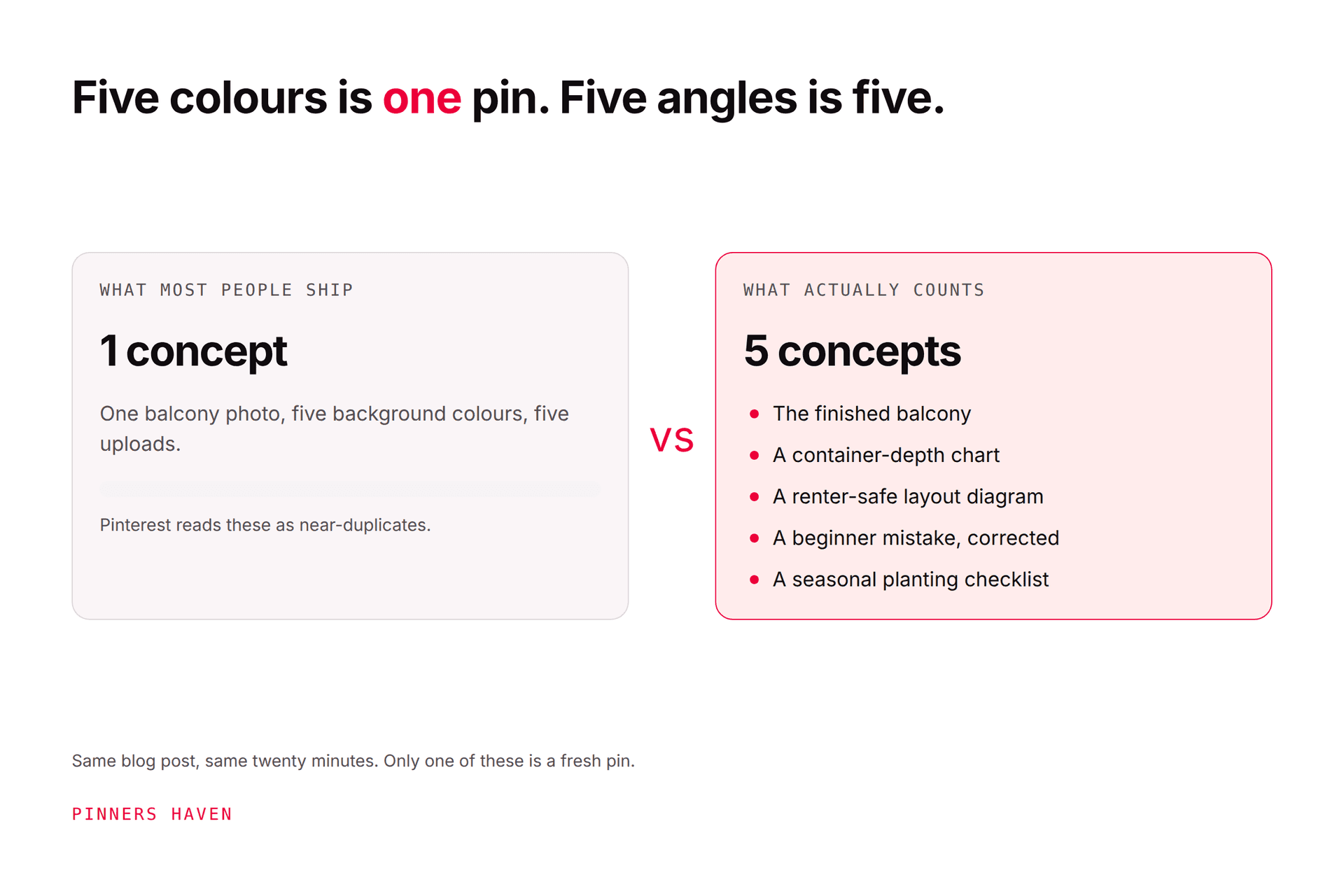
Most people diagnose everything as production and respond by trying to work faster. If your real problem is inventory, working faster just gets you to the duplicate wall sooner, and duplicates are what Pinterest's distribution guidance warns can get you flagged as spam and temporarily blocked.
You might be thinking: "It's obviously all three." Often true. Fix them in order anyway, because inventory sets the ceiling for everything above it.

Fix 1 — set a rate you can actually hold
The rate is the decision everything else inherits, and most people set it by copying someone else's number.
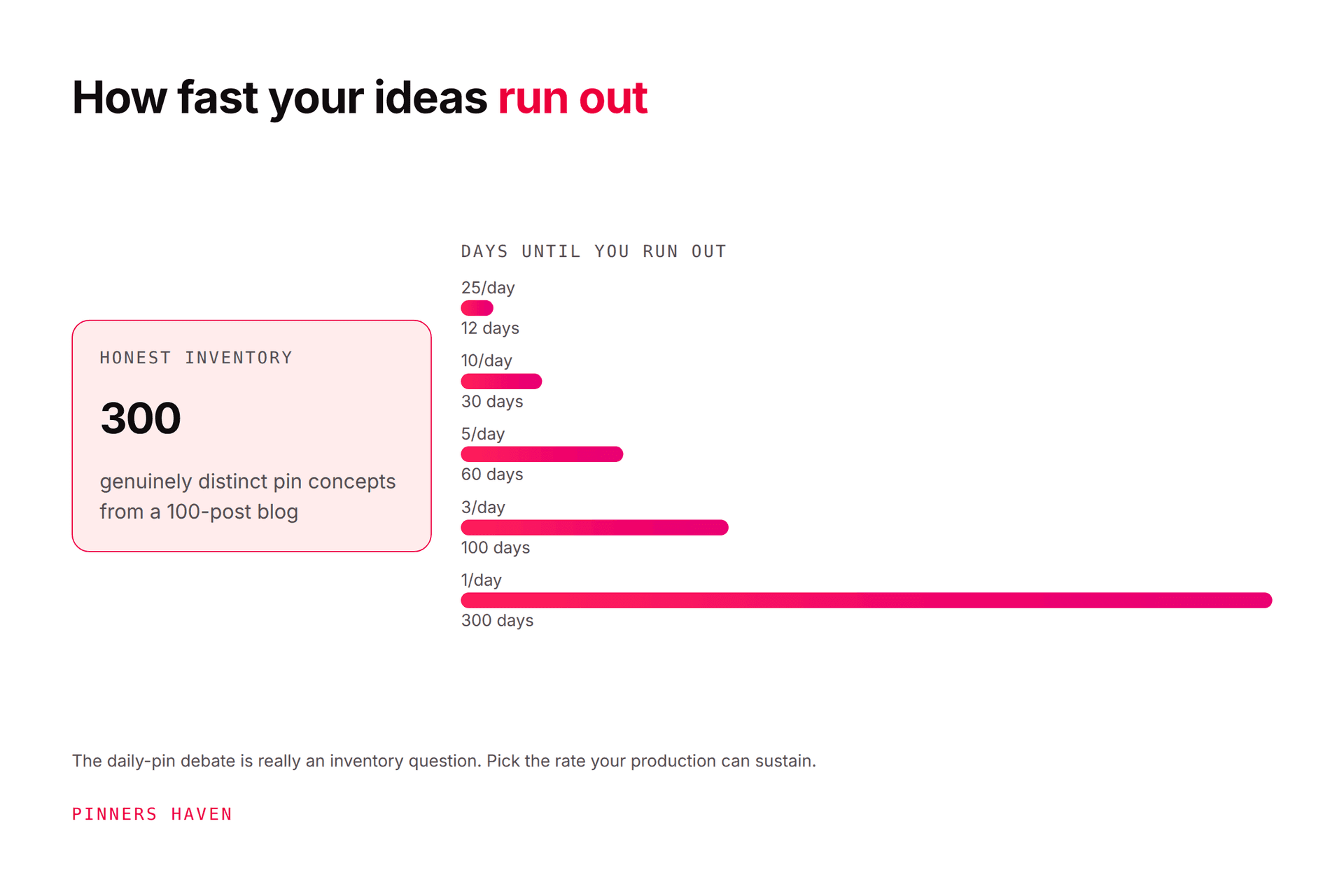
Do the division instead. Take your published pages, multiply by roughly three honest concepts each, and divide by 90 days. That's your sustainable daily rate, and for most one-person operations it lands between one and five pins a day. The full working, including why the popular "25 a day" figure breaks down, is in how often should you pin on Pinterest.
Two rules that save a lot of grief:
Round down. A rate you beat feels like winning. A rate you miss feels like failing, and that feeling is what makes people stop opening the tab.
Set it for your worst month, not your best. December you and March you are different people with different amounts of time. Schedule for March.
Pinterest's own written guidance asks for original content weekly, so even a genuinely modest rate is inside best practice. You have far more permission to go slow than the Pinterest advice industry suggests.
Fix 2 — batch production, and batch it in stages
Making three pins a day, every day, is a terrible way to make ninety pins. You pay the setup cost thirty times over and the context switch is brutal.
Batch monthly, and here's the part that matters: batch by stage, not by pin. Do not build one complete pin start to finish and then start the next one. Do every step for every pin before moving to the next step.
A realistic monthly session for 60 to 90 pins:
Stage | What you do | Rough time |
|---|---|---|
1. Concepts | List destinations, write 2–4 distinct concepts each. Stop when ideas turn cosmetic. | 30 min |
2. Design | Build every image in one sitting, in the same tool, in one headspace | 90 min |
3. Copy | Write every title and description together, so they don't repeat each other | 45 min |
4. Queue | Load everything, assign boards, space the dates | 30 min |
Call it three to four hours a month. That is the entire job, and it is dramatically less than the same work done daily in fifteen-minute fragments.
Stage 3 is where the quality difference shows up. Writing ninety descriptions in one pass means you can see when you're repeating yourself. Writing three a day means you can't, which is how people end up with sixty near-identical descriptions and no idea it happened.
Fix 3 — publish from a buffer, never live
This is the single highest-leverage change on the page, and it's the one people skip.
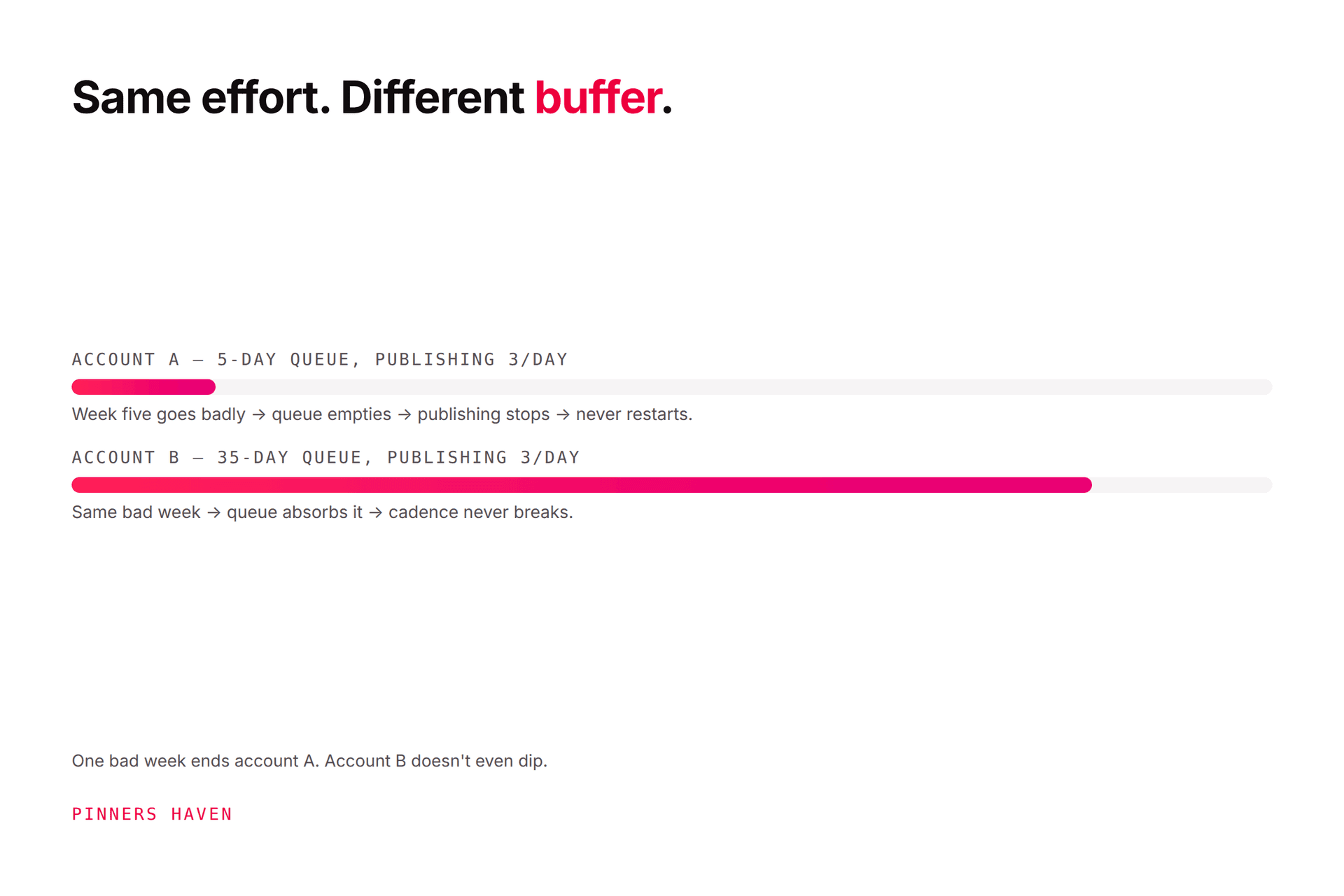
Live publishing means your streak depends on you being available every day. Queue publishing means your streak depends on work you did weeks ago. Only one of those survives a flu.
Your buffer depth, the number of days of content already queued, is the real health metric for a Pinterest account. Not follower count, not impressions. Buffer depth predicts whether you'll still be publishing in six months.
Buffer depth | What it survives | Verdict |
|---|---|---|
0–2 days | Nothing. A single busy evening breaks it | Fragile |
3–7 days | A short trip, if nothing else goes wrong | Still fragile |
14 days | Illness, a work deadline, a holiday | Workable |
30+ days | A bad month, and gives you a full batch cycle of slack | The target |
The trap is what we'd call consistency debt. Once you're publishing from a queue, it's easy to feel productive while the buffer quietly drains, because pins are still going out. You're borrowing against a batch you haven't done yet. Track the depth, not the output, and refill before it drops under fourteen days.
Get to 30 days without a heroic first batch
You don't have to build a month's queue in one weekend. Publish slightly below your sustainable rate for the first few cycles, and bank the difference.
At a sustainable three a day, publish two a day and produce three. You gain a day of buffer roughly every three days, so you reach a 30-day queue in about three months without ever working harder than your normal rate. Slow, boring, and it works.

What to cut when you fall behind
You will fall behind. The question is only what gives way, and the instinct, to stop publishing until you can do it properly again, is exactly backwards.
Cut volume. Protect cadence. Dropping from three a day to one a day is a rate change. Dropping to zero for two weeks is a gap, and gaps are far harder to come back from, both for your account's rhythm and for your willingness to reopen the tab.
In order, cut:
Volume first. Three a day becomes one a day.
Then new concepts. Publish the queue you have; don't start a new batch.
Then design ambition. A clean template beats a beautiful pin that never ships.
Never the queue itself. If the buffer hits zero you have to rebuild the habit from nothing, and that's the part almost nobody does twice.
To be straight with you about expectations: a reduced rate for a month will probably show up in your reach. That's a real cost and it's worth naming. It is still cheaper than a two-month gap, and far cheaper than quitting, which is what usually happens instead.
When batching still isn't enough
Everything above is achievable by hand, and plenty of people run good Pinterest accounts exactly this way. Here's where it tends to break anyway.
The monthly batch is fine at 30 pins. At 90 it's a long afternoon. At 300, across several sites, it stops being a batch and becomes a second job, and the first thing that gets sacrificed is stage 3, the copy, because it's the least visible. That's how accounts drift into sixty variations of the same description without anyone deciding to.
That's the specific gap Pinners Haven is built to close. It writes up to 20 angles for one topic so a single page yields real keyword surface, generates an SEO title with three to five unique description variations per pin so the copy never collapses into repetition, designs original images rather than recycling one layout, and publishes on a paced cadence you set. Its Freshness Meter retires a design after roughly five to ten uses, which handles the template fatigue you'd otherwise never notice. Nothing goes out until you approve it.
The honest caveat: it removes the production and attention failures, and it does nothing about inventory. If your library only supports one pin a day, this changes nothing about that number. Fix 1 is still yours. Solo is $41/mo billed annually for 3 sites and 900 pins a month, with a 14-day trial. No card is needed; when the trial ends, publishing pauses until you pick a plan.
(Disclosure: we make Pinners Haven. We're not affiliated with Pinterest.)
Frequently asked questions
How often do I need to post on Pinterest to stay consistent?
Pinterest's written guidance asks for original content weekly. Beyond that, consistency means holding whatever rate you chose without gaps, and a sustained one pin a day beats an erratic five. The arithmetic for setting your rate is in how often to pin on Pinterest.
Will taking a break hurt my Pinterest account?
A gap doesn't trigger a penalty, and Pinterest notes pins can gain engagement long after publication, so existing content keeps working. What a break costs you is momentum and the habit itself. Reducing your rate is almost always better than pausing.
How far ahead should I schedule pins?
Aim for a 30-day queue. Pinterest's native scheduler caps you at 10 scheduled pins up to 30 days out, so a deeper buffer means either an approved third-party tool or batching your uploads. See how to schedule pins for the free options.
Is it better to post daily or a big batch weekly?
Publish daily from a queue; produce in a monthly batch. Those aren't in conflict, they're the whole system. Bursts of similar pins sent out together are the pattern most associated with duplicate flags, so batch the making, not the publishing.
How long before consistent pinning shows results?
Judge over a full seasonal cycle rather than a few weeks. Pinterest is a planning platform, so demand for your topic moves with the calendar, and a fair read needs roughly 90 days minimum. That window is also why your buffer needs to survive it.
What if I genuinely don't have time to make pins?
Then your rate is too high for your current capacity, and that's a legitimate answer rather than a failure. Drop to the rate you can hold, even if it's two pins a week, and raise it when something changes. A small real cadence compounds; an aspirational one doesn't.
The account that wins is the one still publishing
Nobody's Pinterest account fails because they pinned three a day instead of twenty-five. They fail because month four arrived and there was nothing in the queue.
So work backwards from that. Pick a rate you'd still hit on a bad week, batch it monthly in stages, and build the buffer to thirty days before you even think about scaling up. It is a far less exciting plan than most Pinterest advice, and it's the one that's still running next spring.
You've got this. Start with the rate.