Pinterest Algorithm: What Actually Affects Pin Distribution
Search "Pinterest algorithm" and you'll be told there are exactly four ranking factors, that every pin has a 48-hour window, and that you must publish precisely fifteen pins a day. All three are folklore. One of them — the 48-hour window — is directly contradicted by Pinterest's own documentation.
Joe Nyambura
Founder & operator, Pinners Haven · August 18, 2026
On this page31 sections
- One name, several ranking problems
- The signals Pinterest actually documents
- Relevance
- Originality and usefulness
- Creative quality
- Engagement
- Context and timing
- Account and destination trust
- Five algorithm claims to treat carefully
- "Every pin only has 24 or 48 hours"
- "There are exactly four ranking factors"
- "You must publish N pins every day"
- "Followers determine reach"
- "A drop proves a penalty"
- A practical optimisation loop
- 1. Choose one intent
- 2. Build the destination first
- 3. Create distinct pin concepts
- 4. Add accurate context
- 5. Publish with sensible lead time
- 6. Read the metric sequence
- 7. Change one major variable
- Where the loop actually breaks
- Frequently asked questions
- How often does Pinterest update its algorithm?
- Do hashtags help?
- Should I delete low-performing pins?
- Does AI-generated content rank?
- Why does one pin do well in search but get no home-feed reach?
- Does posting time matter?
- Optimise for understanding, not for theories
Search "Pinterest algorithm" and you'll be told there are exactly four ranking factors, that every pin has a 48-hour window, and that you must publish precisely fifteen pins a day. All three are folklore. One of them — the 48-hour window — is directly contradicted by Pinterest's own documentation.
So let's do the less exciting, more useful thing.
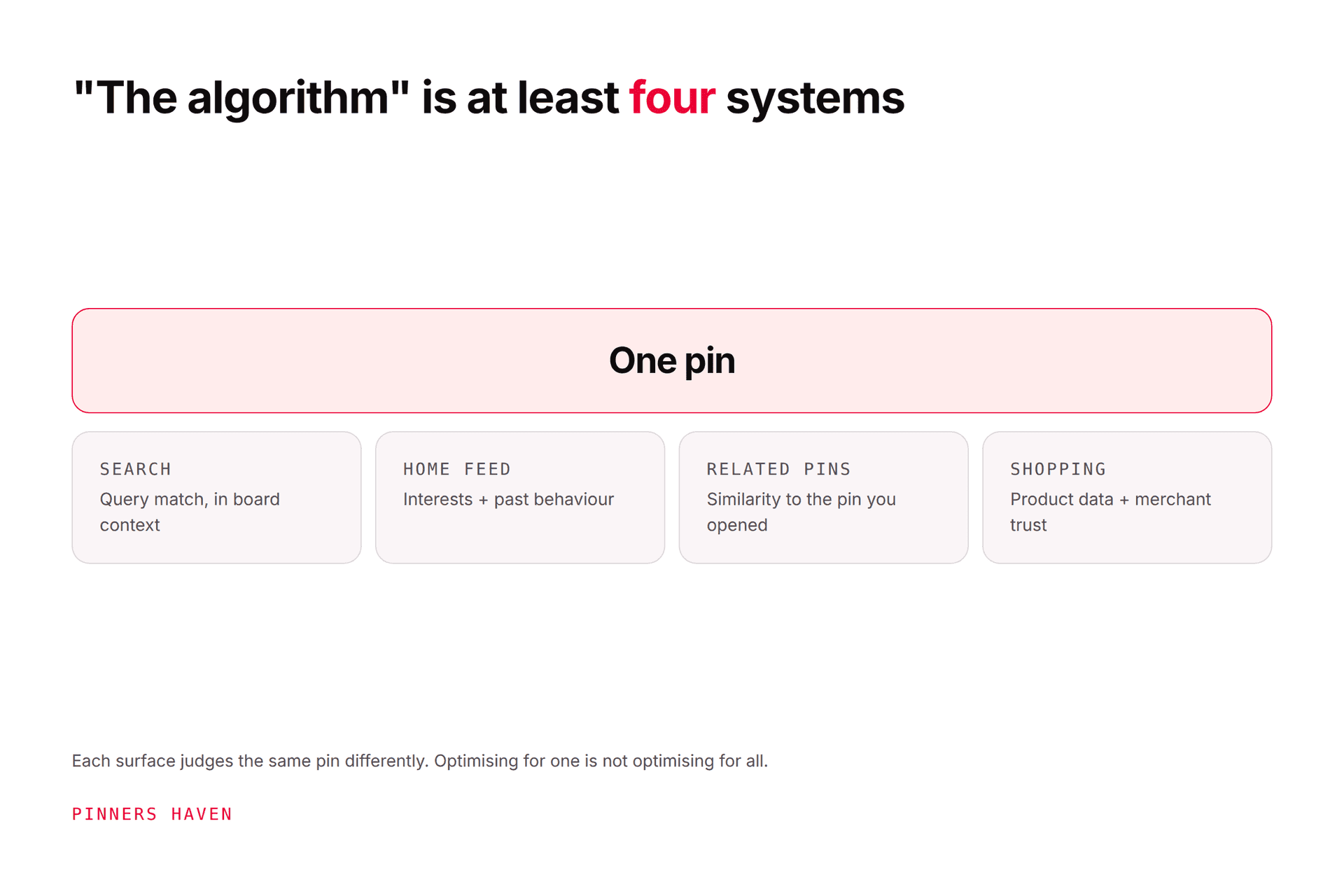
Pinterest's algorithm is not one public formula. It's a set of machine-learning systems ranking and recommending pins across search, the home feed, related content, and shopping — each solving a different problem. Pinterest's own guidance points at relevance, original useful content, clear context, engagement, seasonality, quality, and policy compliance. It does not publish weights, a factor count, or a timer.
That's a less satisfying answer than a secret hack. It's also the only one that won't waste your next six months.
One name, several ranking problems
Pinterest has to answer genuinely different questions depending on where a pin appears:
In search, which pins best match this query and the intent behind it?
In the home feed, which ideas fit this person's interests right now?
Around a pin, which related ideas are useful next?
In shopping, which product information is relevant and current?
Pinterest's AI transparency page explains that machine learning powers recommendations, ranking, safety, and other features.
Collapsing all of that into "the algorithm" is convenient shorthand, and it's also why people get confused when a pin ranks well for its keyword but never shows up in anyone's feed. Those are different systems with different jobs. Nothing is broken.

The signals Pinterest actually documents
Relevance
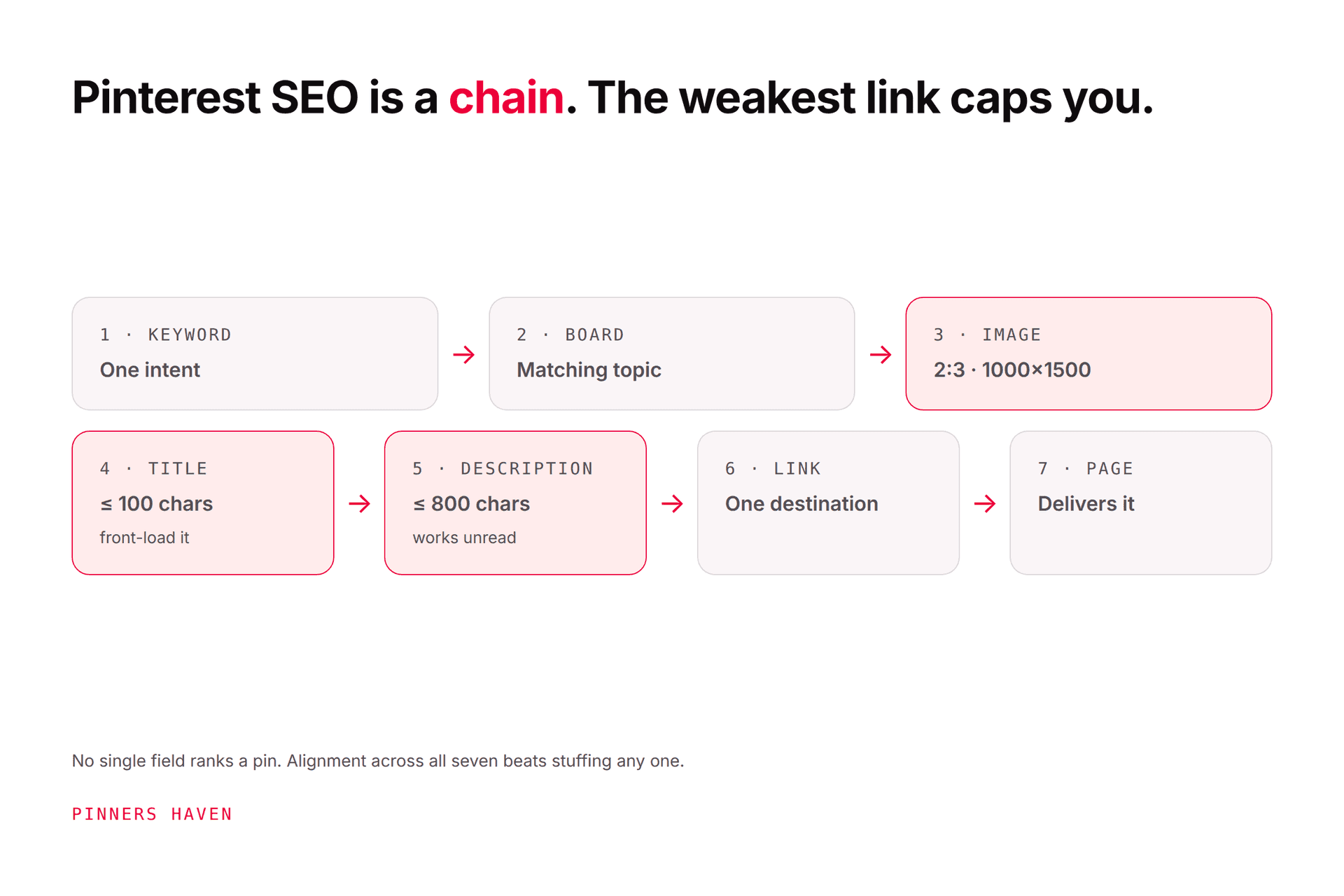
The system needs enough context to understand what it's looking at. Pinterest advises a clear title, description, link, and relevant board, and the image, the copy, and the destination all need to promise the same thing.
Use a natural primary phrase where it genuinely helps a person understand the pin. Add related language only when it describes what's actually on the page. Our Pinterest SEO guide covers this alignment properly.
Originality and usefulness
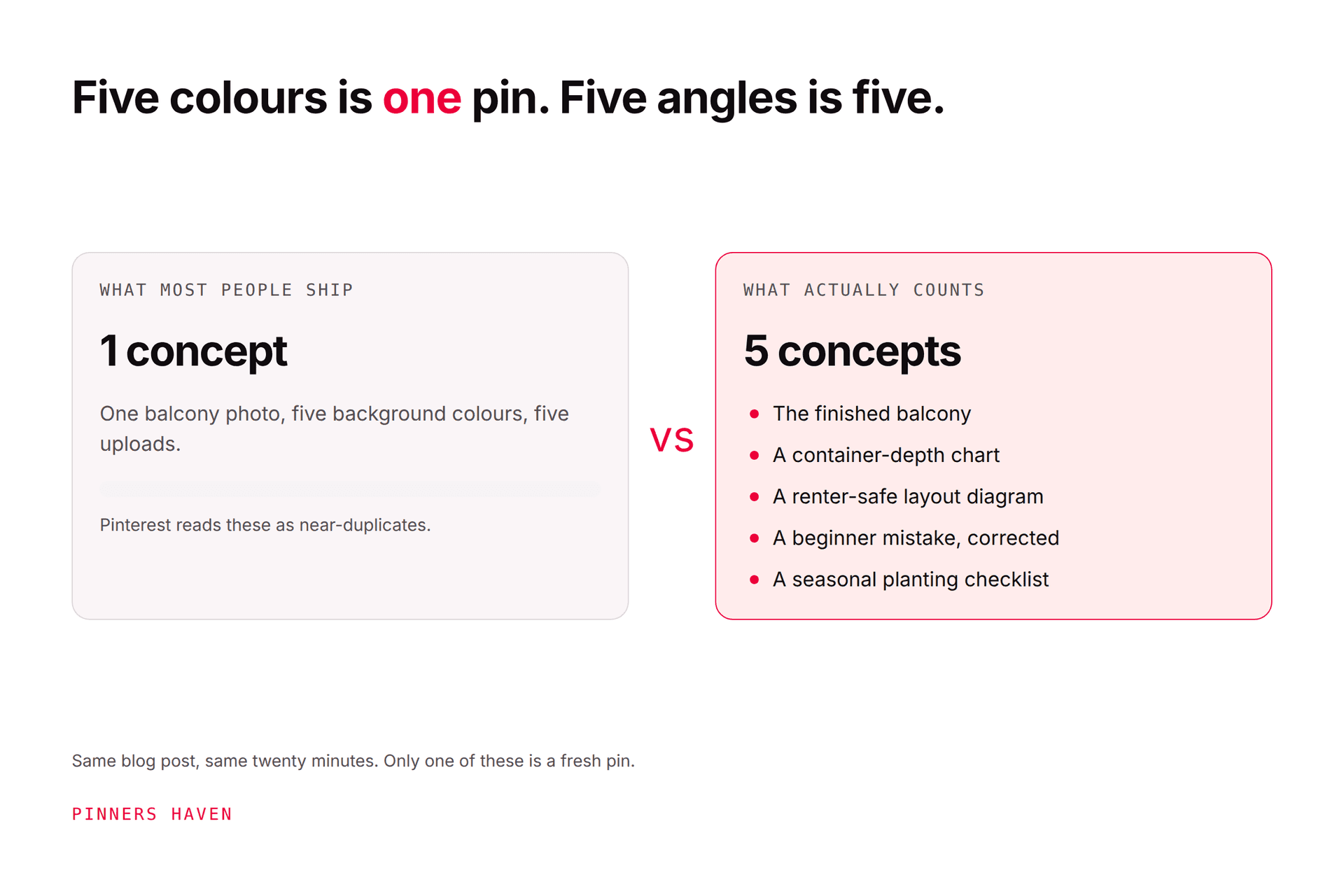
Pinterest's pin distribution guidance recommends publishing original content weekly. "Original" means a distinct, useful creative idea, not a colour swap posted repeatedly to the same URL. Our fresh pins guide draws that line precisely, because it's the one most people get wrong.
A useful pin sets an honest expectation and leads to a page that finishes the job. Thin, copied, unsafe, or unrelated destinations create a bad experience no matter how good the graphic is.
Creative quality
Pinterest recommends high-quality vertical creative, commonly 2:3, with video guidance in the 15–60 second range. The practical reason is unglamorous: the idea has to be legible on a phone, at thumbnail size, while someone scrolls past it.
Quality here means:
one clear visual subject
text that's readable at feed size, not just on your monitor
a headline that's accurate
brand recognition without crowding
enough contrast
a destination that matches
Engagement
Pinterest says searches, saves, engagement, and relevance can all affect distribution. Each action means something slightly different: a save suggests future value, a pin click suggests interest in detail, an outbound click suggests the promise was strong enough to leave the platform.
Don't reduce this to a magic ratio. What good looks like depends entirely on the content and the goal. A recipe earns saves before clicks. A product comparison may earn fewer saves and far more qualified outbound visits, and be the more valuable pin.
Context and timing
Language, location, season, holiday timing, format, and live trends all move demand independently of your work. A genuinely strong Christmas idea published in December has excellent content and terrible timing.
Use Pinterest Trends to find the curve, then publish early enough for both discovery and production lead time. Our keyword research process covers connecting trend language back to intent.
Account and destination trust
Pinterest's Community Guidelines prohibit repetitive or irrelevant content, manipulative engagement, deceptive behaviour, and unauthorised automation.
Policy systems and ranking systems aren't the same thing, but the practical effect overlaps: behaviour that triggers enforcement will obviously limit your reach. Keep links safe and accurate, and never create additional accounts to manufacture engagement.
Five algorithm claims to treat carefully
"Every pin only has 24 or 48 hours"
Pinterest explicitly says there is no set engagement window, and that a pin may pick up engagement hours, days, months, or years after publication.
This one deserves singling out because it drives genuinely bad behaviour — people delete pins that "failed," panic-publish to beat an imaginary clock, and conclude they're penalised when a pin is quiet for a fortnight. Early performance is informative. It is not an expiry timer.
"There are exactly four ranking factors"
Four-part frameworks are useful teaching devices and they're not evidence. Nothing indicates Pinterest uses four signals, or assigns them stable weights, or applies the same ones across surfaces. Machine-learning systems change continuously.
"You must publish N pins every day"
Pinterest recommends consistent original content. It does not publish a daily quota. A sustainable weekly cadence pointed at useful destinations beats flooding the platform with near-duplicates, and the flooding approach carries real enforcement risk.
"Followers determine reach"
Followers matter, but Pinterest distributes heavily through search and recommendations. Topic fit, query relevance, and individual interest all give your content routes that bypass your follower count entirely, which is exactly why small accounts can outperform big ones on a specific query.
"A drop proves a penalty"
Seasonality, lost search demand, creative fatigue, broken pages, measurement changes, policy action, and ordinary platform testing all produce declines that look identical. Work the impressions troubleshooting guide before concluding anything, and read the shadowban guide before using that word.
A practical optimisation loop
1. Choose one intent
Write down the exact task the searcher wants done. "Small pantry organisation ideas" is a brief. "Home inspiration" is a wish.
2. Build the destination first
Answer the query with original examples, steps, photos, data, or tools. Make it fast and usable on a phone. Pinning to a weak page just distributes disappointment more efficiently.
3. Create distinct pin concepts
Genuinely different promises: a finished result, a mistake to avoid, a step-by-step, a comparison, a checklist. Not identical copy on five barely-changed templates.
4. Add accurate context
Descriptive title, natural description, relevant board, correct link, required commercial disclosures. Text on the creative should match the destination — if the pin says "free printable," the page had better have one.
5. Publish with sensible lead time
For seasonal topics, work backwards from when people start planning, not from the event. For evergreen work, pick a pace your editorial process can genuinely sustain.
6. Read the metric sequence
Pinterest Analytics defines impressions, saves, pin clicks, and outbound clicks. Read them in order, because where the sequence breaks tells you what to fix:
Where it breaks | Likely cause |
|---|---|
Low impressions | Limited demand, relevance, distribution, or timing |
Impressions, no pin clicks | Weak visual or headline appeal |
Pin clicks, no outbound clicks | Closeup answered it, or the destination promise is weak |
Outbound clicks, no site outcomes | Landing page or offer problem |
Pinterest notes the latest 48 hours of real-time estimates can change. Don't make big decisions off one noisy day.
7. Change one major variable
Test a new concept, audience angle, keyword intent, or destination improvement. Record the date. Compare a reasonable window. Change everything at once and you'll learn nothing, which is how most people spend a quarter.

Where the loop actually breaks
Read step 6 and 7 again and notice what they demand: measuring saves and outbound clicks per pin, then deliberately making more of what worked and less of what didn't.
Almost nobody does this. Not through laziness, because doing it by hand across a few hundred pins means a spreadsheet nobody maintains past week three. So people optimise on impressions instead, because impressions are the number Analytics shows first, and impressions are the metric that matters least.
That gap is what Pinners Haven was built around. It measures saves and outbound clicks per pin rather than impressions, and biases new generation toward the angles and designs that are actually earning them, so the results compound instead of restarting each time you sit down. It also runs the earlier parts of the loop: twenty angles per topic to widen keyword surface, original designs per pin, and a Freshness Meter that retires a template after roughly five to ten uses before sameness drags distribution down.
None of that beats the algorithm. There's nothing to beat. It just runs the documented loop above consistently, which is the part humans reliably stop doing around week six.
(Disclosure: we make Pinners Haven. We're not affiliated with Pinterest.)
Frequently asked questions
How often does Pinterest update its algorithm?
There's no public schedule. Machine-learning and product systems can evolve continuously, while larger features get announced separately. This is precisely why "the algorithm changed" is such a popular explanation — it can never be disproved.
Do hashtags help?
Don't rely on them as a ranking shortcut. Write clear, natural titles and descriptions that accurately describe the content and intent; that's the documented lever.
Should I delete low-performing pins?
Usually not just because the first week was quiet — Pinterest says pins can gain engagement much later, so you may be deleting a slow winner. Remove content that's inaccurate, unsafe, duplicated, off-brand, or pointing at a broken page.
Does AI-generated content rank?
Origin alone neither guarantees nor prevents distribution. Generated or modified content still needs accuracy, rights, relevance, quality, correct labelling where applicable, and policy compliance. See our AI Modified explainer.
Why does one pin do well in search but get no home-feed reach?
Because those are different ranking problems, as above. Strong query relevance doesn't imply strong interest-graph fit for any particular user. This is normal and isn't a sign of anything wrong.
Does posting time matter?
Less than the folklore suggests, and it's the most over-optimised variable in Pinterest marketing. Relevance, originality, and consistency move distribution far more. Our best time to post guide covers what the data supports and what it doesn't.
Optimise for understanding, not for theories
The most durable strategy here is to help Pinterest and the reader understand the same thing: what the pin offers, who it helps, and what happens after the click.
Clear intent and genuinely useful content outlast every framework built around a hidden timer — including whichever one is circulating this month.
See also: how Pinterest's AI actually works in 2026, layer by layer.