Best Time to Post on Pinterest: A Data-Backed Answer
If you need a starting window, current Sprout Social data suggests posting on Pinterest Tuesday through Thursday from 10 a.m. to 1 p.m. in your audience's local time. Treat that as a benchmark, not a universal rule. Sprout analyzed nearly two billion engagements across about 307,000 profiles and 30,000 customers fro
JN
Joe Nyambura
Founder & operator, Pinners Haven · August 18, 2026
If you need a starting window, current Sprout Social data suggests posting on Pinterest Tuesday through Thursday from 10 a.m. to 1 p.m. in your audience's local time. Treat that as a benchmark, not a universal rule. Sprout analyzed nearly two billion engagements across about 307,000 profiles and 30,000 customers from November 27, 2025 through February 27, 2026. Sprout Social's current timing study
Other datasets disagree. Hootsuite's current analysis highlights noon on Tuesday and Friday. Different customers, industries, metrics, and methods produce different winners. Your best time is when your audience is planning, and Pinterest content can continue circulating after publication.
Current best-time benchmark
Sprout's global Pinterest engagement windows are:
Day
Starting benchmark
Monday
Weaker than midweek; test around late morning
Tuesday
10 a.m.–1 p.m.
Wednesday
10 a.m.–1 p.m.
Thursday
10 a.m.–1 p.m.
Friday
Secondary test day; another dataset favors noon
Saturday
Generally weaker in Sprout's dataset
Sunday
Generally weaker in Sprout's dataset
These are broad engagement averages, not Pinterest's official organic ranking rule. Sprout advises brands to use their own top-post history and notes that audience, industry, and time zone change the answer. Sprout reporting guidance
Why timing studies disagree
"Best time" depends on what was measured:
impressions, engagement, clicks, or conversions;
organic content, ads, or both;
global accounts or one market;
publisher time or audience-local time;
all industries combined or one niche;
median performance or a peak average;
recent weeks or a full seasonal cycle.
Hootsuite's current published benchmark favors noon on Tuesday and Friday, while Sprout's larger current window favors midweek late mornings through early afternoon. Hootsuite social timing study
The honest conclusion is not that one source is wrong. It is that a general average should supply your first test slots, not your permanent schedule.
Pinterest timing is more than the hour
Planning lead time
A holiday Pin published on the holiday itself can be too late because people searched, saved, compared, and bought earlier. Use Pinterest Trends to see when interest starts rising in your target region, then publish early enough for planning and iteration. Pinterest Trends values are normalized, not absolute search volume. Pinterest Trends
Audience time zone
Schedule for the people you want to reach. If the audience spans several zones, test overlapping windows or stagger original content. Do not convert 10 a.m. into your location without identifying which audience the benchmark describes.
Content intent
A weeknight recipe planner, workday B2B template, and wedding inspiration board may have different usage patterns. Compare timing within similar topics and formats.
Content lifespan
Pinterest distribution can continue as people discover and save Pins. Timing may affect the first response, but relevance, search demand, board context, creative quality, and destination match determine whether the Pin remains useful.
Find your best time in four weeks
1. Choose comparable Pins
Prepare at least 12 Pins across three or four closely related topics. Keep quality and destination type reasonably consistent. Do not compare a proven viral recipe with an unrelated new product and attribute the difference to the clock.
2. Select test windows
Use four audience-local windows:
midweek late morning, 10 a.m.–1 p.m.;
midweek evening;
Friday around noon;
weekend morning or evening.
Rotate topics across windows so each window receives a fair mix.
3. Publish consistently
Schedule the test across four weeks, and record the actual publish time and the target timezone for every pin — this is the detail that ruins otherwise good timing tests, especially around daylight-saving transitions. Any scheduler that spaces publication and reports pin and board performance will do; Pinners Haven does both.
4. Compare the right metrics
Use fixed post-publication windows, such as the first 24 hours, seven days, and 28 days. Pinterest Analytics reports impressions, saves, Pin clicks, and outbound clicks; real-time values are estimates and may change. Pinterest Analytics
Choose the metric that matches the job:
awareness: qualified impressions and saves;
traffic: outbound clicks and rate;
sales/leads: destination conversions;
audience building: follows attributed to Pins.
5. Keep a winner only when the pattern repeats
One unusually strong Pin does not prove a time slot. Look for repeatable differences across several Pins and weeks. Retest when the season, audience, region, or content mix changes.
Common timing mistakes
Converting a benchmark to the publisher's time zone instead of the audience's.
Publishing seasonal content after planning has peaked.
Testing different times with completely different topics.
Choosing the slot with the most impressions when the goal is sales.
Posting a large burst at the "best" minute.
Treating old charts as permanent Pinterest facts.
Frequently asked questions
What is the best day to post on Pinterest?
The latest broad Sprout study favors Tuesday through Thursday, while other datasets differ. Begin there and test against your audience data.
Is morning or evening better?
Current Sprout data favors late morning through early afternoon on midweek days. Audience behavior and niche can make evenings stronger, so include both in a controlled test.
Does posting time matter on Pinterest?
It can affect early exposure and response, but it is only one variable. Topic timing, relevance, original creative, board context, and destination quality often matter more over a Pin's life.
Should I post every day?
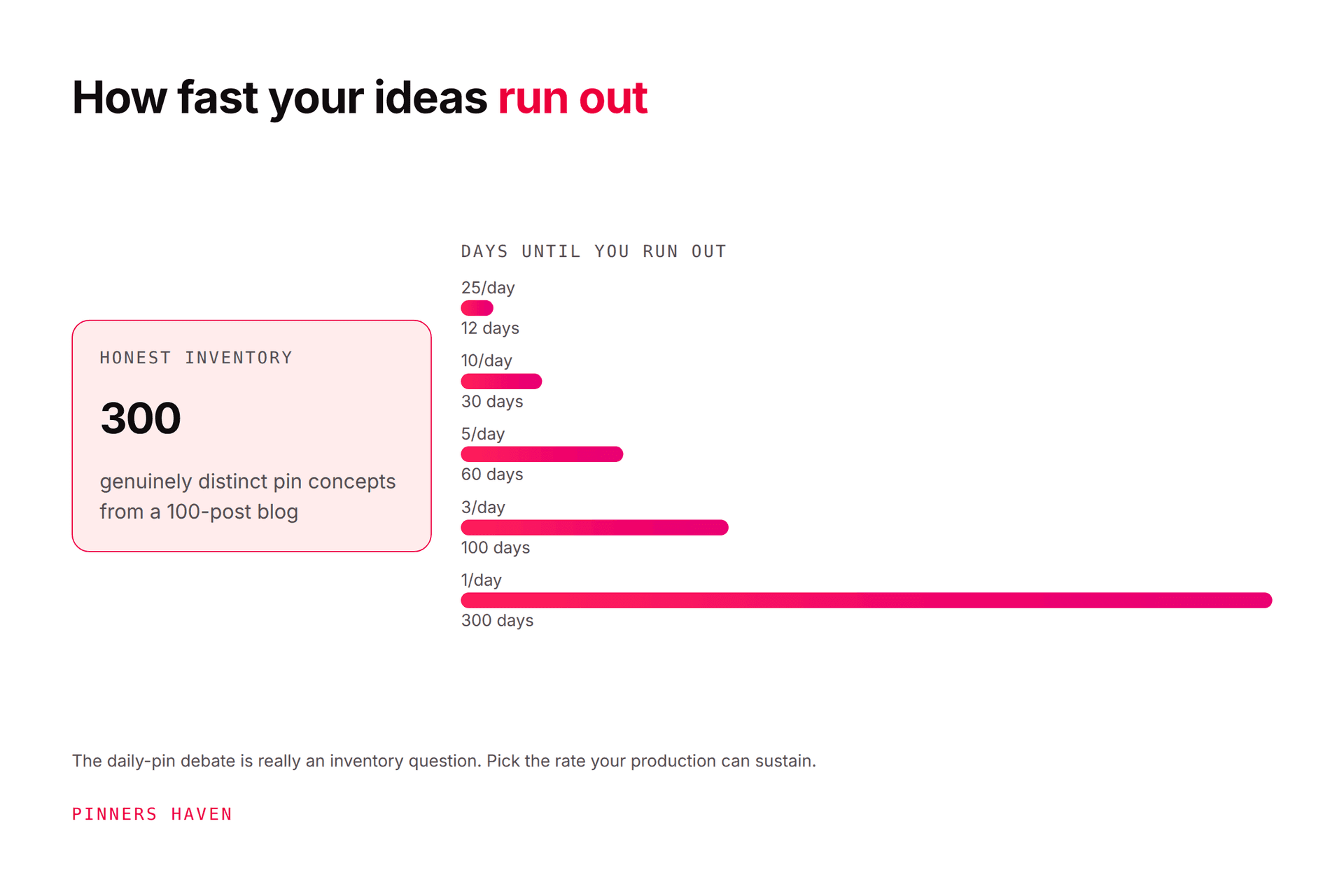
Not because a timing chart says so. Publish at a sustainable pace with original, reviewed content. Consistency helps testing; arbitrary daily volume does not guarantee distribution. For the arithmetic behind setting that pace, see how often to pin on Pinterest, and how to post consistently for holding it.
Which time zone should I use?
Use the time zone of the target audience or your largest relevant audience segment. For a global audience, test staggered windows and compare by market where data allows.
Use the benchmark, then replace it
Start with the strongest current general evidence: midweek from late morning to early afternoon. Within a month, your own controlled results should begin replacing that borrowed average. Keep testing the calendar as well as the clock, because arriving before the planning wave matters more than publishing at a supposedly perfect minute.
Where timing actually sits in the hierarchy: it is the most over-optimised variable in Pinterest marketing. Relevance, originality, and consistency move distribution far more than the hour you publish, and Pinterest says pins can gain engagement months or years later — which caps how much any posting time can matter. Get SEO and freshness right first; treat the clock as a tiebreaker.
If holding a steady cadence is the real problem, that's what Pinners Haven automates: paced, spaced publishing on a schedule you set, with your approval on every pin. From $19/mo billed annually.