Does Pinterest Use AI? How the Algorithm Actually Works in 2026
Yes. Pinterest uses AI in three distinct layers, and its CEO said on the August 2026 earnings call that "effectively, every Pin a user sees is personalized and served by AI." Layer one is ranking and recommendation machine learning: Pinterest's help centre says it uses AI "to recommend and show the most relevant ideas
JN
Joe Nyambura
Founder & operator, Pinners Haven · August 13, 2026
You've noticed the feed knows you a little too well, you've seen "AI modified" under a pin that looked like a photograph, and you've read three forum threads arguing about whether "the algorithm" is a person, a rule, or a robot. Fair question, and most answers to it are either a shrug or a conspiracy. Here's the plain version, with Pinterest's own words next to each claim.
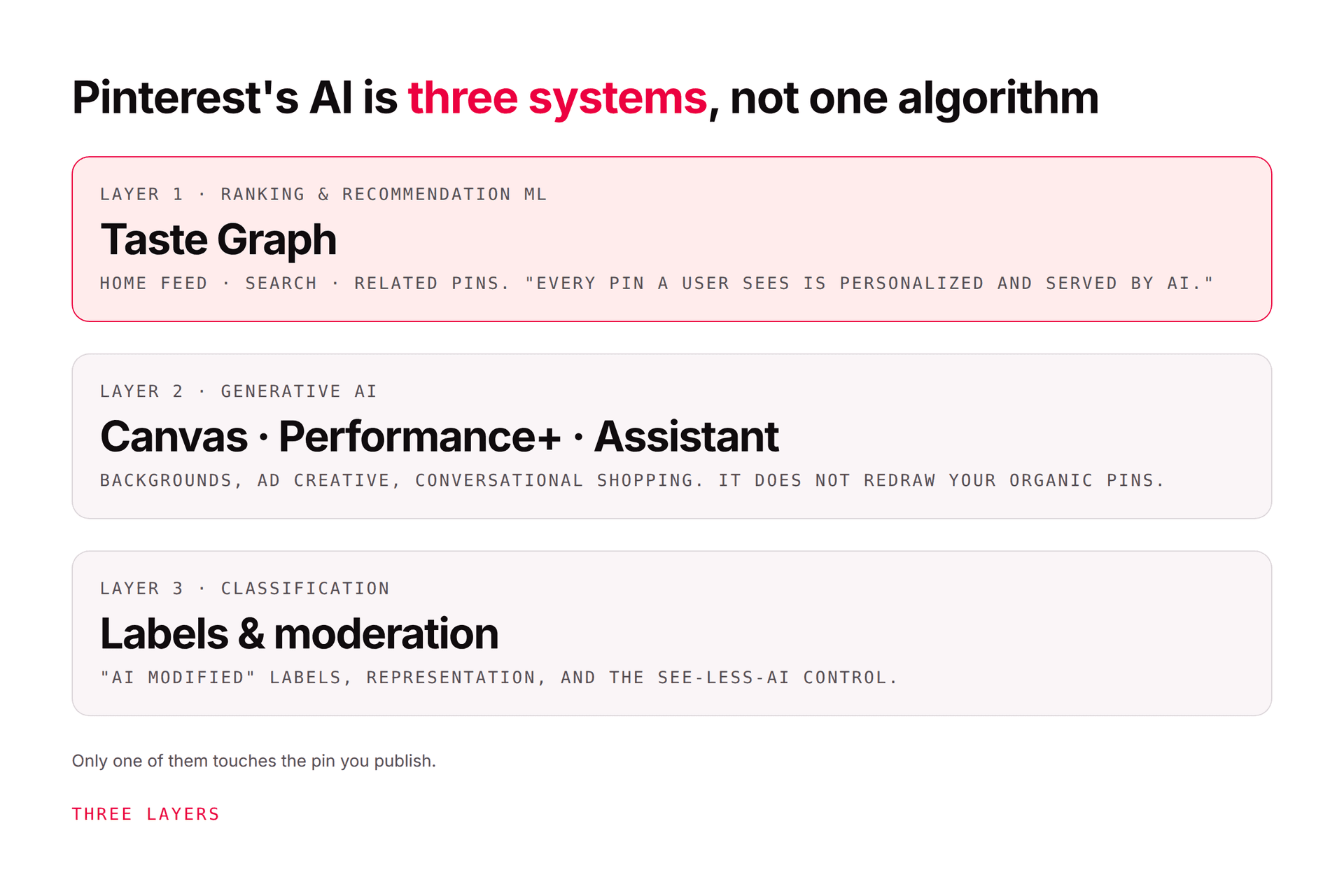
Yes. Pinterest uses AI in three distinct layers, and its CEO said on the August 2026 earnings call that "effectively, every Pin a user sees is personalized and served by AI." Layer one is ranking and recommendation machine learning: Pinterest's help centre says it uses AI "to recommend and show the most relevant ideas across home feed, search and related feeds," driven by what it calls its proprietary Taste Graph. Layer two is generative AI: Pinterest Canvas (its image-generation model) for product backgrounds, Performance+ creative for ads, and Pinterest Assistant, a visual-first conversational layer available to most US users since the end of July 2026. Layer three is classification: the "AI modified" labels on image pins, content moderation, and representation in feeds. Pinterest does not generate the pins in your feed; it ranks, labels, and assists around them. Here's each layer, a dated 2026 timeline, and what every one of them does to your pin.
Layer 1: the AI that decides what you see (ranking and recommendation)
This is the layer people mean by "the Pinterest algorithm," and it's the oldest. Pinterest's AI at Pinterest page says it uses AI "to recommend and show the most relevant ideas across home feed, search and related feeds." On the Q2 2026 call, Bill Ready described the engine as "our proprietary Taste Graph," built to personalise "with a deep understanding of taste, context and intent," and added a number worth remembering: "over 96% of text-based searches on our platform are unbranded." People come to Pinterest to search for ideas, not brands, and the ranking layer's job is to match those searches to pins.
What it's known to read, per Pinterest's own distribution guidance: the text on the pin (title, description, link), whether the pin's images, text, and keywords match the landing page, which board it's saved to, whether the content is original or a repeat of what already exists, and how people respond to it; Pinterest "uses that engagement information to determine what content is most relevant to share with people." It also says there's "no set engagement window," so a pin can be picked up months after publishing.
What it doesn't publish: weights, thresholds, or a list of "ranking factors." Anyone selling you the four factors is guessing. Pinterest algorithm: what actually affects distribution goes signal by signal and separates the documented from the folklore.
What this layer does to your pin: it decides whether your pin is shown, to whom, and on which surface, based on relevance, match, originality, and response. It is indifferent to whether a human or a model drew the image. It is not indifferent to forty near-identical pins.
Layer 2: the AI that makes things (generative)
Here's the thing nobody tells you: most of Pinterest's generative AI in 2026 is pointed at advertisers and shoppers, not at your organic pins.
Pinterest Canvas is Pinterest's image-generation foundation model, used for "creation of backgrounds on product images," per the help page. Pinterest's transparency material says a version was trained on roughly 500 million rows from publicly available pins, descriptions, and metadata plus licensed and synthetic data, which our Pinterest AI explainer covers, along with how to opt your pins out of training.
Performance+ is Pinterest's AI-driven ads suite. At Cannes in June 2026 Pinterest announced a new creative-selection model that "increased click volume by 7.5% compared to the previous singular variant model" in testing, plus a Business Assistant in closed beta and a Pinterest MCP for advertisers' agentic tools. On the Q2 call, Ready said "approximately 30% of our lower funnel revenue was running through Performance+ campaigns as of Q1."
Pinterest Assistant is the user-facing one: a "visual-first" conversational layer, launched in beta in October 2025, that blends images, voice, and text, leans on the Taste Graph, and, per Pinterest, outperforms off-the-shelf models "by over 30% on the relevancy of shopping recommendations." Ready said it was available "to the vast majority of U.S. users as of the end of July" 2026 and "helps our users answer those later-stage research questions."
Ask Pinterest, a limited-access app, is where Pinterest says it's experimenting with "the next generation of AI-powered shopping experiences."
What this layer does to your pin: mostly nothing, directly. If you run ads, Performance+ may pick which of your creative variants to show. If a shopper asks the Assistant for "a linen apron like this but in green," your product pin is a candidate if the ranking layer thinks it matches. The generative layer doesn't redraw your organic pins or write your descriptions; that's still you, or your tools.
Layer 3: the AI that labels and polices (classification)
The third layer is the one creators bump into most. Pinterest's help page says it uses AI to "enhance our content moderation systems," to "increase inclusive representation across Pinterest's recommendation feeds, such as diverse body types," and to identify AI-generated or modified images: "Pinterest will show a label on the close-up of an image Pin" when its systems, creator disclosure, or metadata indicate AI. It also says it uses "human reviewers and feedback from the public to refine our AI."
The same layer powers the user control: "Refine your recommendations in your settings to see less AI content in certain categories on your feed." That's "less," not "none," and how to turn off AI on Pinterest sets the honest expectation. What "AI modified" means covers the label itself and how to appeal a wrong one.
What this layer does to your pin: it may label it if the image was generated or materially edited with AI (or if your metadata says so), it may remove it if it breaks policy, and it may show it to fewer people who've asked to see less AI content in that category. It doesn't down-rank a labelled pin in search by default; Pinterest has said the label is a disclosure, not a penalty, and that reach follows relevance and engagement.
The 2026 timeline, dated
When
What Pinterest did or said
Source
30 Oct 2025
Pinterest Assistant launched in US beta: visual-first, multimodal, built on the Taste Graph
Pinterest Newsroom
24 Jan 2026
"Best ways to grow" guide: keywords in every field, weekly originals, followers a "supporting metric"
create.pinterest.com
17 Jun 2026
Cannes: Business Assistant (closed beta), Pinterest MCP (alpha), Performance+ creative model (+7.5% clicks), Ask Pinterest
Pinterest Newsroom
End Jul 2026
Assistant available to "the vast majority of U.S. users"
Q2 call
4 Aug 2026
Q2 results: 640M MAU; "every Pin a user sees is personalized and served by AI"; Performance+ ≈30% of lower-funnel revenue as of Q1; models "trained on our unique human curation of style and taste"
Press release + Q2 call
One more line from the call worth knowing if you care how the sausage is made: Ready said Pinterest's open-source-based models run at a "cost per transaction at less than 8% of the cost of comparable closed proprietary models." Pinterest's AI is large, cheap to run, and everywhere.
So how does "the algorithm" actually work, in one paragraph?
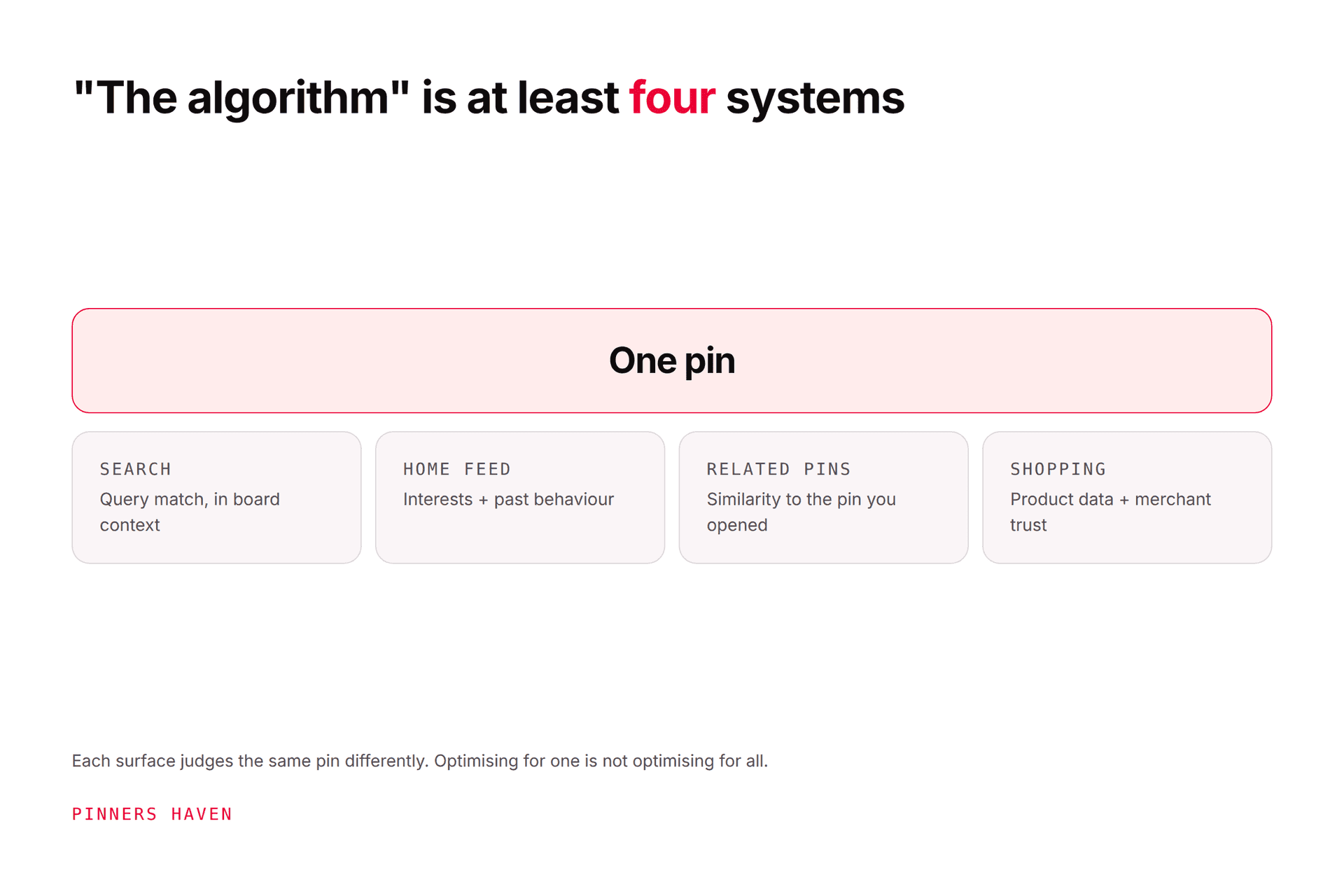
A searcher types or speaks or snaps something. The ranking layer turns that, plus what it knows about their taste, into a query against hundreds of millions of pins, scoring candidates on how well the pin's text, image, board, and landing page match the intent, how original the content is, and how people like them have responded to it. The top results are served, across home feed, search, and related pins, and each surface weighs things a little differently. Every save, click, and close-up feeds back in. Generative features sit beside that loop (Assistant helps refine the question; Performance+ picks ad creative), and classifiers label and filter what flows through it. No human ranks your pin, no chronological feed exists, and no published formula tells you the weights. What is published is what the system is looking for, and it's short: relevance, match, originality, response.
What this means for your pins
You might be thinking, "so I should optimise for the AI." Sort of. You should optimise for what Pinterest says its AI reads, which turns out to be the same list it has published for years:
Make the pin legible to the ranking layer. One search phrase per pin, title front-loaded, a real description (Pinterest uses it for relevance even when it isn't shown), the most specific board, every field filled, topics tagged. How to improve SEO on Pinterest is the tactic list.
Match the landing page. Pinterest's guidance: images, text, and keywords should match the page. In 2026 that also governs how prominent your "Visit site" button is; Pinterest traffic dropped explains.
Be original, at volume. The ranking layer rewards new ideas and Pinterest's guidance warns that repeatedly uploading existing content may get you flagged. Fresh pins on Pinterest is the standard.
Use AI honestly. Generated or materially edited images should be marked AI-modified; it's a label, not a penalty, and Pinterest's classifier may add it anyway. Quality and match decide reach.
Stop looking for the lever. There isn't a trick that beats a system reading relevance and response. There's only being the most relevant, most original answer to a real search, repeatedly.
That last point is the whole reason Pinners Haven works the way it does: it doesn't try to game the ranking layer, it feeds it what it says it wants. From a page or topic it writes a keyword-led title and three to five distinct descriptions per pin, designs an original image on a human-designed template (retired after roughly five to ten uses so you never look like a duplicate farm), marks AI-modified images, and publishes on a paced, account-safe cadence with you approving each pin. It's built for a platform where every pin is served by AI; it's not built to trick one.
(Disclosure: we make Pinners Haven. We're not affiliated with Pinterest.)
Frequently asked questions
Does Pinterest use AI to decide what I see?
Yes. Pinterest's help centre says it uses AI to recommend the most relevant ideas across home feed, search, and related feeds, and its CEO said on the August 2026 earnings call that effectively every Pin a user sees is personalised and served by AI, driven by what Pinterest calls its proprietary Taste Graph. There is no chronological feed; what you see is ranked on relevance, context, and how people like you have responded.
Does Pinterest generate the pins in my feed with AI?
No. Pinterest ranks and labels pins; it doesn't create the pins in your feed. Its generative AI in 2026 is used for product-image backgrounds (Pinterest Canvas), ad creative selection (Performance+), and the Pinterest Assistant conversational layer. Pins that were made with AI by their creators may carry an "AI modified" label, and you can set Pinterest to show less AI content in some categories.
What is Pinterest Assistant?
Pinterest's visual-first AI conversational layer, launched in US beta in October 2025 and, per the CEO on the Q2 2026 call, available to the vast majority of US users by the end of July 2026. It lets people refine searches with images, voice, and text, draws on Pinterest's Taste Graph, and is aimed at later-stage shopping and research questions. Pinterest says its multimodal model beats off-the-shelf models by over 30% on shopping relevancy.
Does Pinterest's algorithm penalise AI-generated pins?
Pinterest's published guidance ranks on relevance, pin-to-page match, originality, and engagement, not on how an image was produced, and it describes the AI-modified label as a disclosure. What does hurt AI-made pins is what hurts any pins: near-duplicate batches, mismatched landing pages, and bursts, plus users who've opted to see less AI content in a category. Mark AI use honestly and compete on match and originality.
How does the Pinterest algorithm work in 2026?
As a ranking system, not a rulebook: it scores candidate pins for a searcher's intent and taste on relevance (text, image, board, landing-page match), originality, and how similar users have responded, serves the top results across home feed, search, and related pins, and feeds every save and click back in. Pinterest publishes what it reads, not the weights, and says there's no set engagement window. Generative features and AI labels sit alongside that loop.
Can I opt my pins out of Pinterest's AI training?
Pinterest provides a setting to opt your content out of training its generative models, and site owners can use the content-claiming tools for their domains; it does not remove your pins from the ranking AI, which is how every pin is distributed. Pinterest's transparency material says its Canvas model was trained on publicly available pins plus licensed and synthetic data. Our Pinterest AI guide walks the opt-out steps.
Yes, everywhere, and it's reading the same things it always asked for
Pinterest uses AI to rank every pin, to generate shopping and ad experiences, and to label and police what flows through. The part that matters to you is the first layer, and it's reading relevance, match, originality, and response, exactly as Pinterest has documented for years. Build pins for that, mark your AI honestly, and stop hunting for the lever.
You've got the map of the machine. If you'd like pins built to what it reads, at volume, with you approving each one, that's what Pinners Haven does.