Pinterest Affiliate Program: How to Apply + Best Alternatives
Pinterest does not run an affiliate programme. Its own creator guide says "Pinterest isn't part of the affiliate agreements": you join an outside network, generate your unique product link, and use it as a pin's destination.
JN
Joe Nyambura
Founder & operator, Pinners Haven · August 10, 2026
You've searched for the Pinterest affiliate program, found a dozen pages telling you how to "apply," and still can't find the form. That's because there isn't one, and the pages that imply otherwise are selling something. Let me be honest about what to expect: the good news is that what you actually want, to earn commissions from pins, is allowed and documented by Pinterest itself; it's just not a Pinterest programme.
Pinterest does not run an affiliate programme. Its own creator guide says "Pinterest isn't part of the affiliate agreements": you join an outside network, generate your unique product link, and use it as a pin's destination. Pinterest names Rakuten, LTK, ShopStyle, and Amazon Associates US as the programmes it works with, and any other network's links are allowed too, subject to disclosure and its commercial content rules. The "Pinterest programme" that does exist, the Verified Merchant Program, is a blue-check badge for shops with a catalogue, not a commission scheme, and Pinterest's only pay-for-posting scheme, Creator Rewards, ended in November 2022. Below: the four things people mean by the phrase, how to get into each, which networks fit Pinterest, and the rules that keep an affiliate account alive.
Disclosure: we make Pinners Haven, Pinterest publishing software. This isn't financial or legal advice; read every programme's current terms yourself. We're not affiliated with Pinterest.
Is there a Pinterest affiliate programme?
No. Pinterest's own guide to affiliate links (updated June 2025) gives three steps: join an affiliate programme, create a pin, and add the affiliate link as the destination with a title and description that match the product page. The key line is that Pinterest "isn't part of affiliate agreements." Your commission, cookie window, payment threshold, and rules all come from the network or merchant, never from Pinterest.
What Pinterest does provide is permission and a few conditions: the link "should go directly to a shop's product detail page," "some shortener services are not currently supported," and you must follow Pinterest's, the programme's, and the FTC's rules on disclosure and commercial content.
So when a page says "how to apply for the Pinterest affiliate program," translate it to "how to join an affiliate network and use its links on Pinterest." That's what the rest of this article does.
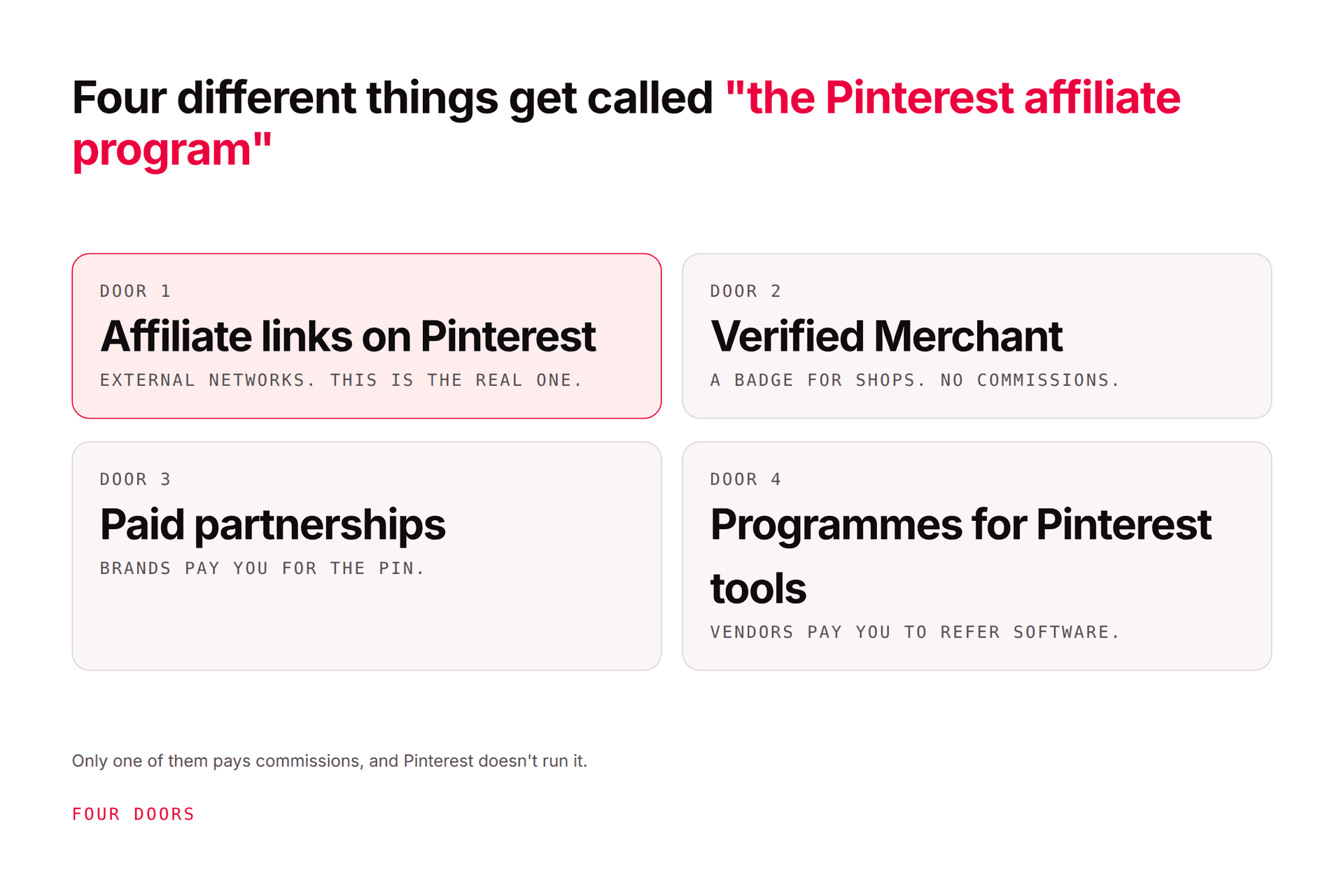
The four things people mean by "Pinterest affiliate program"
What you might mean
What it actually is
Who it's for
How you get in
1. Earning commissions from pins
Affiliate links from outside networks, used as pin destinations
Creators, bloggers, anyone with a business profile
Apply to the network or merchant (below)
2. The Verified Merchant Program
A Pinterest badge for shops with a catalogue and conversion tracking
Ecommerce sellers, not affiliates
Meet Pinterest's requirements; no commissions involved
3. Getting paid by brands for pins
Paid partnerships, tagged with Pinterest's paid-partnership tool
Creators with an audience
Brands come to you, or you pitch them
4. Promoting Pinterest tools for a cut
Affiliate programmes run by software vendors (schedulers, design tools)
Bloggers who write about Pinterest
Apply on each vendor's site
Most searchers mean the first. Let's start there.
1. How to "apply": joining the networks that work on Pinterest
You apply to networks and merchants, each with its own bar. Checked August 2026; every one of these changes its terms, so read the current agreement before you publish a single pin.
Network / programme
Pinterest fit
How to join and what it asks
Watch out for
Amazon Associates (US)
Named by Pinterest. Huge catalogue; low rates
Free signup; you must refer 3 qualifying sales within 180 days of applying or the application is withdrawn. Rates run 0–10% by category (checked on Associates Central, 21 August 2026): 10% Luxury Beauty, 4.5% books/kitchen/automotive, 4% apparel and jewellery, 3% toys/home/beauty/sports, 1% grocery and health, so most physical goods land between 1% and 4.5%
Publisher signup, small activation fee historically, then per-merchant approval. ShareASale closed 6 Oct 2025 and its merchants moved to Awin
If an old guide tells you to join ShareASale, it's out of date
Impact
Many DTC and SaaS brands
Free creator signup; each brand approves separately
Brand-by-brand rules on social traffic
CJ Affiliate
Large retailers and travel
Publisher application
Expects a website for most advertisers
Direct brand programmes
Often the best rates
Apply on the brand's site
Read the traffic-source clause; some forbid direct social links
Three practical notes on "applying":
A website helps even when it isn't required. Amazon and Impact accept social profiles; Rakuten, CJ, and many brands prefer a site. A single owned page counts. Make money with Pinterest without a blog covers the no-site route honestly.
Apply to the programme, then to the merchant. On Awin, Impact, CJ, and Rakuten you're approved by the network first and by each advertiser second. Budget a week or two.
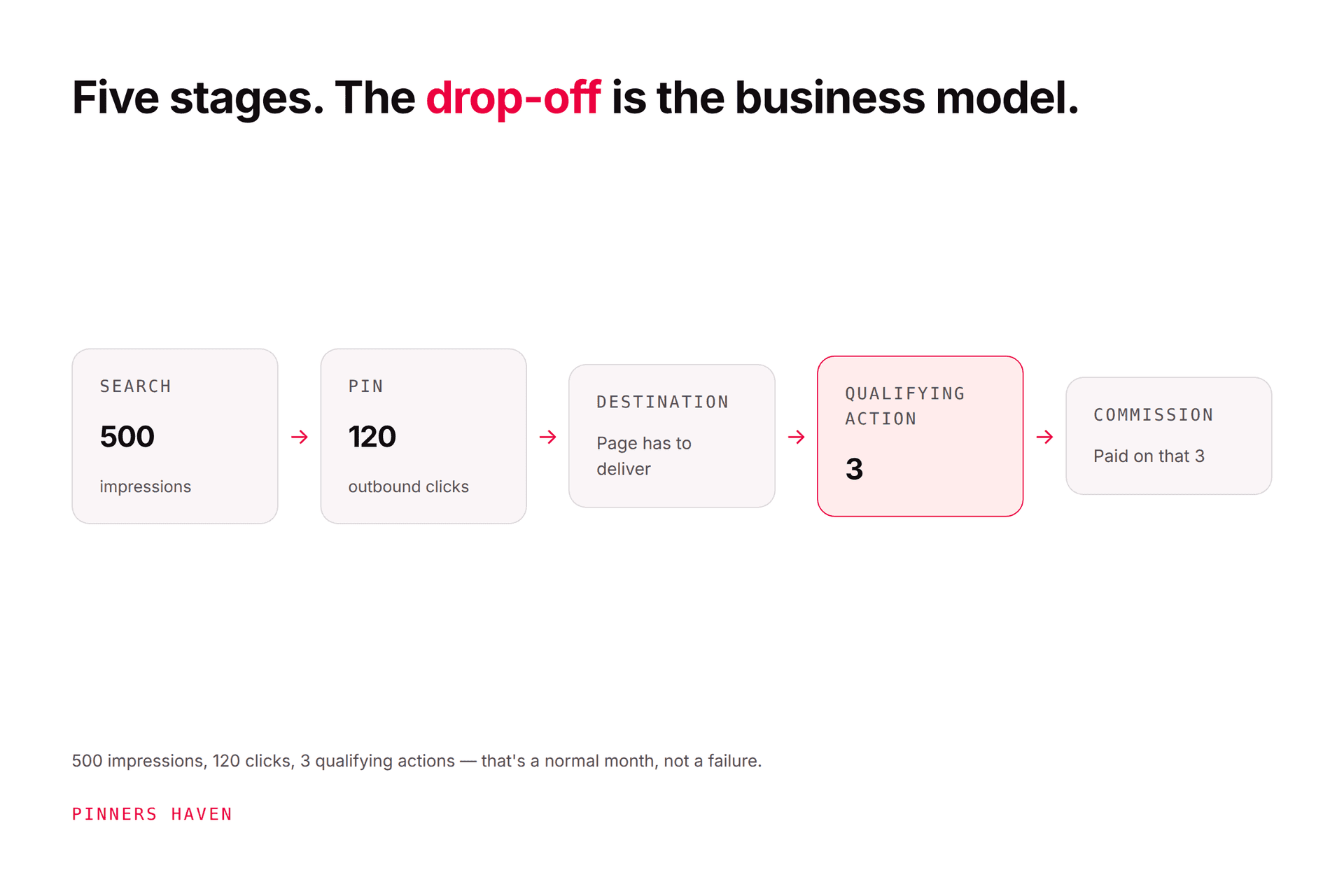
Pick by product fit, not headline rate. A 4% commission on something your audience actually buys beats 30% on something they don't. The full selection logic, and the path from pin to commission, is in Pinterest affiliate marketing: a step-by-step guide.
The rules that keep an affiliate account alive on Pinterest
This is where "program" searchers get hurt, because the networks approve you and then Pinterest's spam systems decide whether you stay. Pinterest's commercial content guidelines ask for original content, disclosed commercial intent, authentic account use, and no repetitive high-volume posting or traffic manipulation. In practice:
Disclose on every pin. The FTC wants disclosures with the endorsement, in plain language. "Affiliate link" or "I may earn a commission" in the description. When the pin links straight to the merchant, the description is the endorsement.
Link to the product page, not a redirect maze. Pinterest says direct to the product detail page, and some shorteners aren't supported. Networks' own tracking links are fine; opaque chains aren't.
Add something the merchant's page doesn't. A comparison, a use, a result, a caveat. A pin that's the merchant's image plus the merchant's claim is the thinnest content on the platform, and it's what the originality rules target.
Watch the volume. Thirty near-identical affiliate pins in an hour is the pattern that trips enforcement. Pinterest's guidance asks for original content on a sustainable cadence; how often to pin has the arithmetic.
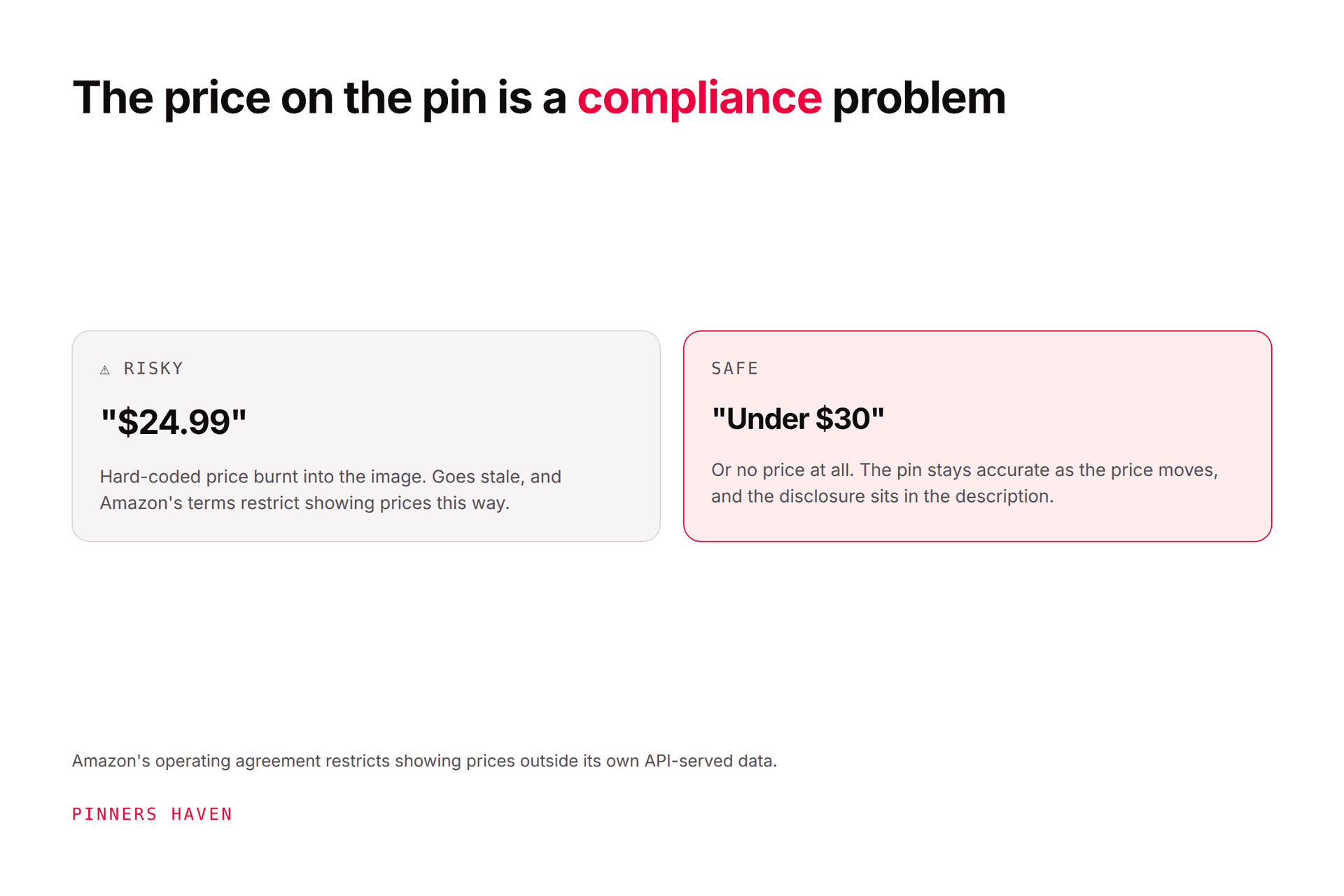
Two rulebooks, always. Pinterest's and the programme's. Amazon's forbids prices in images; some brands forbid direct social links; LTK has its own content norms. The stricter rule wins.
You might be thinking, "everyone posts affiliate pins like a machine gun and seems fine." Until they aren't. Pinterest account flagged as spam is the page people read afterwards; the rules above are the page to read first.
2. The Verified Merchant Program: the Pinterest programme that does exist
If you sell rather than refer, there is a Pinterest programme with an application-like bar, and it's worth knowing what it is and isn't. Pinterest's Verified Merchant Program "helps people on Pinterest discover and buy from vetted brands." Merchants who qualify get a blue checkmark on their profile and pins and eligibility for merchant-detail features.
What it asks, per Pinterest's page (availability varies by country):
A Pinterest account created at least three months ago, with a profile picture and completed About section
A website created at least nine months ago, claimed by the account, that meets Pinterest's merchant guidelines
A catalogue with at least 75% of products ingested successfully
Conversion data flowing: page visits, add-to-cart, and checkout events, at least one of each every seven days within the last 30 days, with currency and product IDs
It is not an affiliate or commission programme. You earn nothing from Pinterest for having the badge; you earn from your own sales, and the badge is a trust signal. Third-party guides quote different thresholds (13-month sites, 50% catalogue); Pinterest's own page is the one that counts, so check it on the day. Pinterest for ecommerce covers the catalogue setup that gets you there.
3. Paid partnerships: the other way pins pay
Brands can pay you to feature them, and Pinterest provides a paid-partnership tool to tag the brand when you create a pin from a business profile. There's no application; brands approach creators with reach, or you pitch them. It needs an audience first, which is why it's the last thing on a new account's list. Published rate cards are third-party estimates; can you actually make money on Pinterest? grades them.
4. Affiliate programmes for Pinterest tools
The other thing the phrase catches: software vendors in the Pinterest space (schedulers, design tools, keyword tools) run their own affiliate programmes, typically 20–30% recurring, and bloggers who write about Pinterest promote them. Apply on each vendor's site; treat them like any other programme: product fit first, disclose always. We're not listing vendors here because rates and terms move monthly and we're an interested party in that market.
Where the work actually is
Every door above, once you're through it, lands in the same place: you need a steady supply of original pins, each aimed at a real search, each pointing at the right product page, each disclosed. Affiliate accounts need that discipline more than any other kind, because Pinterest's originality and volume rules are enforced hardest where the links are commercial.
That's the layer Pinners Haven handles. From a product URL or topic it writes a keyword-led title and three to five distinct descriptions per pin (your disclosure line included, once you set it), designs an original image on a human-designed template, and publishes on a paced, account-safe cadence through Pinterest's official OAuth, with you approving each pin. It won't get you into LTK or pick products your audience buys; that's yours. It keeps the pin supply original and the cadence human, which is what keeps an affiliate account out of the spam queue.
No. Pinterest's own creator guide says it "isn't part of affiliate agreements": you join an outside programme such as Rakuten, LTK, ShopStyle, or Amazon Associates (the four it names), or any other network, generate your product link, and use it as a pin's destination. Pinterest sets the rules for using those links (disclosure, direct product-page linking, no repetitive posting) but pays no commissions itself.
How do I apply for the Pinterest affiliate programme?
You don't, because there isn't one. Apply instead to an affiliate network or merchant programme: Amazon Associates has free signup and a 3-sales-in-180-days rule; Awin (formerly ShareASale), Impact, CJ, and Rakuten approve you as a publisher and then per advertiser; LTK and ShopStyle are application-based. Then create pins with those links from a Pinterest business profile, disclosed on each pin.
Which affiliate programmes work best on Pinterest?
The ones whose products match what your audience searches for on Pinterest: home, food, fashion, beauty, crafts, parenting, travel, digital products. Pinterest names Rakuten, LTK, ShopStyle, and Amazon Associates US as partners; Awin carries many home, craft, and Etsy programmes; Impact and direct brand programmes often pay better rates. Choose by product fit and the programme's traffic rules, not by headline commission.
Can I use Amazon affiliate links on Pinterest?
Generally yes, with care. Pinterest permits affiliate links, and Amazon's Operating Agreement allows links on social media, though it never names Pinterest. You must include Amazon's disclosure, never put an Amazon price in your pin image, avoid obscuring that the link goes to Amazon, and make three qualifying sales within 180 days to keep the account. Read both sets of rules before publishing.
Is the Verified Merchant Program an affiliate programme?
No. It's a Pinterest programme for sellers that awards a blue checkmark to shops meeting its requirements: an account at least three months old, a claimed website at least nine months old, a catalogue with 75% of products ingested, conversion events flowing, and compliance with merchant guidelines, in supported countries. It pays no commissions; it's a trust signal for your own store's sales.
Do I need a website for affiliate marketing on Pinterest?
Not for every programme. Amazon Associates and Impact accept social profiles, and Pinterest permits linking straight from a pin to a product page. Rakuten, CJ, and many brand programmes prefer a website, and a single owned page improves approval odds and conversion. Without a site you take on more platform risk, so many affiliates add one page once a product proves it sells.
Join the network, follow Pinterest's rules, then do the work
The "Pinterest affiliate programme" is really four things, and only one of them is what most people want: permission to earn from other companies' programmes by pinning well. You've got the list of networks, the rules Pinterest itself sets, and the one programme that actually has a Pinterest badge attached. The rest is original pins, disclosed, at a pace the account can carry.
If that last part is the bottleneck, Pinners Haven keeps the pin supply original and the cadence safe while you pick the programmes and the products.