The Pinterest AI Backlash: What's Actually Going On
Pinterest has an unhappy user base right now, and the standard framing, that people are anti-AI, misses what's actually being said. Read the complaints closely and they're rarely about the technology. They're about a specific broken promise.
Joe Nyambura
Founder & operator, Pinners Haven · August 18, 2026
On this page13 sections
- What people are actually complaining about
- What Pinterest has actually done
- Why this is good news if you publish
- Where we sit, honestly
- If you're thinking of leaving
- Frequently asked questions
- Why is there a backlash against AI on Pinterest?
- Can I turn off AI content on Pinterest?
- Is Pinterest losing users over AI?
- Should I stop using AI images on my pins?
- Will AI pins get less reach?
- What are the best Pinterest alternatives without AI?
- The bar just moved, and it moved in your favour
Pinterest has an unhappy user base right now, and the standard framing, that people are anti-AI, misses what's actually being said. Read the complaints closely and they're rarely about the technology. They're about a specific broken promise.
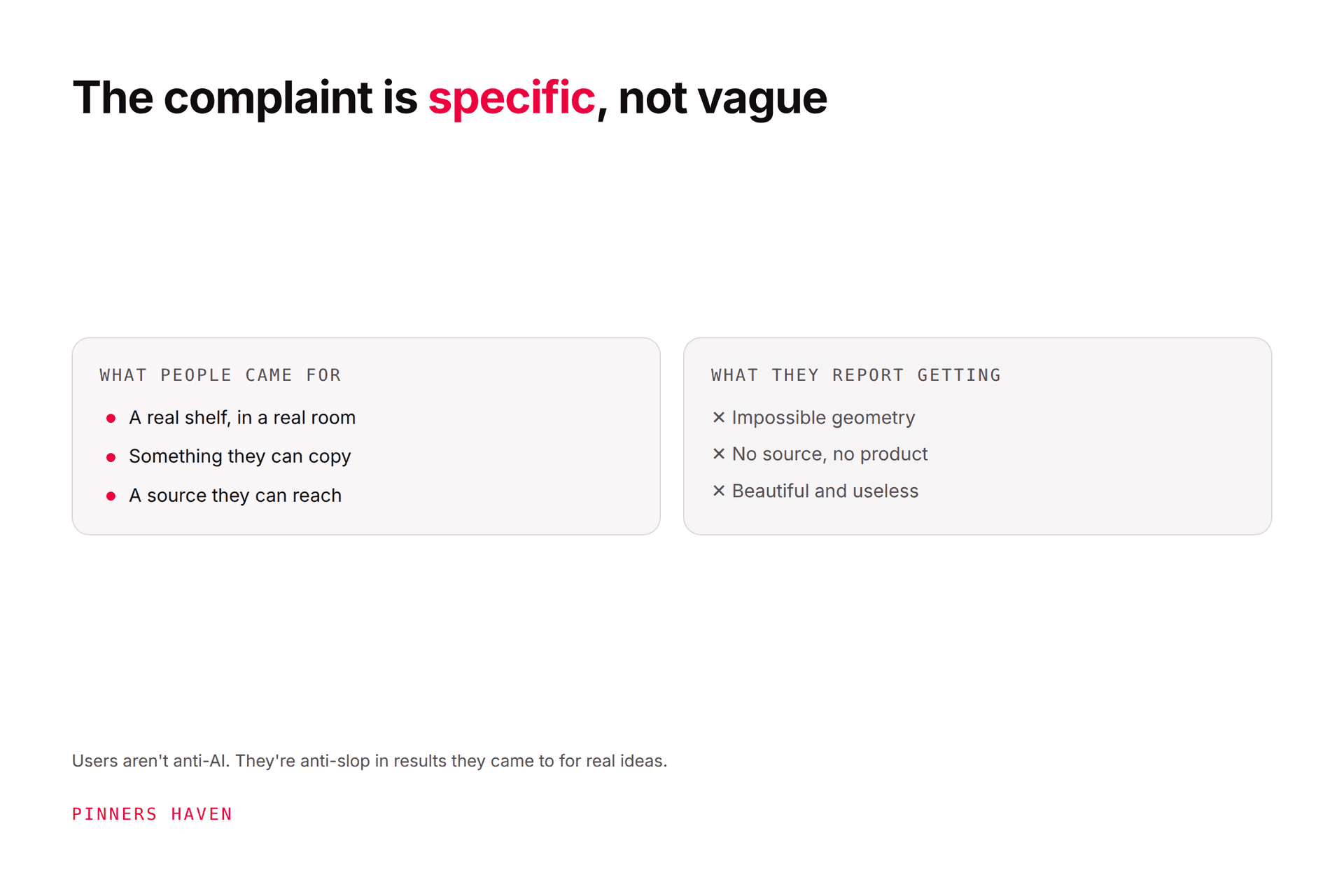
The Pinterest AI backlash is fundamentally a utility complaint, not a philosophical one. People use Pinterest to plan things they intend to do: build the shelf, cook the meal, copy the haircut, buy the coat. A generated image of a room that could not physically exist is useless for that, no matter how attractive it is. When enough results become unbuildable, unbuyable or unreproducible, the platform stops being a planning tool and becomes a mood board, and the people leaving are the ones who needed the first thing. Pinterest has shipped labelling and a content control in response, which helps and does not resolve it.
A disclosure that belongs at the top rather than the bottom: we make Pinners Haven, which generates pin images using AI. We are an interested party in this argument. What follows is our honest read of it, including the part that isn't flattering to us.
What people are actually complaining about
Sort the grievances and they fall into four groups, only one of which is about AI as such.
1. The results can't be acted on. A recipe pin leading to a generated dish nobody cooked. A woodworking plan with joinery that doesn't work. A room with three vanishing points. The pin promised a thing to do and delivered a picture.
2. The destination is worse than the pin. Generated creative is cheap, so it's disproportionately used by pages with nothing behind them. The correlation isn't causal, but users experience it as one.
3. Search feels less trustworthy. When some results are unverifiable, people start distrusting all of them, including yours. That's the real cost to honest publishers.
4. Some people simply object. Artists especially, on training and livelihood grounds. That's a genuine position and it isn't going to be argued away by a marketing blog.
Groups one through three are fixable by publishers. Group four isn't, and shouldn't be dismissed.

What Pinterest has actually done
Pinterest has shipped labelling for AI-generated and modified images and a setting to see fewer of them in supported surfaces. Our guides cover the mechanics: how to turn off AI on Pinterest, the AI filter, and what "AI modified" means.
Being honest about the limits, which we cover in more detail in those pieces:
the control reduces recommendations, it doesn't purge the platform
detection is incomplete, so unlabelled generated content still appears
search and ads behave differently from the home feed
labels depend on signals that can be absent
So the tooling is a real response and an incomplete one. If your objection is philosophical, a filter that mostly works won't satisfy it.
Why this is good news if you publish
Here's the part the backlash coverage misses. When a discovery surface fills with content that can't be verified, the value of verifiable content goes up.
Concretely, these are now differentiators rather than table stakes:
A real photograph of the actual thing, with real imperfections
Numbers: dimensions, timings, temperatures, quantities, costs
Process shots showing an intermediate stage nobody would fake
A named author with a reason to be trusted
A destination that delivers exactly the promise, immediately
None of that is new advice. What's changed is the size of the gap between content that does it and content that doesn't. Our fresh pins guide covers the creative standard; this is the same argument with higher stakes.
The counterintuitive read: the backlash is not a reason to publish less on Pinterest. It's a reason to publish more carefully, because the competition just got easier to beat on the one axis that matters.
Where we sit, honestly
We generate pin images with AI. So the fair question is whether we're part of the problem.
Our position, and you can judge it:
Generated imagery isn't the failure. Unaccountable content is. A pin fails when it promises something the destination doesn't deliver, or depicts something that can't exist, or was published without anyone looking at it. Those are review failures. They're extremely easy to commit at volume with a generator, which is why volume-first AI tooling has done real damage here.
What we do about it in the product: images are AI photography colour-matched to human-designed templates rather than generated end to end, the Freshness Meter retires each template after roughly five to ten uses so you don't get a wall of identical output, and nothing publishes until you approve it. That approval gate is the part that matters for this argument.
What that doesn't fix, stated plainly: an approval gate only works if you actually look. A generated image of a product you don't sell, or a room that can't be built, will sail through if you click approve without reading. The tool cannot supply the judgement, and anyone selling you automation that claims to is selling the thing this article is about.
If your position is that AI images shouldn't be on Pinterest at all, we're not going to talk you out of it, and you should use a different tool or photograph your own work.
(Disclosure: we make Pinners Haven, and it generates AI images. We're not affiliated with Pinterest.)
If you're thinking of leaving
Reasonable. Before you move, be clear about what you'd be trading.
Pinterest's advantage is search intent at scale: people arrive planning to do or buy something. The human-curated alternatives are genuinely nicer places and substantially smaller, and most of them are inspiration or archival tools rather than traffic sources. We compared them in Pinterest alternatives without AI.
The realistic options, in order of how many people should pick them:
Stay and differentiate. Publish verifiable content and benefit from the contrast.
Stay, and use the AI control to fix your own browsing experience while continuing to publish.
Diversify. Keep Pinterest for traffic, build a presence somewhere aligned with your values.
Leave. Legitimate, and it costs you a discovery channel that isn't easily replaced.
Don't do this on impulse in a bad week. Pinterest notes pins can gain engagement long after publication, so an account you abandon keeps working for a while, which makes "pause and decide later" a real option.
Frequently asked questions
Why is there a backlash against AI on Pinterest?
Mainly because generated images are frequently unactionable. Pinterest users are typically planning something concrete, and a picture of a room that couldn't be built or a dish nobody cooked fails that job regardless of how good it looks.
Can I turn off AI content on Pinterest?
You can reduce it. Pinterest offers a control to see fewer AI-generated Pins in supported surfaces, plus labelling. Detection is incomplete, so it reduces rather than removes. See how to turn off AI on Pinterest.
Is Pinterest losing users over AI?
There's visible, vocal dissatisfaction among creators and some users, particularly artists. Whether that's producing meaningful sustained departure isn't something we can demonstrate with public data, and anyone quoting a confident number is guessing.
Should I stop using AI images on my pins?
Not necessarily, but the burden is accuracy. If the image depicts something you sell, teach or made, it must be truthful about it. If it depicts something impossible, or the destination doesn't deliver the promise, that's the failure people are reacting to.
Will AI pins get less reach?
Pinterest hasn't published anything indicating generated content is systematically down-ranked, though its user-facing control reduces such Pins for people who enable it. The practical risk is behavioural: users who don't trust a pin don't save or click it.
What are the best Pinterest alternatives without AI?
Cara, Are.na, Milanote, mymind, Cosmos, Savee and Raindrop each serve part of the job. All are much smaller and most are inspiration or archival tools rather than traffic channels. See Pinterest alternatives without AI.
The bar just moved, and it moved in your favour
The honest summary of the backlash is that Pinterest's core promise, find something and go do it, is harder to keep when a share of results can't be acted on.
That's a real problem and Pinterest's response is partial. But for anyone publishing genuinely useful, verifiable, specific content, a feed full of pretty and unusable images is not a threat. It's the least competitive the platform has been in years, on the only axis that ever actually mattered.