Pinterest Repins vs Fresh Pins: What Actually Works Now
Fresh pins (new images with new copy, even for a page you've pinned before) are what Pinterest asks for and what drives almost all website traffic: Pinterest's guidance says to "aim to create original content weekly" and warns that repeatedly saving the same pins "may get you flagged as spam," and the largest public
JN
Joe Nyambura
Founder & operator, Pinners Haven · August 11, 2026
You've been told repins are dead, that Pinterest "only wants fresh pins," and that you should be making five new graphics a day or else. You've also noticed your old pins still bring traffic and some accounts seem to do fine re-saving everything. Both things are true, which is why the advice sounds contradictory. Let me be honest about what to expect: "repins vs fresh pins" is three different questions wearing one phrase, and the answer to each is different.
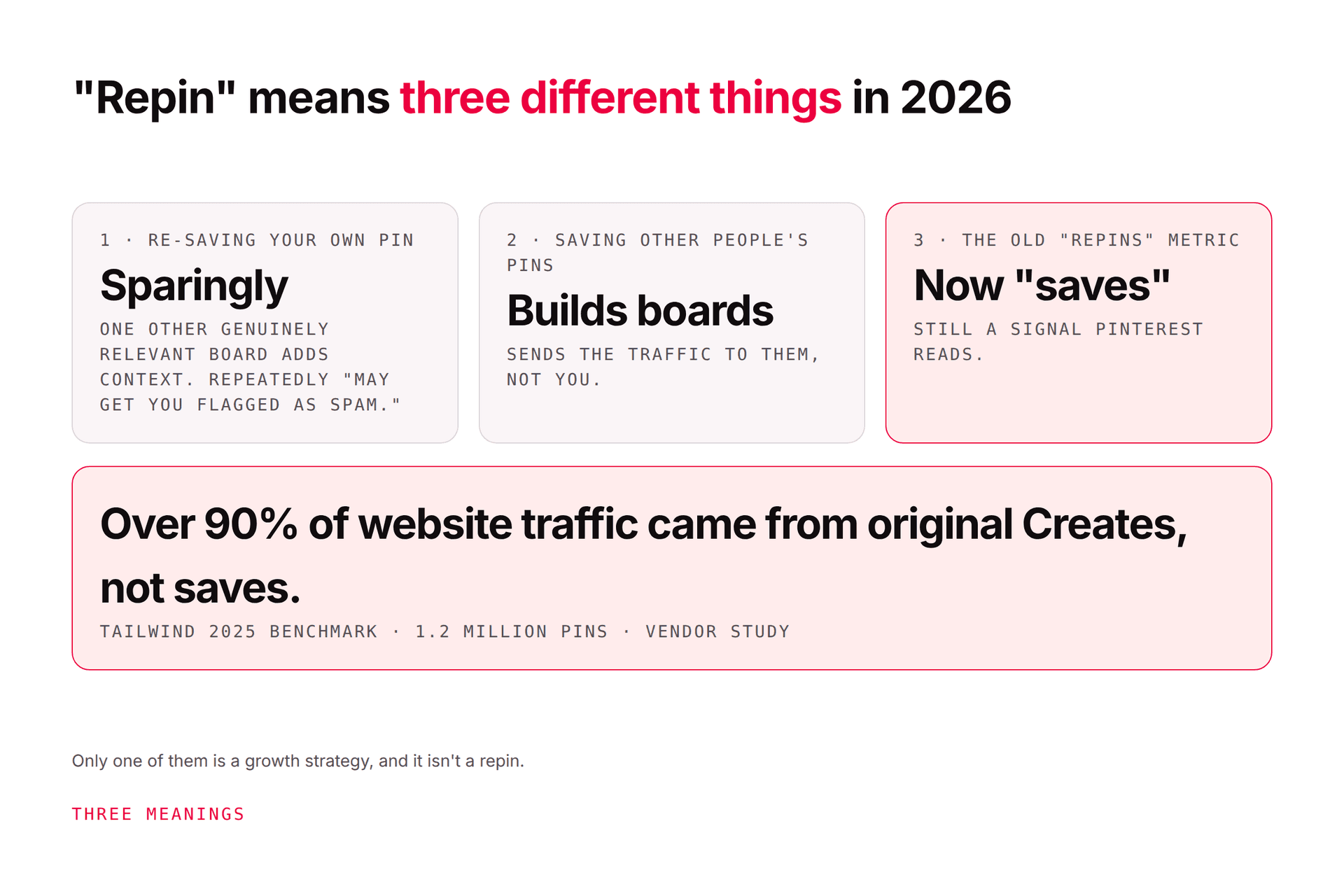
Fresh pins (new images with new copy, even for a page you've pinned before) are what Pinterest asks for and what drives almost all website traffic: Pinterest's guidance says to "aim to create original content weekly" and warns that repeatedly saving the same pins "may get you flagged as spam," and the largest public dataset, Tailwind's 2025 benchmark of 1.2 million pins, found over 90% of traffic to creator and brand sites came from original Creates, not saves. Repins still do three narrower jobs: re-saving your own pin to one other genuinely relevant board can extend its context (sparingly), saving other people's pins builds board completeness and sends traffic to them, and "repins" as a metric is now simply "saves," a signal Pinterest does read. So: repins aren't dead; they're just not a growth strategy. Here's each meaning, what it still does, and a ratio you can use.
First: which "repin" do you mean?
You mean…
What it is
What it does for you in 2026
Pinterest's rule
1. Re-saving your own pin to another board
Same image, same link, new board
Adds board context once; at volume it's the duplicate pattern Pinterest warns about
"Try not to repeatedly save the same Pins"
2. Saving other people's pins
Curating content you don't own onto your boards
Fills boards, shows taste; traffic and credit go to the original creator
Counted as "saved content," distinct from what you publish
3. "Repins" the metric
The old name for saves
Saves are an engagement signal Pinterest reads; they indicate future interest
Encourage saves; they drive future impressions
Most of the "do repins still work?" anxiety is about meaning 1. Most of the "should I repin others?" questions are meaning 2. Meaning 3 is a vocabulary change. Let's take them in order.
What Pinterest actually says
Three primary lines settle most of this.
First, Pinterest's distribution guidance: "Create Pins frequently and consistently to grow your following and increase your reach. Aim to create original content weekly." And, on the same page: "Try not to repeatedly save the same Pins or upload content that already exists on Pinterest. You may get flagged as spam."
Second, Pinterest separates what you publish from what you save. Its created and saved content page defines published content as "all of the content you create on Pinterest or the content you save from your claimed website" and saved content as "all of the content you save from Pinterest or a site that you do not own." Both get Pin stats; only one is yours.
Third, its January 2026 growth guide tells creators to "save your Pins to any relevant, existing board that has already gained engagement," which is the one explicit endorsement of meaning 1: saving your pin to a relevant, established board. Note "relevant" and the singular.
There is no published freshness score, no fresh-to-repin ratio, and no statement that repins are penalised. What counts as a fresh pin goes through why that matters and where the "cosmetic vs meaningful" line actually sits.
What the data says (and whose data it is)
The only large public dataset on this is a vendor's. Tailwind's 2025 Pinterest Marketing Benchmark Report (published November 2024; about 17,000 accounts and 1.2 million pins; roughly a quarter published through Tailwind) found that "over 90% of traffic to creator and brand websites were from Creates," and that the share grows with age: about 85% for pins under 90 days old, rising to 97% for pins over two years old. Saves of your content by others, and your re-saves, contributed the rest.
Two honest notes. It's Tailwind's data, with a sample the report itself says skews to English-speaking ecommerce, service, and creator accounts; treat the exact percentages as their users, not the platform. And the direction matches Pinterest's written guidance, which is why we trust it more than the forum claims of a "2026 algorithm update" or a "Contextual Originality metric" that no Pinterest source mentions.
The same report has the finding people skip: among fresh pins, "the top 1% most viral Pins accounted for over 50% of the total Impressions and Clicks," while "the bottom 80% of Fresh Pins accounted for less than 10%." Read that twice before you start a fresh-pin treadmill. Fresh beats repinned, and good fresh beats lots of fresh by a mile.
Meaning 1: re-saving your own pin
What it still does: puts an existing pin on a second board, which gives Pinterest one more context signal and puts it in front of that board's followers. Pinterest endorses saving your pins to a relevant board that already has engagement.
What it doesn't do: create a new pin. It's the same image and link; Pinterest's systems know that. It doesn't get the "new content" distribution that an original gets, and the Tailwind data suggests saves of existing pins drive a small and shrinking share of traffic.
When it tips into a problem: the same pin saved to five boards, or re-saved every week to "refresh" it, or a scheduler looping a pin on repeat. That's "repeatedly saving the same Pins," the behaviour Pinterest says may get you flagged, and it's the most common reason we see accounts with plenty of activity and falling reach. Pinterest not getting impressions on new pins is where that ends up.
Our rule: a new original pin can be saved to its primary board and, once, to one other genuinely relevant board. Not five. Not on a loop.
Meaning 2: saving other people's pins
What it still does: makes your boards complete and useful, signals what your account is about, and is normal Pinterest behaviour. A "Small Apartment Storage" board with 40 good pins from around the platform reads as a real board.
What it doesn't do: grow your traffic. Distribution and clicks go to the original pin's creator and their link. Pinterest counts it as "saved content," not yours. An account that's 90% other people's pins has a lovely profile and no business.
Our rule: curate for board quality, not for volume. A few saves a week to round out a board is seasoning; it isn't the meal. And skip the old schemes around it (group boards, follow-for-follow, engagement pods); they're dead weight at best and spam risk at worst.
Meaning 3: "repins" the metric
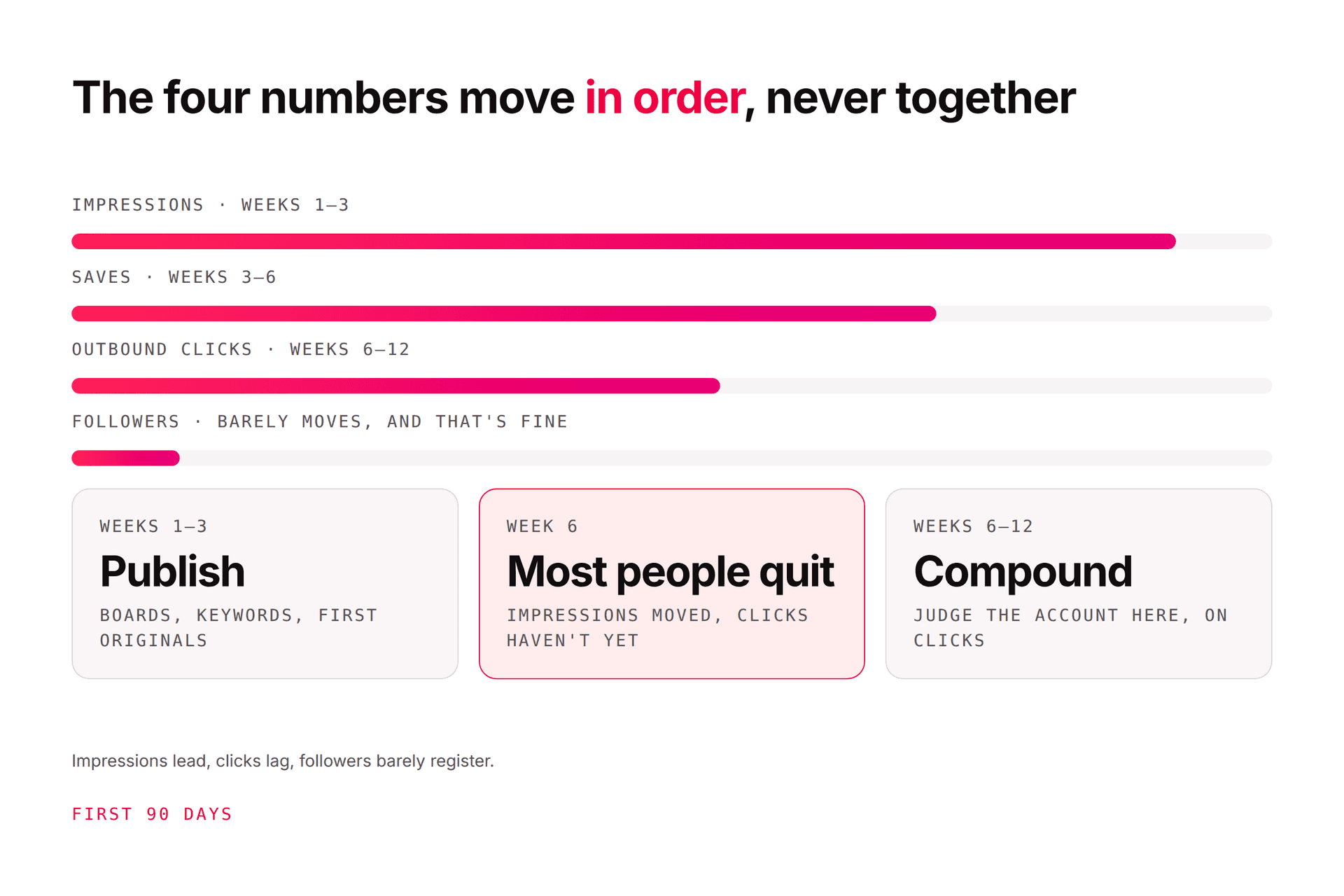
Pinterest renamed repins to saves years ago; older guides still say repins. Saves are a real signal: Pinterest tells creators to encourage them because they "drive future impressions," and its growth guidance says savable, actionable content is a key engagement lever. So "do repins still work?" in this sense is "do saves matter?" and the answer is yes, as a signal on your original pins. Ask for the save where it's natural ("save this for your next repot"), and read saves as the first sign a concept works; how to grow from zero explains why saves move before clicks.
So what's the ratio?
You might be thinking, "just give me the number." Pinterest doesn't publish one, and we'd be lying if we did. What we can give you is the shape that holds up across the accounts we've seen and the data above:
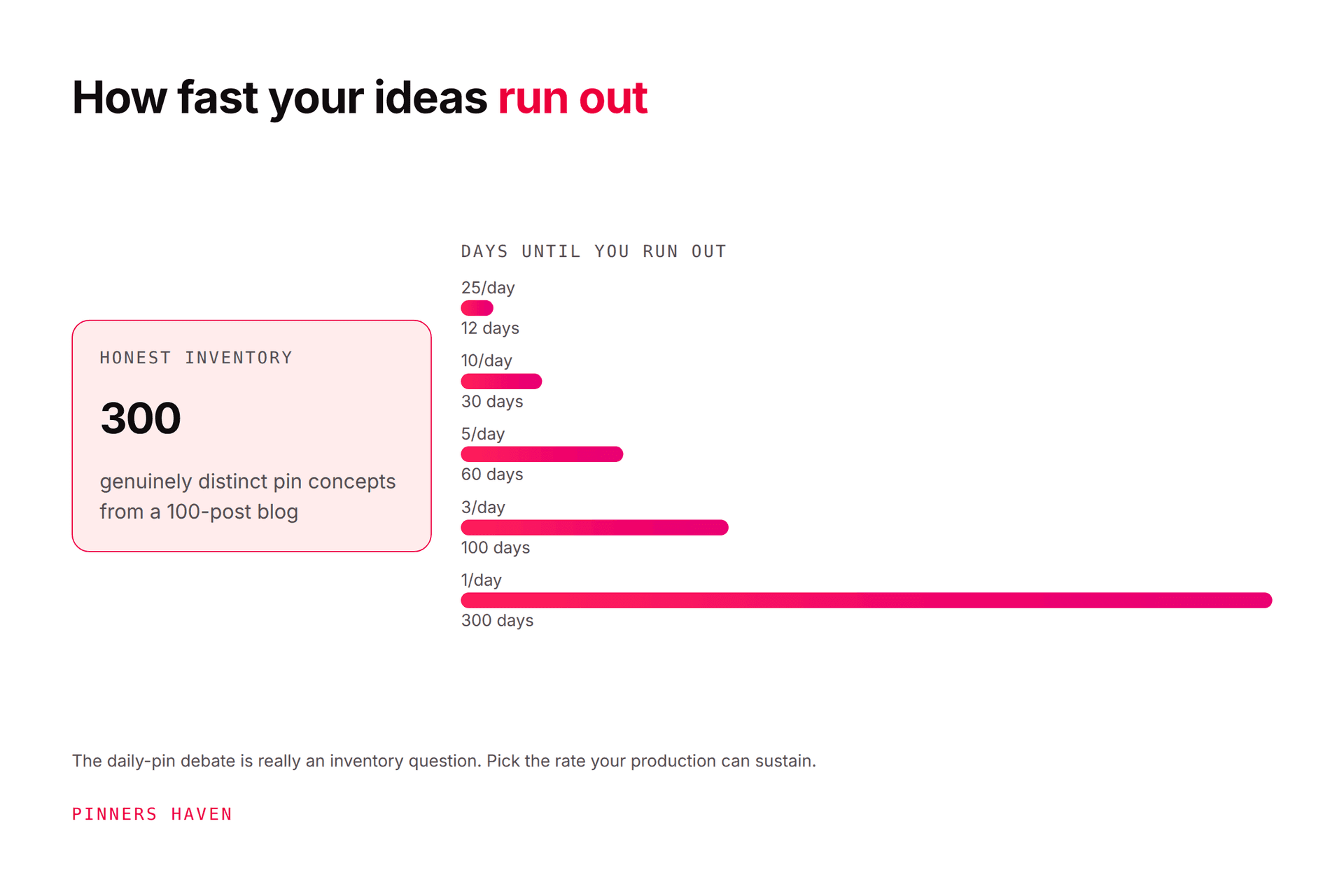
Originals are the engine. Pinterest's cadence guidance is weekly; for most operators that's three to ten new pins a week, each a different angle on a page, each pointing at a real destination. How often to pin has the arithmetic.
Your own re-saves are a garnish. One extra relevant board per new pin, at most, and never on a schedule.
Others' pins are furniture. Enough to make boards complete; never enough to be the account.
If your week is 80% originals, a few own re-saves, and a handful of curated saves, you're inside everything Pinterest has written. If it's 80% re-saves of the same twelve graphics, you're running the exact pattern its guidance names.
The treadmill problem, honestly
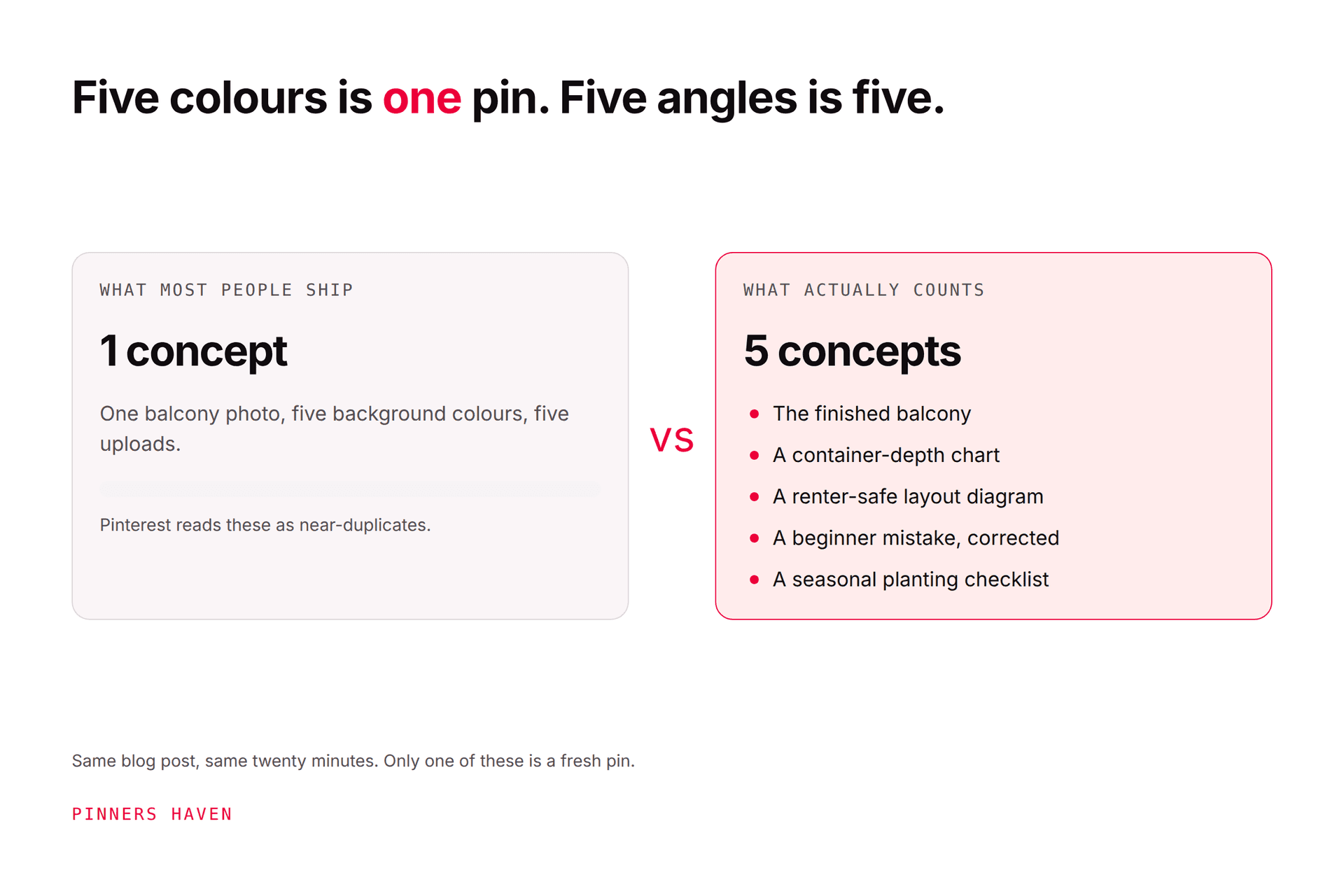
Here's the thing nobody tells you: "fresh pins win" is true and it has a trap in it. Read the Tailwind finding again: the bottom 80% of fresh pins earn under 10% of impressions and clicks. Pumping out new graphics that are the same idea in a new colour satisfies the letter of "fresh" and produces the bottom 80%. The winning fresh pins are new concepts: a different promise, a different image, a different search. Fresh pins on Pinterest has the test: would a reader who saw the first pin learn something new from the second?
That's also why re-saving feels tempting at week six, when the obvious concepts are used up and each new one takes an hour. Pinners Haven exists for that week. From a page or topic it writes up to 20 angles, each with a keyword-led title and three to five distinct descriptions, designs an original image per pin on a human-designed template, and retires each template after roughly five to ten uses (the Freshness Meter) so you're publishing originals, not clones. It then publishes on a paced, account-safe cadence, with you approving each pin, and never loops a pin back out as a "repin." It's built for the ratio above: originals as the engine, re-saves as nothing more than a garnish.
(Disclosure: we make Pinners Haven. We're not affiliated with Pinterest.)
Frequently asked questions
Do repins still work on Pinterest in 2026?
In a narrow way. Re-saving your own pin once to another genuinely relevant board is something Pinterest endorses; re-saving the same pin repeatedly is the pattern its guidance says may get you flagged as spam, and the largest public dataset (Tailwind's 2025 benchmark) found over 90% of website traffic came from original pins, not saves. Saving other people's pins builds your boards but sends traffic to them. Repins aren't dead; they're not a growth strategy.
What's the difference between a repin and a fresh pin?
A fresh pin is a newly created image with its own title and description, even if it links to a page you've pinned before. A repin (now called a save) is an existing pin saved again: your own pin to another board, or someone else's pin to yours. Pinterest treats what you publish and what you save as different content types, and its guidance asks for original content weekly while warning against repeatedly saving the same pins.
How many repins vs fresh pins should I do?
Pinterest publishes no ratio. A shape that stays inside its guidance: originals as the engine (weekly at minimum; three to ten new pins a week for most operators, each a different angle), your own re-saves as a garnish (one extra relevant board per new pin at most, never on a schedule), and others' pins as furniture to complete boards. If most of your weekly activity is re-saving the same graphics, you're running the pattern Pinterest warns about.
Is it bad to repin your own pins?
Not once, to a relevant board that already has engagement; Pinterest's 2026 growth guide recommends exactly that. It becomes a problem at volume: the same pin on five boards, or re-saved weekly to "refresh" it, or looped by a scheduler. Pinterest's guidance says repeatedly saving the same pins may get you flagged as spam, and it's a common cause of busy accounts with falling reach.
Should I repin other people's content on Pinterest?
A little, for board quality. Saving good pins from others makes your boards complete and shows what your account is about, which is normal Pinterest behaviour. It doesn't grow your traffic: distribution and clicks go to the original creator and their link, and Pinterest counts it as saved rather than published content. Curate for completeness, and put your effort into original pins to your own pages.
Do fresh pins rank better than repins?
For reaching new people and driving traffic, yes, by a wide margin in every dataset and in Pinterest's own emphasis on original content; older pins can keep earning for years, but new traffic comes from new pins. Fresh doesn't mean cosmetic, though: the same benchmark found the bottom 80% of fresh pins earned under 10% of impressions and clicks. New concepts win; recolours don't.
Originals are the engine. Everything else is garnish.
Repins vs fresh pins stops being confusing once you say which repin you mean. Your own re-saves: once, to a relevant board, then stop. Others' pins: furniture for your boards. Saves as a metric: a signal on your originals. And originals, genuinely different concepts to real pages, weekly: the only thing in the list that grows an account.
You've got the three meanings and the ratio. If the originals are the part you can't sustain, Pinners Haven makes them, and it never passes off a re-save as a new pin.