Pinterest Hashtag Generator: Do Hashtags Still Work in 2026?
You're looking for a hashtag generator, which means you're about to spend effort on the least valuable field in Pinterest marketing. Let me save you the trouble first and then tell you where that effort should go.
JN
Joe Nyambura
Founder & operator, Pinners Haven · August 18, 2026
You're looking for a hashtag generator, which means you're about to spend effort on the least valuable field in Pinterest marketing. Let me save you the trouble first and then tell you where that effort should go.
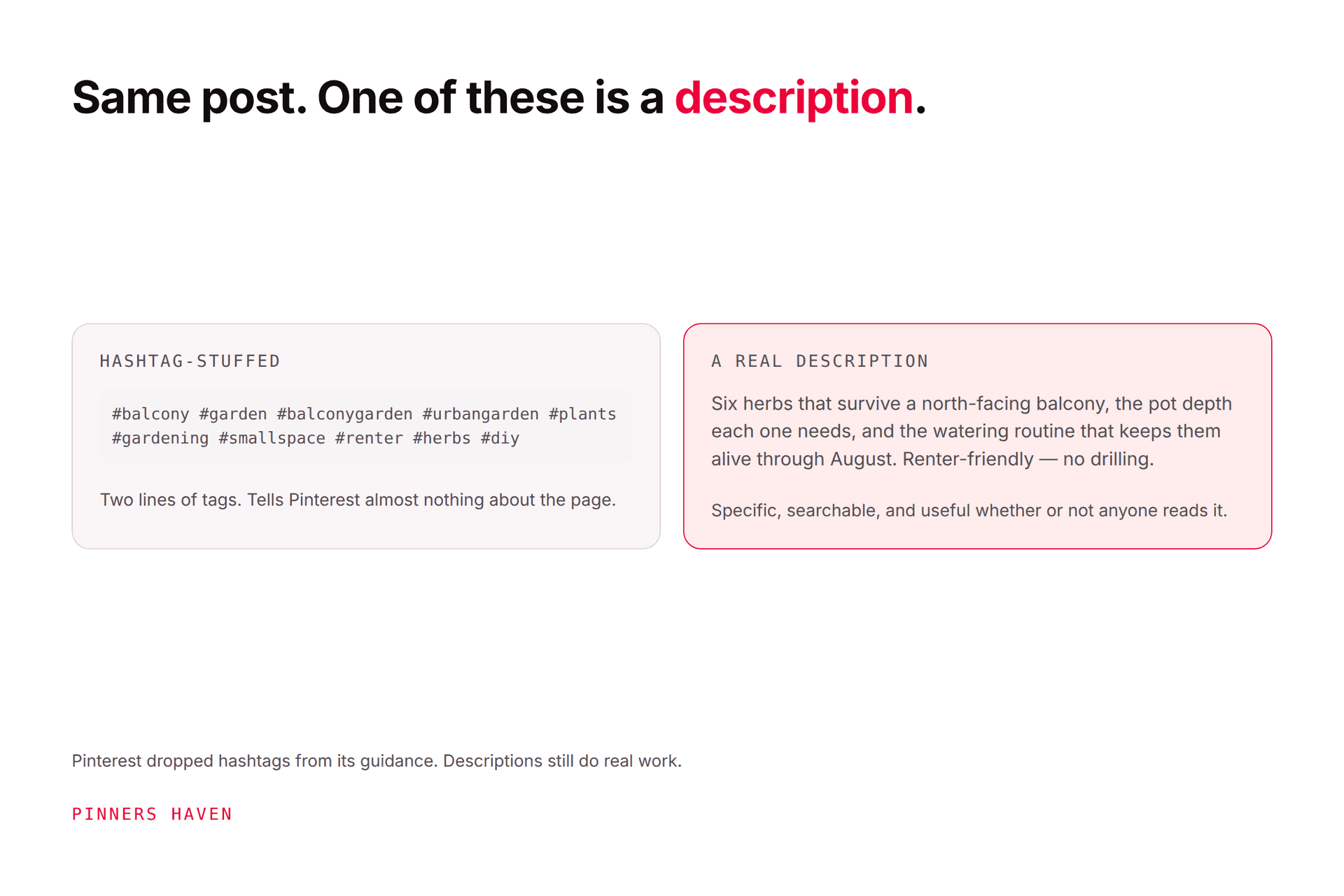
Hashtags are not a meaningful Pinterest ranking factor. Pinterest removed hashtag guidance from its Creative Best Practices page in February 2022 and has said publicly that hashtags were widely abused and had not proven to be a valuable tool. Pinterest search reads your title, description, board name and image, and it reads them as language. A keyword-rich sentence does everything a hashtag would and also reads like a human wrote it, which the hashtag block does not. If you want to add three or four relevant tags at the end of a description, that's harmless. Building a workflow around generating twenty of them is effort spent on the wrong field.
This is not the answer most pages give, because "hashtags don't matter much" doesn't sell a generator.
What Pinterest actually did
The useful history here is short.
Pinterest introduced hashtags, creators over-used them, spammers over-used them harder, and in February 2022 Pinterest removed the suggestion to use hashtags from the "Optimize your Pin copy" section of its Creative Best Practices. The stated reasoning circulating from Pinterest at the time was that hashtags had been widely abused and hadn't proven to be a valuable tool.
Nothing since has reinstated them as a recommendation. Pinterest's current guidance on Pin performance and distribution talks about original content, relevance, quality and useful links. It does not tell you to add hashtags.
When a platform stops recommending a feature and never resumes, that's your answer. You don't need a study.
Why they behave differently here than on Instagram
On Instagram a hashtag is a destination: a browsable feed people follow and search. That's what makes hashtag strategy meaningful there.
On Pinterest, discovery runs through search and the home feed, both driven by how well your content matches what someone typed and what Pinterest understands your pin to be about. Pinterest reads the words in your title and description as language, not as tags. So #balconygarden is, at best, a clumsier way of writing "balcony garden," and it wastes a word doing it.
What to write instead
The description is the field that matters, and it's the one people fill in last, badly, at midnight.
A good Pinterest description does four things:
Says exactly what the pin is, using the phrase someone would search.
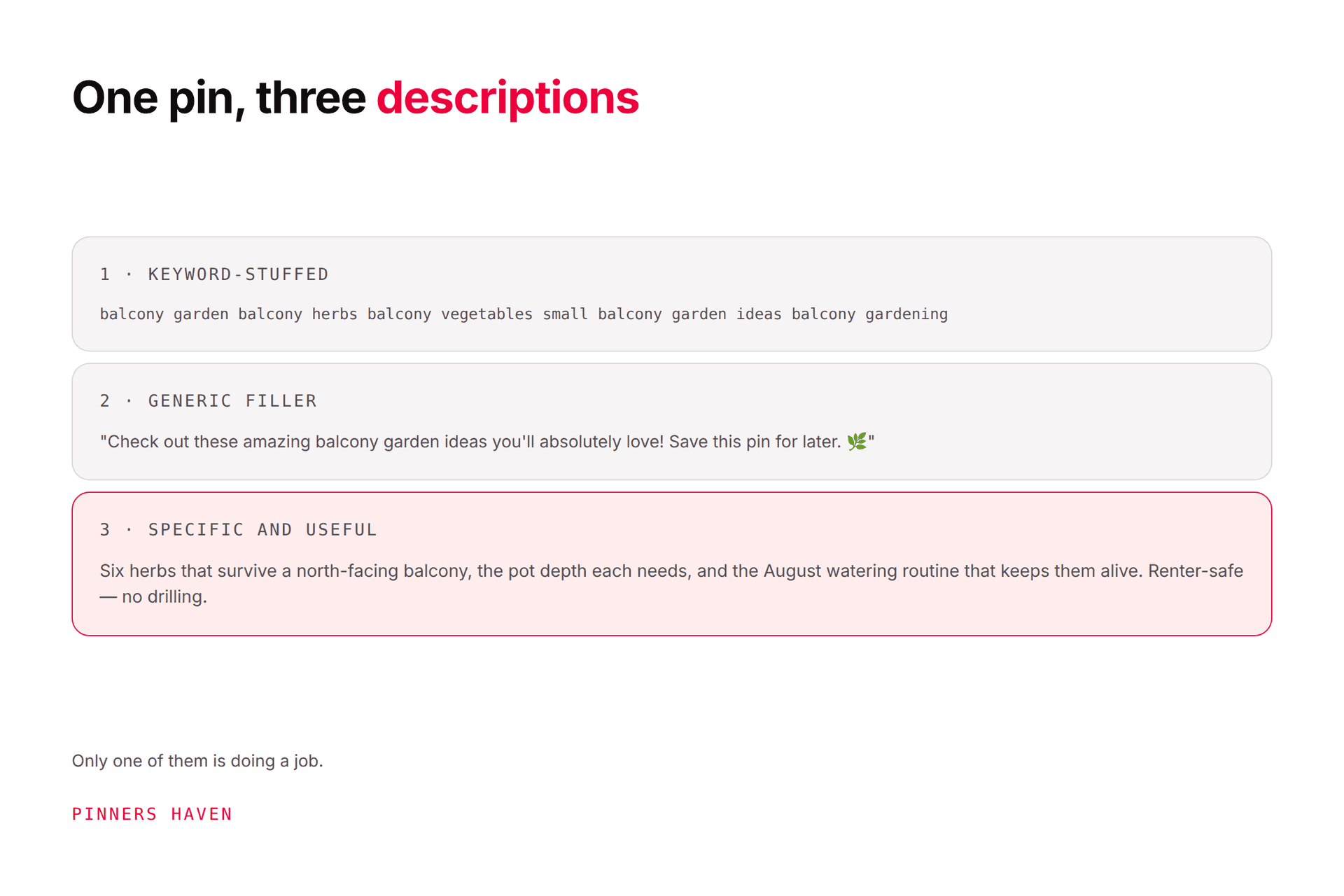
✅ "A renter-friendly balcony garden layout for a 4x8 ft space, using containers you can take with you. Includes soil depths for tomatoes, herbs and salad, plus which pots survive a windy fifth floor."
The second one contains "balcony garden," "renter," "containers," "soil depth," "herbs," "windy" and a size, all as natural language, and it tells a reader something. The first one contains the same keywords stripped of meaning and repeated in a form Pinterest stopped recommending years ago.
Three to five, maximum, at the end of the description.
Specific over broad.#renterfriendlygarden over #garden.
Never in the title. That space is expensive.
Never as a substitute for the sentence-form keyword.
Never the same block on every pin. Repeating an identical description across many pins is the metadata version of duplicate content, and Pinterest warns that repetitive uploads can get you flagged as spam.
That last point is the only genuine risk in this article. A twenty-hashtag block copy-pasted onto sixty pins is repetitive content by any reading.
What a "hashtag generator" is really for
Most hashtag generators produce a list of loosely related tags from a seed word. On Pinterest that gives you:
tags in a field that isn't a meaningful ranking factor
generic terms with no specificity
the same block on every pin, which is the one actively harmful outcome
So the tool works, and the job doesn't need doing. That's not a criticism of any particular generator; it's a criticism of the whole category as applied to Pinterest.
To be clear about our own position: we don't make a hashtag generator, and we're not going to build one. We'd rather tell you the field doesn't matter than sell you a tool for it.
Where the effort should go
If you were about to spend an hour on hashtags, spend it on this instead, in order:
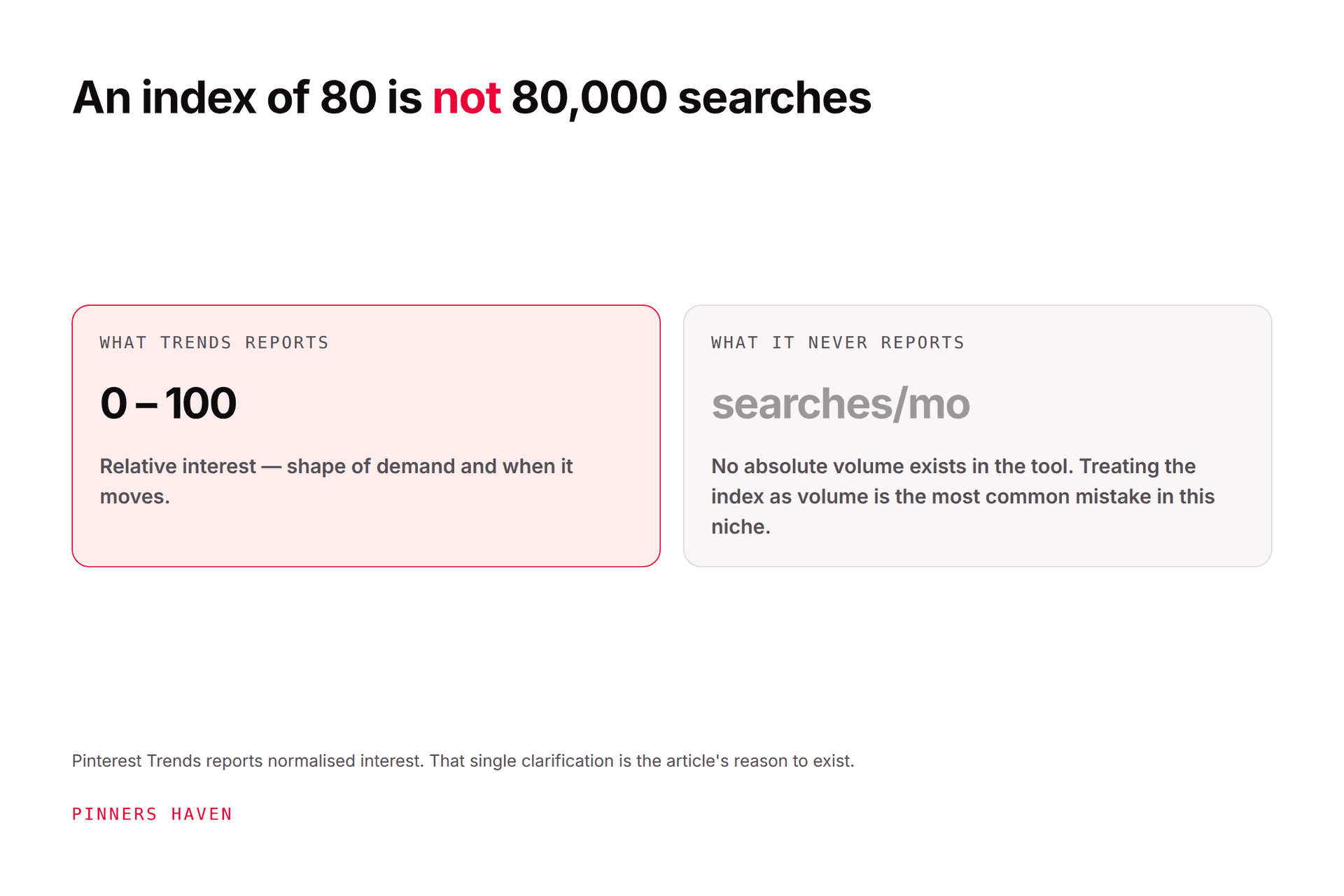
Find the actual phrases people search. Pinterest's search autocomplete is free and shows you real phrasing. Pinterest Trends shows relative interest and seasonality.
Write a title that leads with the specific benefit, at a length that isn't truncated.
Write a description that could stand alone as a useful sentence.
Put the pin on a board whose name matches the topic. Board context is a real signal and it's free.
Make the image match the query at thumbnail size.
Write a different description for every pin. This is the one that scales badly and matters most.
Step six is where people quietly give up, and it's the reason so many accounts end up with one description pasted across an entire batch.
When descriptions become the bottleneck
Writing a genuinely distinct, keyword-led description for every pin is straightforward for ten pins and grinding for three hundred. What happens in practice is that the first few get real copy and the rest get a template with the topic swapped in, which is exactly the repetition problem above.
That's the specific gap Pinners Haven fills. It writes up to 20 angles for a single topic and produces an SEO title plus three to five unique description variations per pin, so the copy never collapses into one repeated block. It also designs original images on human-designed templates and publishes on a paced, account-safe cadence, with a Freshness Meter retiring each design after roughly five to ten uses. Nothing publishes until you approve it.
No hashtag generator, because you don't need one. Plans start at $19/mo billed annually, with a 14-day trial; no card is needed, and when it ends publishing pauses until you pick a plan.
(Disclosure: we make Pinners Haven. We're not affiliated with Pinterest.)
Frequently asked questions
Do hashtags work on Pinterest in 2026?
Not meaningfully. Pinterest removed hashtags from its own creative best-practice guidance in February 2022 and hasn't reinstated them. Search ranking is driven by keywords in your title, description and board name, read as natural language.
How many hashtags should I use on Pinterest?
If you use them at all, three to five relevant ones at the end of the description. Twenty is a legacy Instagram habit that reads as spam on Pinterest and eats space better spent on a real sentence.
Where do hashtags go on a Pinterest pin?
At the end of the description, never in the title. Title space is limited and is your most valuable keyword placement, so don't spend it on tags.
Are Pinterest hashtags clickable?
Pinterest does not treat hashtags as browsable topic feeds the way Instagram does. Discovery happens through search and the home feed, which is why a searchable sentence outperforms a tag.
Should I add hashtags to old pins?
No. Editing a large number of existing pins to add a low-value field is a poor use of time and risks disrupting content that's already performing. If you're editing old pins at all, improve the descriptions instead.
What replaced hashtags on Pinterest?
Nothing replaced them, because keyword-led copy was always the mechanism. A specific title, a descriptive sentence-form description, a well-named board and an image that matches the query do the work people hoped hashtags were doing.
Is a Pinterest hashtag generator worth using?
For Pinterest specifically, no. It automates a field that doesn't move rankings, and the usual output, an identical tag block pasted across every pin, is closer to a risk than a benefit.
Write the sentence, skip the tags
The most useful thing about the hashtag question is what it reveals: people know the description matters and reach for the mechanical version of filling it in.
The unmechanical version works better and takes about the same time. Say what the pin is, who it's for, and why it's worth the click, in words a person would actually use. Pinterest reads that. It stopped asking for the other thing four years ago.