Pinterest for Print on Demand: Get POD Sales Without Ads
Print on demand and Pinterest look like an obvious fit. Visual product, zero inventory, free traffic. Then you publish forty mockups, get a few hundred impressions, and quietly conclude Pinterest doesn't work for POD.
Joe Nyambura
Founder & operator, Pinners Haven · August 18, 2026
On this page19 sections
- Why POD pins fail on Pinterest
- Creative that actually separates you
- Make the design readable at thumbnail size
- Shoot or stage a real context
- Frame for a person and an occasion
- Group designs into a collection pin
- Niche down, then niche down again
- The legal part, which is not optional
- Make the margin maths honest
- Where POD sellers stall
- Frequently asked questions
- Does Pinterest work for print on demand?
- Can I use Printful or Printify mockups on Pinterest?
- How many pins should I make per POD design?
- Do I need a website for POD, or can I pin to a marketplace?
- What POD niches work best on Pinterest?
- How far ahead should I publish seasonal POD designs?
- Will Pinterest flag me for posting lots of similar product pins?
- Stop pinning the mockup everyone else has
Print on demand and Pinterest look like an obvious fit. Visual product, zero inventory, free traffic. Then you publish forty mockups, get a few hundred impressions, and quietly conclude Pinterest doesn't work for POD.
It does. The problem is that you and several thousand other sellers uploaded the same mockup.
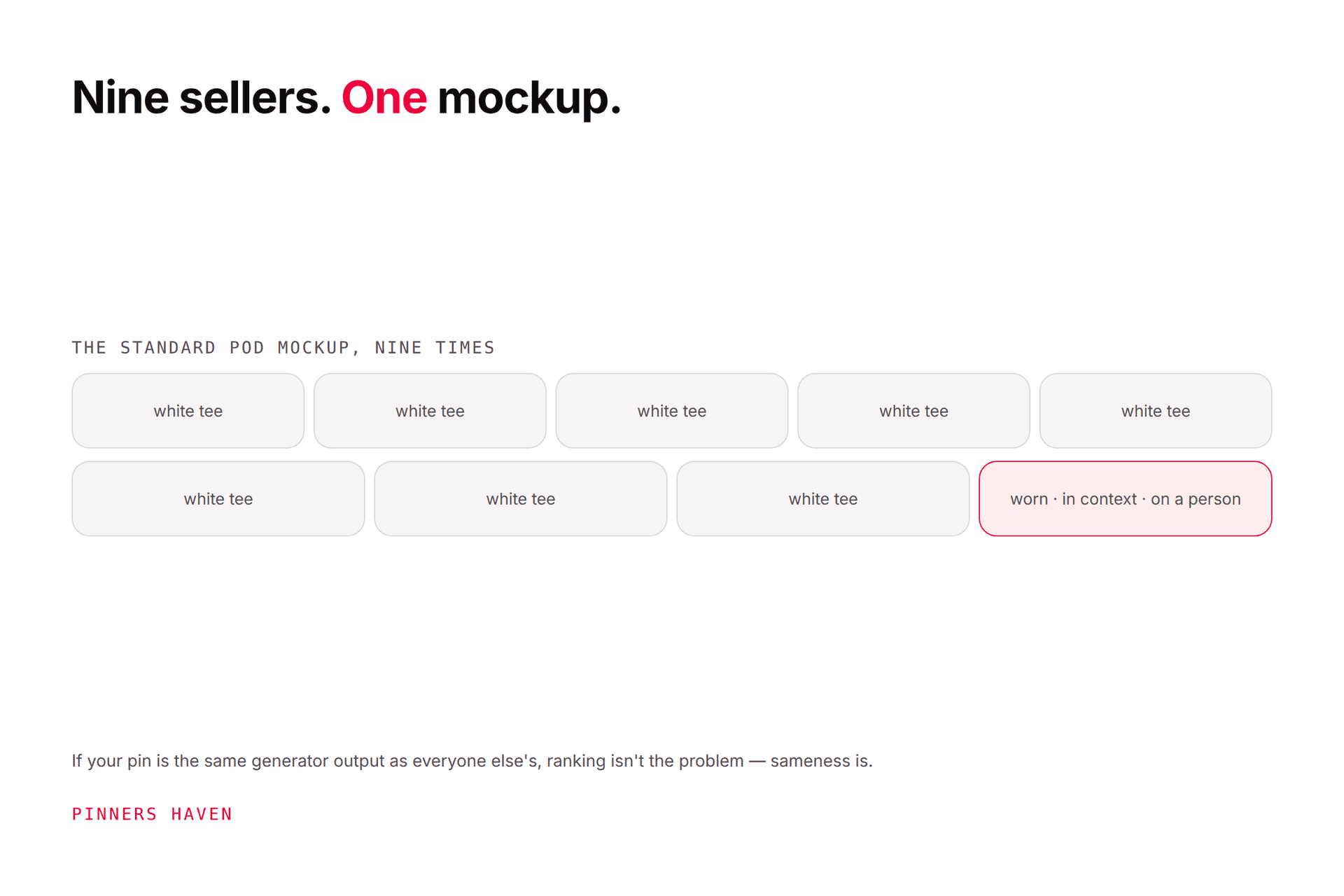
Print on demand works on Pinterest when your creative isn't the generator's default mockup. Every POD platform hands every seller the same photographic templates, so the feed is saturated with visually identical white-tee-on-grey-background pins that differ only in the artwork. Pinterest has nothing to distinguish yours by, and neither does a shopper scrolling at thumbnail size. The sellers who get organic POD traffic pin the design in context, at a size where the phrase is legible, framed for a specific person or occasion. That's the whole game, and it costs nothing but effort.
The second thing to be honest about up front: POD margins are thin, so "free traffic" has to genuinely stay free to be worth it.
Why POD pins fail on Pinterest
Open Pinterest and search any common POD phrase. You'll see the same shot repeatedly: front-facing garment, neutral background, centred design, generated by the same handful of templates every POD platform ships.
That creates three separate problems at once.
For discovery, there's nothing distinctive to surface. Pinterest's distribution favours original content, and a mockup used by thousands of sellers is the definition of unoriginal even when your artwork is entirely yours.
For the shopper, the pins are indistinguishable at thumbnail size. Nobody is comparing garments. They're scrolling past a wall of the same grey rectangle.
For duplication risk, if you also publish twelve colourways of the same mockup, you've built exactly the repetitive pattern Pinterest's guidance warns about, where repeatedly uploading existing content can get you flagged as spam.
Notice that your artwork can be genuinely excellent and all three still apply. The design isn't the problem; the container is.

Creative that actually separates you
Make the design readable at thumbnail size
This is the highest-leverage fix and almost nobody does it. Most POD designs are text, and most POD pins show that text at roughly a tenth of the pin's height, on a garment, in the middle of a grey frame.
Take your design and reproduce it as artwork filling the pin, large, legible, on a background that suits the joke or sentiment. Then put the garment version underneath or beside it. The buyer can now read what they're buying, which is a low bar that the standard mockup fails.
Shoot or stage a real context
The garment in a real setting, worn by a real person, in the environment the buyer would wear it. If you can't photograph it, a lifestyle-styled mockup is still better than the default, and a different default is better than the same one everyone uses.
Frame for a person and an occasion
This is where POD search traffic actually lives:
Weak pin | Searchable pin |
|---|---|
"Funny cat shirt" | "Gift ideas for a cat owner who has everything" |
"Nurse tee" | "Nurse graduation gift ideas" |
"Camping mug" | "Stocking fillers for someone who camps" |
"Teacher shirt" | "End of year teacher gift ideas under $30" |
The right-hand column is what people type. The left-hand column is what your product is called. Only one of them gets found, and it isn't the accurate one.
Group designs into a collection pin
Nine related designs in one grid, pinned as "12 gift ideas for [specific person]," is a genuinely useful pin and a completely different concept from any single-product pin. It also earns saves, which single product pins rarely do.
Niche down, then niche down again
A store selling shirts for cat owners, nurses, campers, teachers and gamers has no identity Pinterest can build an audience around, and no board that reads as a topic worth following.
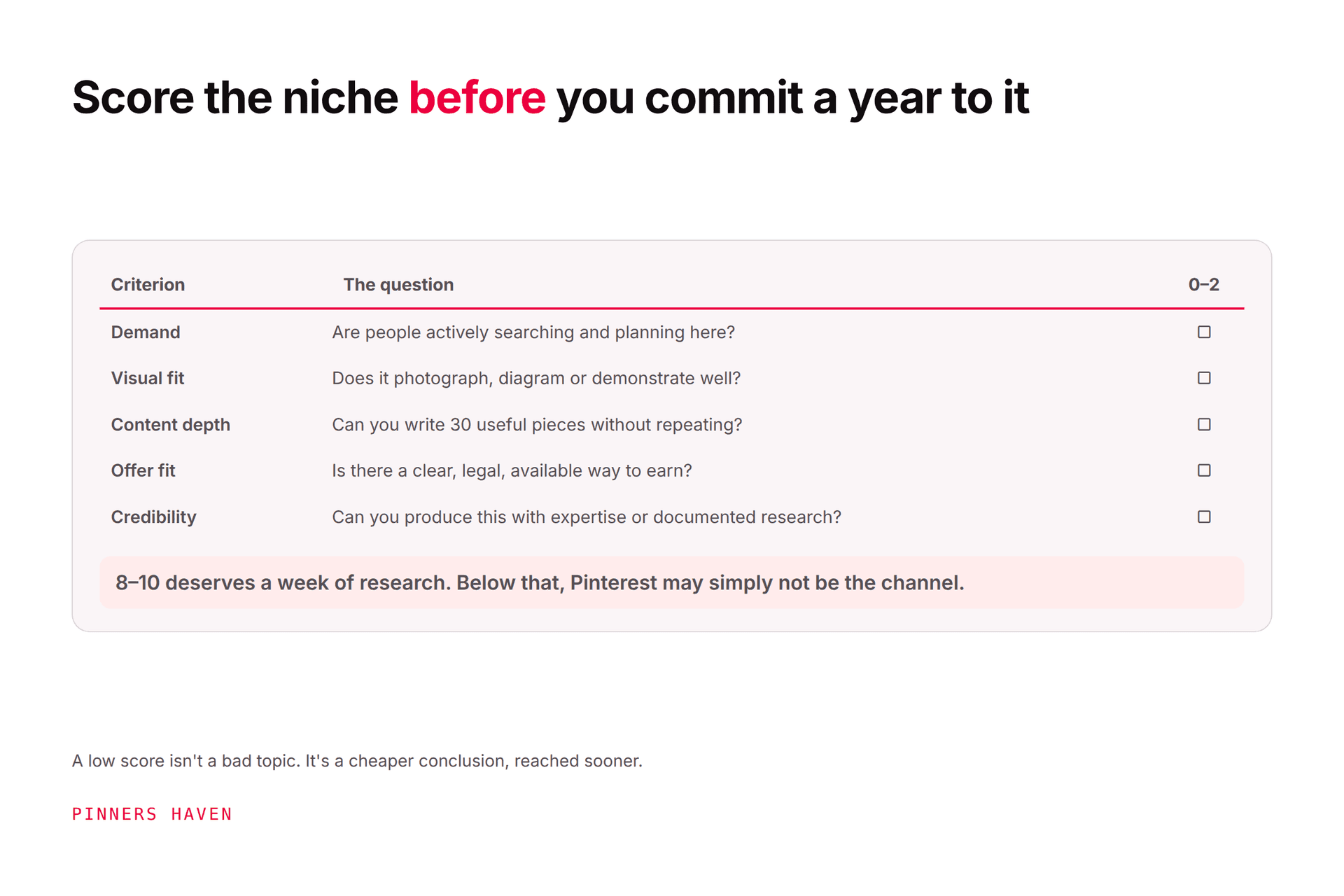
A store selling only for one of those, deeply, has boards that make sense, a keyword surface that compounds, and a profile someone would follow. Our Pinterest niches guide covers scoring a niche properly before you commit.
The POD-specific version of that test: can you name thirty designs for this audience without repeating a joke? If not, it's a product line, not a niche.
The legal part, which is not optional
POD is the highest trademark-risk business on this list, and Pinterest makes the risk worse by being public, indexed and permanent.
Phrases can be trademarked, including short, obvious-sounding ones. "It's just words" is not a defence.
Character, team, brand and franchise artwork is not yours to sell, and fan art is not an exception.
AI-generated designs do not launder rights. A generator producing something close to a protected work is your problem once you sell it.
Search the register before you publish, not after a takedown.
A takedown on the POD platform removes the listing. Your pins stay up, keep driving traffic to a dead link, and remain evidence. Clean up both.
Get proper legal advice for your jurisdiction. This section is orientation, not a legal opinion.

Make the margin maths honest
POD margins are genuinely thin, often single-digit dollars per unit after platform and printing costs. That doesn't make Pinterest a bad channel, but it does change what "free" means.
If a product nets you $6 and a proper set of pins takes an hour to produce, you need meaningful volume before that hour pays back. Which argues for two things:
Concentrate effort on designs that already sell. Don't build creative for a catalogue of untested ideas.
Build reusable creative systems, so pin number 200 costs a fraction of pin number 1.
To be straight about expectations: organic Pinterest traffic for POD is a slow compound, not a launch tactic. If you need sales this month, this isn't the lever. If you're building something over a season or two, it's one of the few genuinely free ones left.
No income claims here or in your pins. Not what you make, not what buyers save. This niche attracts enough hype without adding to it.
Where POD sellers stall
The pattern is always the same. Twenty designs, each deserving three or four distinct concepts, is 60 to 80 pins. Then you add a seasonal collection and it's 120. Then a second niche and it's 200.
What happens instead is that the first five designs get real creative and everything after runs on the default mockup, which puts you straight back into the sameness problem this whole article is about.
Pinners Haven produces that creative layer: up to 20 angles per topic, an SEO title with three to five unique descriptions per pin, and original designs on human-designed templates rather than the same generator mockup. The Freshness Meter retires each design after roughly five to ten uses, which directly addresses the repetition risk that hits POD harder than any other niche. Nothing publishes until you approve it.
Solo covers 3 sites and 900 pins a month at $41 billed annually; Operator covers 25 sites at $124 if you run several stores. There's a 14-day trial, and no card is needed. When it ends, publishing pauses until you pick a plan.
What it doesn't do: it doesn't design your products, check trademarks, or fix a thin margin. Product selection and rights clearance are entirely yours, and they matter more than the pins.
(Disclosure: we make Pinners Haven. We're not affiliated with Pinterest.)
Frequently asked questions
Does Pinterest work for print on demand?
It can, for sellers who publish original creative rather than the platform's default mockups. Pinterest is strong for gift-driven and occasion-driven shopping, which suits POD, but the channel is saturated with visually identical pins and undifferentiated creative doesn't surface.
Can I use Printful or Printify mockups on Pinterest?
You can, and thousands of sellers already have, which is exactly the problem. Use them as a supporting image rather than your primary pin, and lead with creative that shows the design legibly or in a real context.
How many pins should I make per POD design?
Three or four genuinely distinct concepts: the design as readable artwork, a real or non-default context shot, an occasion or recipient framing, and optionally a collection grid. Colourways of the same mockup don't count as separate concepts.
Do I need a website for POD, or can I pin to a marketplace?
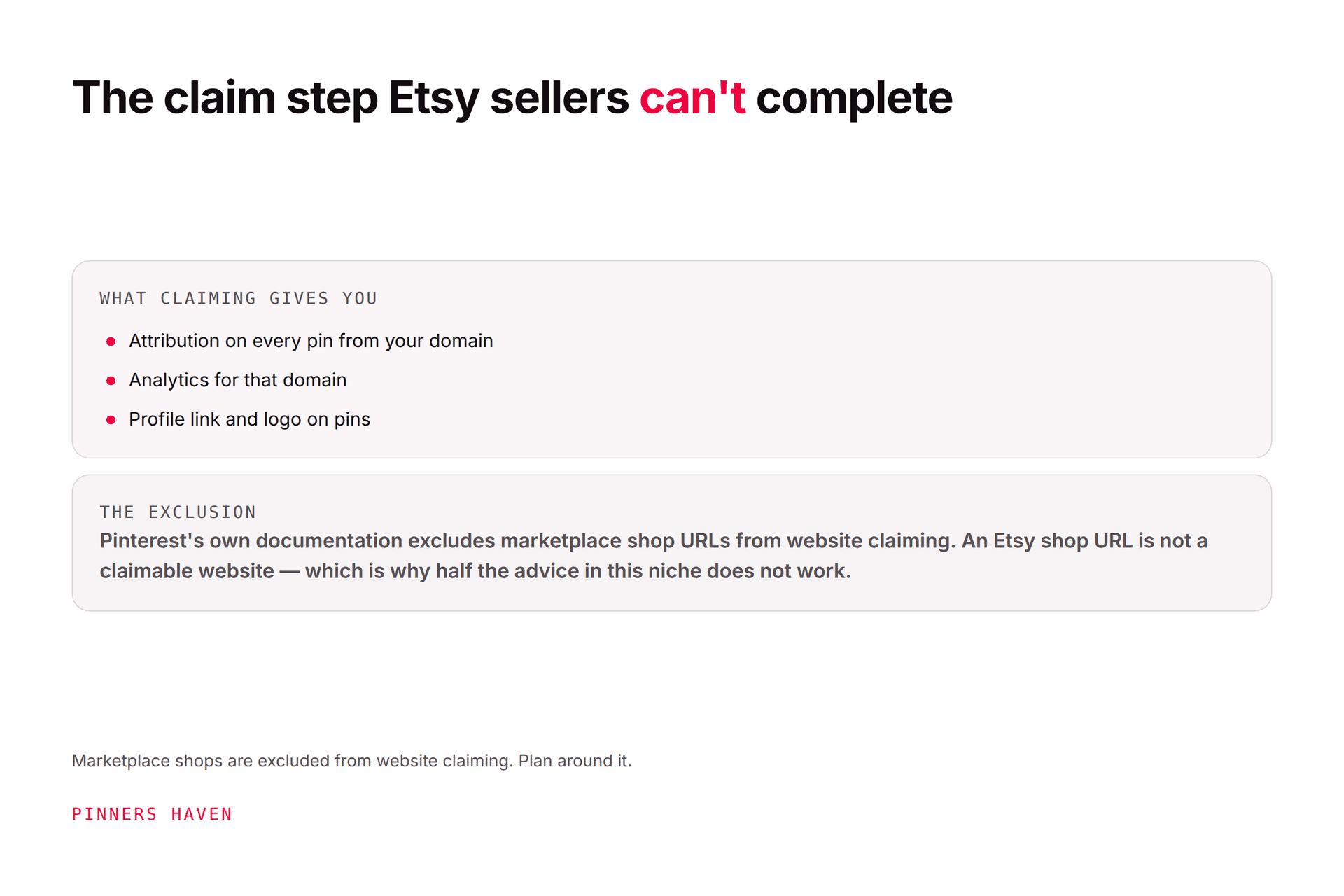
Either works, but most marketplace shops can't be claimed as your domain on Pinterest, which limits attribution. Pinning to a site you control and linking onward costs a click and buys you ownership of the traffic.
What POD niches work best on Pinterest?
Gift-driven and identity-driven ones, where someone is searching for a person rather than a product: occupations, hobbies, milestones, pets, family roles. Broad novelty stores struggle because there's no search anyone is running.
How far ahead should I publish seasonal POD designs?
Months, not weeks. Pinterest users plan early, and holiday gift searching begins long before the holiday. Check the ramp for your specific topic in Pinterest Trends and publish into it.
Will Pinterest flag me for posting lots of similar product pins?
It can. Pinterest warns that repeatedly uploading content that already exists may get you flagged as spam and temporarily blocked from creating Pins. Twelve colourways of one mockup is precisely that pattern, so vary the concept rather than the colour.
Stop pinning the mockup everyone else has
The reason POD feels like it doesn't work on Pinterest is that most POD pins are, functionally, the same pin. Same template, same angle, same grey background, different words too small to read.
You don't need better artwork to fix that. You need the artwork shown at a size someone can actually read, in a context someone can picture, framed for a person someone is actually shopping for.